Design has long borne witness to ebbs and flows in the zeitgeist. Nowhere is this more legible than in fashion, where shifts in silhouette, material, craft and production can trace the social conditions from which they emerge. The same is true of furniture and objects: while design is first encountered through the lens of aesthetics, its significance extends beyond the visual. Across mediums, it becomes a record of cultural and socioeconomic change, technological innovation, and changing conceptions of how we live.
Such is the premise of ABITO, an exhibition bringing more than a century of fashion, furniture and social change into dialogue. It traces how the objects that dress us and the objects that surround us have both reflected and shaped changing ideas of freedom, identity and agency—and, in doing so, charts the evolving social position of women themselves. What women wore, how they inhabited domestic spaces, and the objects through which they moved through the world were never merely matters of taste; they were also expressions of changing freedoms, expectations and possibilities.

Here, fashion is considered not in isolation, but as part of the same continuum as the spaces and objects of everyday life. The ABITO exhibition traverses more than a century of women’s emancipation through fashion and furniture; through a series of ten exhibits, with each reflecting a decade in time.
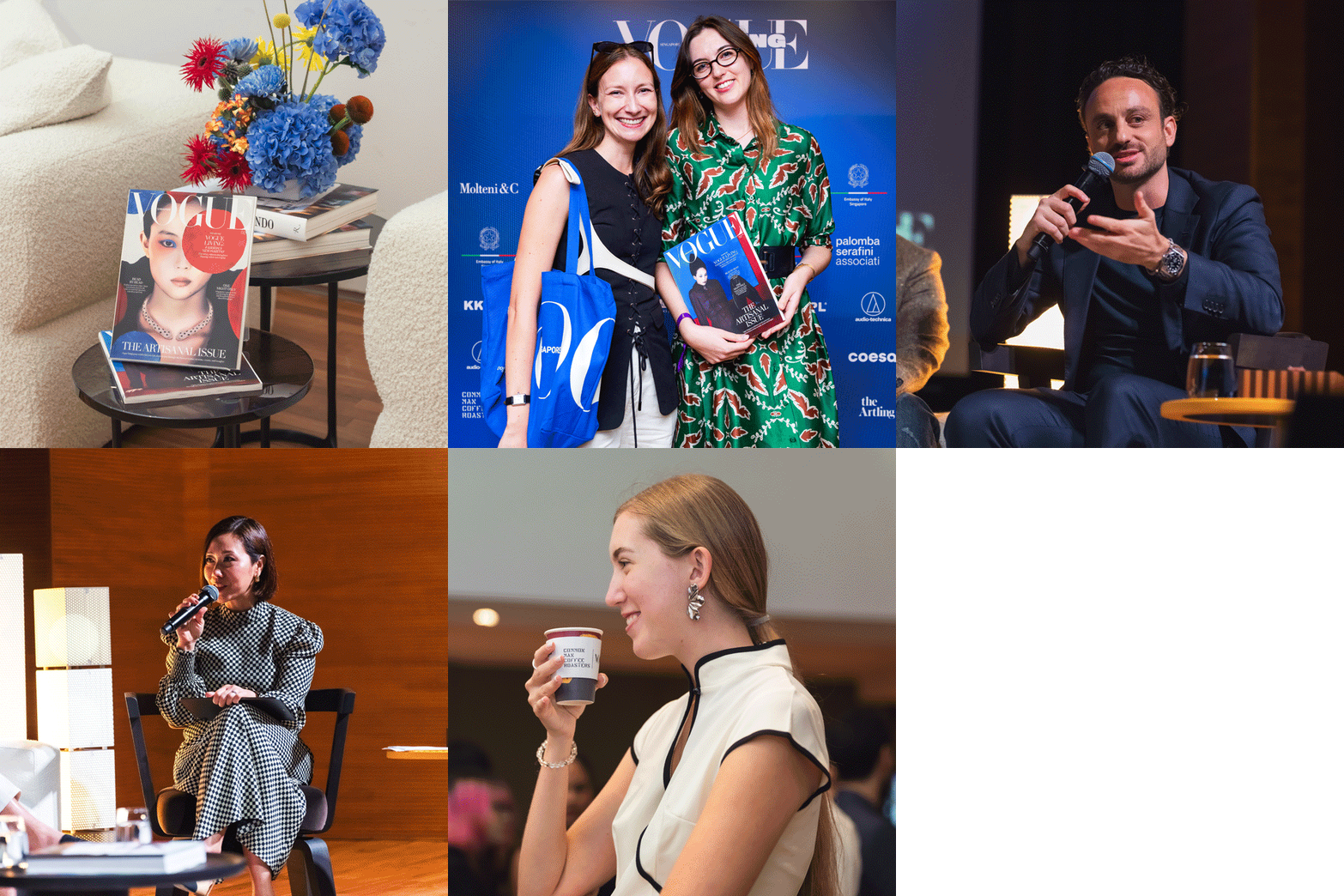
Curated by Ludovica Serafini and Roberto Palomba, of Palomba Serafini Associati, the exhibition first premiered at Salone del Mobile, otherwise known as Milan Design Week—and is now making its global premiere at National Gallery Singapore, in partnership with Vogue Singapore, the Italian Ministry of Foreign Affairs and the Embassy of Italy in Singapore.

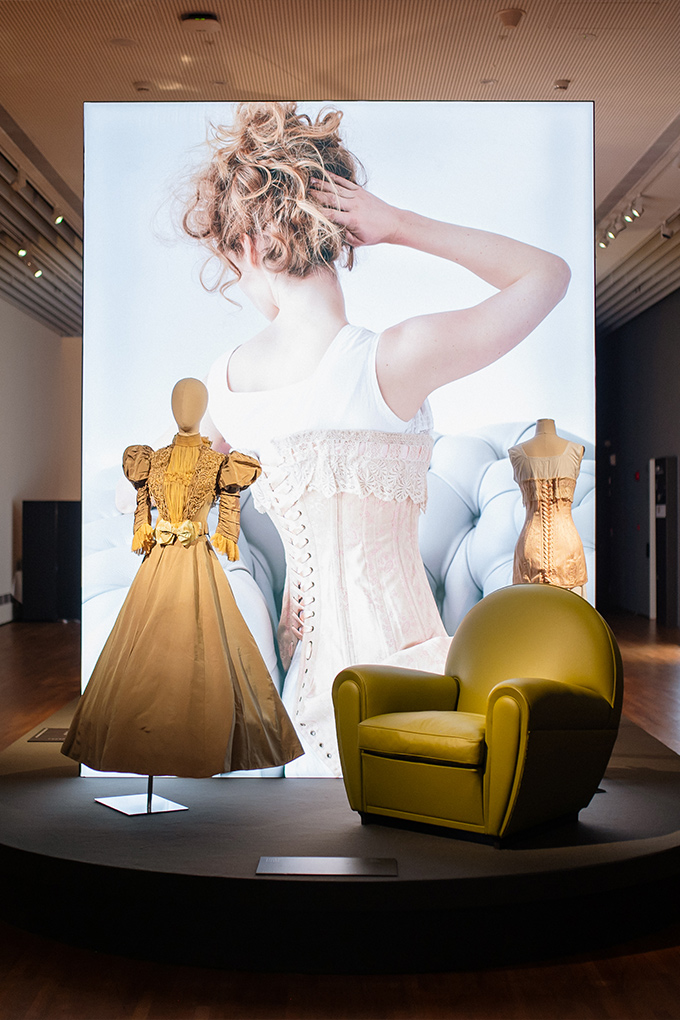
The journey begins with corsetry, where the structured silhouette finds a parallel in the bourgeois language of furniture. Both shape the body and prescribe a particular posture: the corset through literal means, and furniture through soft, backless pieces that pressure the body to stay upright—with physical discipline becoming a metaphor for women’s expected roles in society.
Meanwhile, the 1970s saw both fashion and furniture became more playful, expressive and individual: each piece of furniture on display came as an individual piece rather than as part of a matching sets, reflecting the broader shift in mentality of the home as a reflection of personal identity. This spirit of experimentation is captured in the Fiorucci two-piece ensemble, with dramatically flared hems and colourful machine embroidery. The flowers evoke joy and beauty, while the wheat suggests abundance and the simple pleasure of eating well—together reflecting a decade in which people began to dare, dream and express themselves more freely. Such is the journey that continues across the ten exhibits, as ABITO reveals how the woman’s changing position in society is expressed not only in what they wear, but also through the spaces they inhabit and the objects they choose to live with.

Singapore is, in this sense, an apt setting. Its position as a multicultural meeting point makes questions of cultural exchange and coexistence intrinsic to the context in which ABITO is now being encountered. “Singapore is also a place where different cultures coexist—a truly multicultural hub—and we felt this was particularly relevant for a project like ABITO,” says Palomba. “We believe that culture is, above all, about dialogue and exchange. This is precisely the kind of context in which we believe the project can acquire new meanings while remaining true to its original identity.”

For Palomba, the dialogue between fashion and furniture is not an arbitrary curatorial pairing, but one rooted in their shared relationship to social history. Their connection is “more deeply connected to cultural and social development than we realise,” he says. Across European and Western cultural contexts, both have evolved alongside profound transformations in the ways people live, work, move and understand themselves.
“They can tell us something about the society that created them, about the way people lived, and about how culture and identity evolved over time. This is precisely why bringing fashion and furniture together became such a central part of ABITO,” continues Palomba.
Ahead, a selection of fashion and furniture pieces to look out for at the ABITO exhibition, open for free public view from 3 to 17 October at National Gallery Singapore.

1 / 9
Bodice and romper, circa 1890-1910.
Designed by a tailoring house in Florence in the late 18th century, the bodice is embellished with gold-thread lace featuring tiny metallic beads, and a delicate ivory lace ribbon. It helped manipulate the body into an “S-bend”, where a woman’s torso was pushed forward, hips pushed back, and chest in a “pouter pigeon” curve. Corsetry, more broadly, reflected a physical and metaphorical accomplishment expected of women in society, and equally, furniture was made so that its users would sit upright and present their posture.

2 / 9
La Merveilleuse Coat, 1922 and Poltrona Frau by Renzo Frau, 1919
Founded in Turin in 1911, La Merveilleuse belonged to a generation of Italian ateliers negotiating the passage from traditional dressmaking towards the “fashion” as a modern language. Craftsmanship began to include design—blouses and corsetry began to be made custom, and ornamentation began to have greater intention and personality. The Art Deco pattern and embroidered surface reveals this shift, with carved Bakelite buttons replacing conventional fastenings. Likewise, the furniture had interesting details built in, like a cigarette tray worked into a chair, reflecting a time when women were bolder, and would spend their leisure time smoking.

3 / 9
Sartoria Zecca, 1932
Created by the Zecca atelier around 1932, this was a moment of fashion becoming increasingly shaped by global entities and technological change. Though the atelier was Italian, the fluid, body-conscious silhouette reflects the influence of Parisian couture, from Lucien Lelong’s sculptural draping to Madeleine Vionnet’s pioneering use of the bias cut. Here, the circulation of ideas across borders become visible in the garment itself, transforming not only how a dress was made, but how the body could be dressed. Just as the body created desire with flashes of skin here and there, the chairs made also pushed the envelope for design in unique shapes and industrial materials. .

4 / 9
Sartoria Bonanno by Helen Cristofanetti, 1957
Made by famed Neapolitan tailoring house Bonanno, the ball gown is cut from cotton chintz bearing florals by textile designer Helen Cristofanetti, who was closely associated with early contemporary art circles and the Surrealist movement. Her collision of evening silhouette and domestic textile is telling of postwar femininity: the decorative arts were no longer confined to the interiors they adorned, but increasingly informed the way women dressed as a moment of reclamation. The cultural values in this period prioritised elegance and femininity, as seen in the A-line cut; and shapes began to loosen and become more free flowing.

5 / 9
Fiorucci, 1968; Brionvega Radiofonografo by Achille & Pier Giacomo Castiglioni, 1965; and Flos Taccia Achille e Pier Giacomo Castiglioni, 1962
Founded by Elio Fiorucci in Milan in 1967, Fiorucci emerged alongside a broader transformation in the relationship between fashion and fast-growing youth culture. This 1968 ensemble, with its embroidered denim flares and artisanal cotton-gauze top, reflects a moment when fashion was moving beyond the established codes of the salon and into a more fluid culture of exchange. The socioeconomic pivot was matched in furniture—developing a new, freer language of design where someone might feel more comfortable lounging on the floor for example. Sonic design too hit an equally sonic boom post-WW2, reflecting a time of innovation and creative passion.

6 / 9
Gucci by Tom Ford fall/winter 1997
By the mid-1990s, Gucci was navigating the consequences of its rapid expansion, with its heritage increasingly dispersed across a wider commercial empire. Tom Ford, appointed creative director in 1994, recast established codes through a more contemporary vocabulary of sensuality, tailoring and spectacle—including this open-backed jersey number. For the first time, women could go around at night with a backless dress without fear.
In turn, the body became central to Ford’s renewed visual identity for Gucci, demonstrating how fashion could reconstruct not only a house’s image, but its place within contemporary culture.

7 / 9
Versace by Donatella Versace spring/summer 2004
“Aimed directly at the divas,” as per Sarah Mower in her review of the collection in 2003. Designed by Donatella Versace for spring/summer 2004 and worn by Linda Evangelista in her return to the runway, this is a moment of exuberance.
Everything becomes a moment for experience and experimentation as irony and a zealous sense of play became imbued in all mediums of design—Versace, too, looked inward, referencing her brother Gianni’s own free spirit in the 1980s in this spring/summer 2004 collection. Revisiting it in 2003 reflected a renewed conception of what “glamour” could be defined as—one rooted in visibility, spectacle and a sense of carefree excess that characterised the cultural mood of the moment.

8 / 9
Kartell Louis Gost by Philippe Starcke, 2002
This satirical approach to design in Versace’s gown—where everything is possible, from the plain to the extraordinary—applied to moments of design. In ABITO, the Versace dress is paired with a mere plastic chair: yet, look closer, and realise that its shape is reminiscent of the king’s throne, reduced to the ever-durable transparent material. There is no more monarchy, no more king; and to match this new society, the chair similarly fades.

9 / 9
Max Mara 101801 Coat by Anne-Marie Beretta 1984 and Kartell Mini Geen - A Battery by Ferruccio Laviani, 2022
Designed by Annemarie Beretta in 1981, Max Mara’s 101801 silhouette emerged alongside a changing conception of women’s place in professional life: one beginning to take greater ownership of her life and entering professions historically associated with men. Even in lighting design, they became free from light sources; and rechargeable lamps came to the fore so that light could follow wherever you pleased.
To this day, the 101801 coat remains in production under the Italian label. The coat translates that shift into material form: its double-breasted construction and tailoring borrow from menswear, while its softer silhouette and practicality respond to the changing realities of women’s lives.
The ABITO exhibition is open for complimentary public view, from 3 to 17 October at National Gallery Singapore. Hear more from co-curator Roberto Palomba at Vogue Living Conversations, on 16 October. Learn more here, and reserve tickets here.