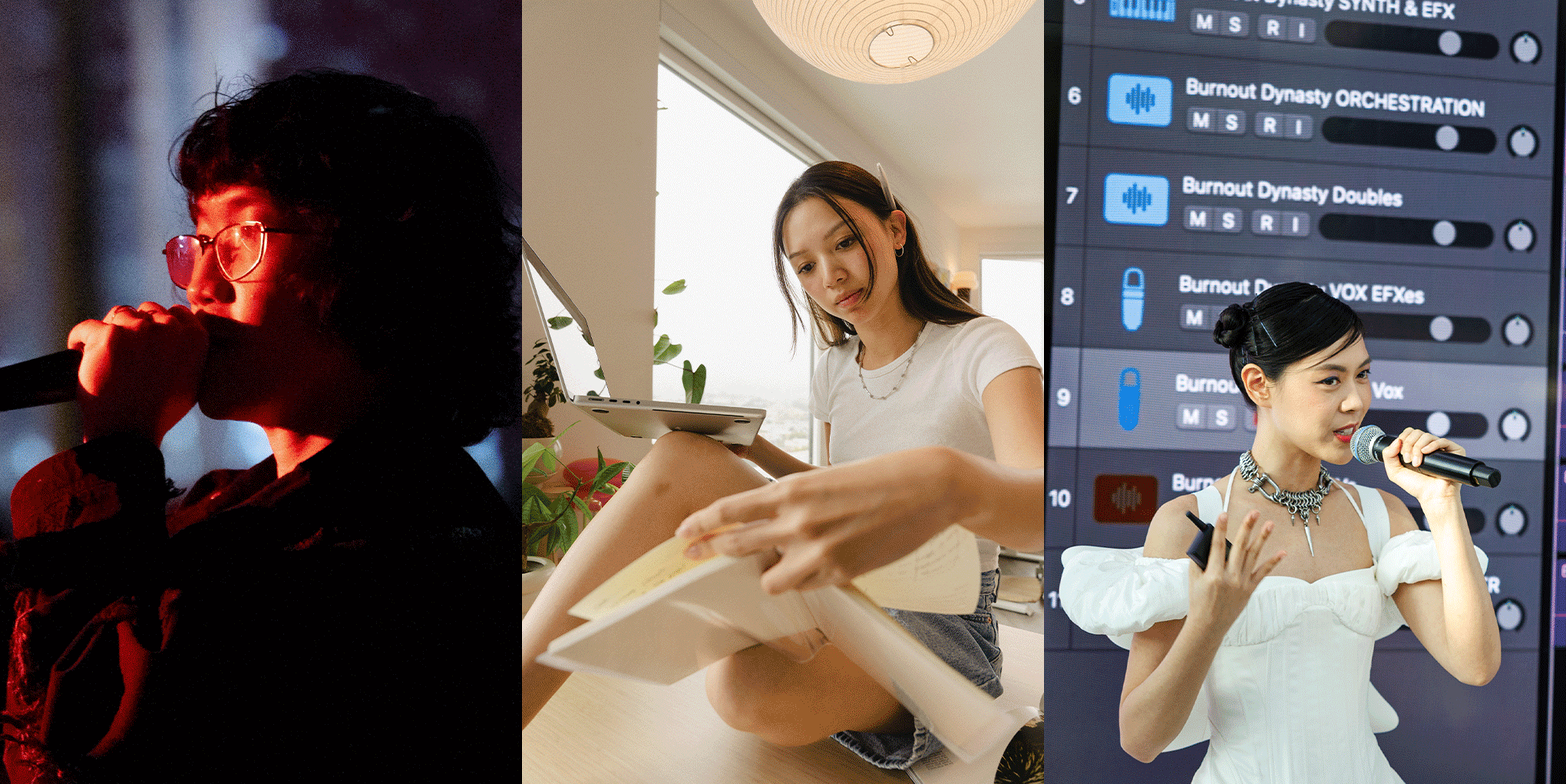
Is the future truly AI? Perhaps, but it’s not the image you have in mind. Apple’s regional campaign ‘Here’s to the Dreamers’ spotlights AI in an alternative limelight, featuring regional creatives who have embraced the ever-evolving technology into their workflow without sacrificing curiosity and artistic integrity. Starring homegrown artist Jasmine Sokko, Vietnamese beatboxer Trung Bảo, Malaysia’s diorama maker Eddie Putera, Indonesian producer Eka Gustiwana and Marisa Chentakul, a Thai creative technologist, the series highlights how the multi-disciplinary creatives gain agency and freedom over their work with the trusty help of AI integration into Apple’s tools. The ideas always remain untouched, with AI a supplementary functional feature that supports the creative thought.
“In a world where everything can be generated, perhaps the most personal thing you can do is resist using it to cut corners, and instead use it without compromising the integrity of your creative process.”
For industry veterans like Gustiwana and Putera, AI assistants help them adapt in a landscape that changes in the blink of an eye—Putera refines the details of his model work concepts with Gemini, while Gustiwana utilises Claude for pre-production research. Artists like Sokko, Trung and Chentakul implement AI to speed up their workflow, filling in the gaps of coding solutions, troubleshooting design prototypes, or creating digital mock-ups. Below, Sokko, Trung and Chentakul share with Vogue Singapore on their artistic journey, how Apple streamlines their creative methodologies, and setting themselves apart in a world seemingly full of AI slop.

How did you get into your craft? Take us through your journey over the years.
Jasmine Sokko: Music started as a quiet obsession when I was 13. But growing up in Singapore, I was surrounded by a very pragmatic idea of what a successful life was supposed to look like, so becoming a musician didn’t feel like the obvious path. While studying business, I started building this parallel universe in secrecy, making electronic music under a masked persona. I was completely self-taught, spending an almost unreasonable amount of time online figuring out production, experimenting, failing, and trying again. When I went to Sweden on exchange, I turned it into a songwriting camp for myself behind my parents’ back. Later, I entered an electronic music competition in China, made it to the finals, and that became the beginning of a much bigger journey. I went from producing in my bedroom to living and touring around the world and opening for artists I had grown up listening to. Over time, music naturally expanded into visuals, technology and world-building. I don’t really see them as separate disciplines anymore. A song can become a visual, a costume, a piece of code or an object. I’ve essentially spent my career figuring out how to make the strange little things in my head tangible.
Marisa Chentakul: I actually started as a designer, not an engineer. I went to art school, studied textiles and apparel and eventually somehow found my way into tech and product design. For years, I was always the person designing what something should look and feel like, but I still needed an engineer to actually make it work. I started vibe-coding because I was curious about how far I could get on my own with AI. In the beginning I was making really small, silly things for myself: a photo booth, a little voice note app for Valentine’s Day, random websites and tools, etc. I wasn’t trying to become a developer—I just really liked that I could have an idea at 11pm and have a working version of it before I went to bed. Eventually, the projects got more ambitious: I made a digital advent calendar, started experimenting with hardware, and recentbly built a tiny computer inside an eyeshadow palette. I think that’s when it clicked for me that AI wasn’t just helping me code! It was changing what I felt capable of making.
Trung Bao: My journey started around 17 years ago in Hanoi through the city’s hip hop and street culture, especially the beatboxing community. I was drawn to beatboxing because of how experimental it was. The whole culture was built around pushing the limits of the human voice, developing techniques that didn’t exist before with an instrument that is so familiar to all of us: our own voice. Beatboxing eventually took me around the world. I started competing and performing internationally, and later became involved in designing some of the biggest beatbox events in the world. Through that journey, I met artists from very different generations, cultures and disciplines, which gradually changed the way I thought about my own practice. These encounters eventually led me to experiment beyond sound. I became curious about what could happen when performance interacted with image, space, light and technology. Some ideas eventually needed to become installations or sculptures, while others became visual works, interactive systems or multi-sensory p{erformances. That expansion happened quite naturally. I never really had a moment where I decided I was going to stop being a musician and become a multidisciplinary artist.Beatboxing is still very much the foundation of how I think today. It taught me to experiment deeply with one material, to train originality every day, and to keep questioning what seems physically or creatively possible. The mediums have now expanded over time, but I still find myself returning to the voice and the presence of the body as a starting point.

How does it feel to be one of Southeast Asia’s most innovative creators as part of the ‘Here’s To The Dreamers’ campaign? How has Apple’s integration with AI software changed the way you work?
JS: It’s surreal to be part of a campaign like this, particularly because I’ve always followed my curiosity rather than a fixed idea of what a creator is supposed to be. I’ve always treated technology less like a gadget and more like an instrument. My Mac is a metaphorical laboratory, with music software, TouchDesigner, 3D tools, Procreate, Keynote and Claude all living within the same ecosystem. It lets me move from an idea to something tangible much faster. AI has mainly reduced the friction between having an idea and exploring it. I can use it to organise information, interrogate ideas, accelerate research or take care of repetitive tasks, which gives me more space for the things I don’t want to outsource: making music, developing ideas and deciding what feels beautiful, strange or emotionally right. For me, the value of technology is ultimately how much more agency it gives me over my imagination.
MC: It still feels a little surreal to be featured! I’m Thai and I moved to USA by myself when I was 16, so to be included in a campaign celebrating Southeast Asian creatives feels really special. Especially because so much of my work now is basically me following all of my weird little curiosities across design, technology, fashion, and art. My Apple devices have always been where those different parts of my process meet. I might start with a sketch on my iPad, prototype, build something on my Mac, or document it on my iPhone. I think what has changed most for me is how fluid the process feels. I’m not thinking as much about “what tool am I supposed to use to make this?” and more about “what do I want to make?”
TB: I’m very happy to represent Vietnam in this year’s campaign, especially at a moment when public discourse around creativity and technology is changing so quickly. For me, innovation has never really been about being the first person to adopt a new technology. I am more interested in whether a tool gives me more freedom to develop an idea in the way I imagine it, without the technology itself becoming a limitation. I can feel that shift quite clearly in my own workflow now. I’m currently working on a MacBook Pro with M5 Max, and together with increasingly capable AI-assisted software, I can develop and run creative systems from a laptop that would previously have kept me attached to a much larger workstation. Because my work moves constantly between many different mediums, that portability changes the way I can create. I can move between studios, travel and collaborate internationally while continuing to develop the same project environment. What excites me about this is the freedom it creates. As the technology becomes more powerful yet lighter and more flexible, I can spend less energy adapting an idea to the limitations of a technical setup. Increasingly, I can build the setup around the idea instead. That is also why being part of the Dreamers campaign feels meaningful to me. We are entering a period where these technologies will shape much more than the tools artists use. They will influence how we create, communicate and experience culture. I think artists should be actively present in that conversation, experimenting with what these technologies can become while also questioning what kinds of human experiences and core values we want them to support.

How does AI bridge the gap between your vision and your idea in fruition?
MC: Before AI, I had so many ideas that would just stay in my Notes app because I didn’t necessarily have the technical skills, time, or resources to make them. Now the distance between “wait, what if…” and actually trying it is so much shorter. I can describe an interaction, sketch something, ask questions when I don’t understand the technical side, and immediately start prototyping. And I think that speed matters creatively. Sometimes an idea is exciting because you can follow the curiosity immediately. You don’t have enough time to convince yourself that it’s too complicated or that you don’t know how to do it. You just start.
TB: For me, AI has shortened the technical distance between an idea and the moment when I can actually test it. I usually start a project with a story, a question, or something I want to understand better. From there, I think about the experience and feeling I want people to have, and only then do I begin thinking about the design, the medium and the technology that can help bring it into the world. A lot of those early ideas are still quite abstract. It might be a certain behaviour I want an installation to have, a way I imagine people interacting with a space, or simply a f eeling that is difficult to describe technically. Turning that into something physical can involve many rounds of prototyping across complex systems and different mediums.
AI has become very useful in that translation process. With modern AI programming tools, my team and I can build bespoke software much faster, test different approaches, debug systems and even adapt more complex open-source technologies to very specific artistic needs. It gives us more freedom to experiment without every technical question becoming a major production barrier. But making something technically possible is only one part of the process. As these tools become more capable, I find myself spending even more time on the beginning of the process: its purpose, the desired experience, and what people might carry with them after leaving it. I think about this relationship between the tech and my creativity a lot. I believe the technology eventually becomes quiet enough that people stop thinking about the system and start paying attention to the experience.
In a world that’s increasingly shaped by AI, how do you curate your own tangible personal taste?
JS: I think taste comes from having a life outside the algorithm. I’m obsessive about research. I’ll go deep into a subject through film, architecture, fashion, typography, history, music, even science, and then become very selective about what stays. I think personal taste isn’t about knowing what’s good. It’s about knowing what’s ‘you’. AI can generate an infinite number of possibilities, but abundance doesn’t create meaning. If anything, the more we can generate, the more important discernment becomes. I want to be able to look at a hundred possibilities and know which one makes me feel something, even if it’s the least obvious choice. That’s also why I don’t use AI to make my music. I enjoy the process of discovering a sound too much to outsource it. If I’m trying to create something uniquely mine, I need to filter everything I encounter through my own perspective first. There is something deeply satisfying about sitting with a sound until you understand why it works. I also think taste needs physicality. Making things with my hands, printing objects, coding visuals, building costumes, and simply observing the world all feed into it. In a world where everything can be generated, perhaps the most personal thing you can do is resist using it to cut corners, and instead use it without compromising the integrity of your creative process.
MC: I actually think taste becomes more important when everyone has access to the same tools. I try to spend a lot of time away from the computer. I go to museums, take random craft classes, make things with my hands, pay attention to packaging, textiles, interiors, objects anything that gives my brain something different to look at. AI is really good at giving you an average of what already exists. So I don’t necessarily want AI to tell me what my taste should be. I want to bring my own references, memories, cultural background, obsessions, and weird ideas into it. Lately, I’ve also been trying to be a beginner again. I’m learning more hardware, making things physically, taking classes where I’m bad at something. I think having experiences outside of your screen is one of the best ways to develop a point of view that actually feels like yours.
Share a Procreate tip that you’ve discovered.
MC: One very simple thing I do all the time is use Procreate almost like a digital sketchbook rather than trying to make everything perfect in it. I’ll take a screenshot or photo of something I’m working on, bring it into Procreate, lower the opacity, and draw directly over it. I do this with UI ideas, physical products, hardware, room layouts. Literally anything. It lets me test a bunch of ideas really quickly without feeling like I have to commit to any of them. Also, I love using Alpha Lock for adding texture and shading without destroying the original shape. Very basic but I use it constantly.


The project ‘Voice Gems’, which I created with London-based artist Harry Yeff, is a good example. The project started from our fascination with something extremely familiar that we often overlook: the human voice. We asked how our relationship with our voices might change if we could see them, and how something so invisible and temporary could become something people could preserve and even hold. Every Voice Gem begins with a real human encounter. A voice, laugh, message or memory is shared with consent, and our bespoke generative system translates the characteristics of that recording into a unique sculptural form. Over the years, these works have carried first words, final words, personal memories and voices connected to different communities and cultural contexts. What interests me is that the technology eventually brings our attention back to something very basic and human. A highly computational system can create a reason for somebody to stop and listen differently to their own voice or the voice of somebody they love. For me, authenticity comes from the lived context and the relationships around the work. As digital content becomes easier to generate, I think those real encounters will only become more valuable.

Your work constantly moves between different worlds and disciplines. How do you stay true to your sound and identity?
TB: I think a lot about translation. Every time an idea moves into another medium, something changes. I have to understand what is essential to the original feeling and what can transform. The identity starts to reveal itself through those small decisions. I notice certain patterns and relationships constantly appearing in my work even when the form changes completely. So I don’t feel a need to make every project recognisably ‘Trung Bao’, content-wise. I actually want each medium and collaboration to affect me as much as I affect them, carrying with me everything I have learned from the experiences that came before. Maybe that process of translation has become a discipline of its own for me.

AI slop has increasingly dominated the algorithm. How do you distinguish yourself as an authentic artist experimenting with technology and AI?
TB: I genuinely love the term “slop.” The fact that it entered our vocabulary so quickly tells me that people are becoming much more alert to what they are consuming online. Manipulation and misinformation have existed on the internet for a long time, but now the scale and speed are forcing us to develop a new kind of sensitivity toward what feels real and what deserves our attention. I actually think that awareness is a good sign. As people experience increasing digital media overload, I feel a growing desire for physical experiences, human interaction and cultural memory. We start valuing things differently once they become harder to simulate. For many people, user algorithms were already one of our earliest everyday encounters with AI. They can create an incredible sense of abundance, but also an illusion that consuming images of places, people and experiences is somehow the same as living through them. At the same time, social media has given me genuine communities and relationships around the world, and that is still what I value it for. That thinking carries directly into my artistic practice. I always find ways for my work to not only end on a screen. I love bringing people into physical spaces, gathering strangers together and creating situations where they become more aware of their own presence and the presence of others.
The current creative industry is greatly impacted by the growing implementation of AI in the field. What would you say to the new age of creatives starting out in 2026 in the age of AI?
MC: Don’t make “being good at AI” your entire personality. The tools are going to change so quickly. The thing that will probably last much longer are the things you care about and your ability to recognise when something is actually good. I would use AI to learn things you previously thought were outside of your lane. If you’re a designer, try coding. If you’re a coder, make a film. Build a tiny game. Make a physical object. Learn electronics. The exciting part of AI to me isn’t doing the same work faster. It’s being able to wander into disciplines you previously thought you weren’t allowed into. And also: make lots of things. Small things, weird things, things that might fail. I think your body of work and point of view are going to matter much more than being an expert at whatever AI tool happens to be popular right now.
Discover Apple’s ‘Here’s To The Dreamers’ here.