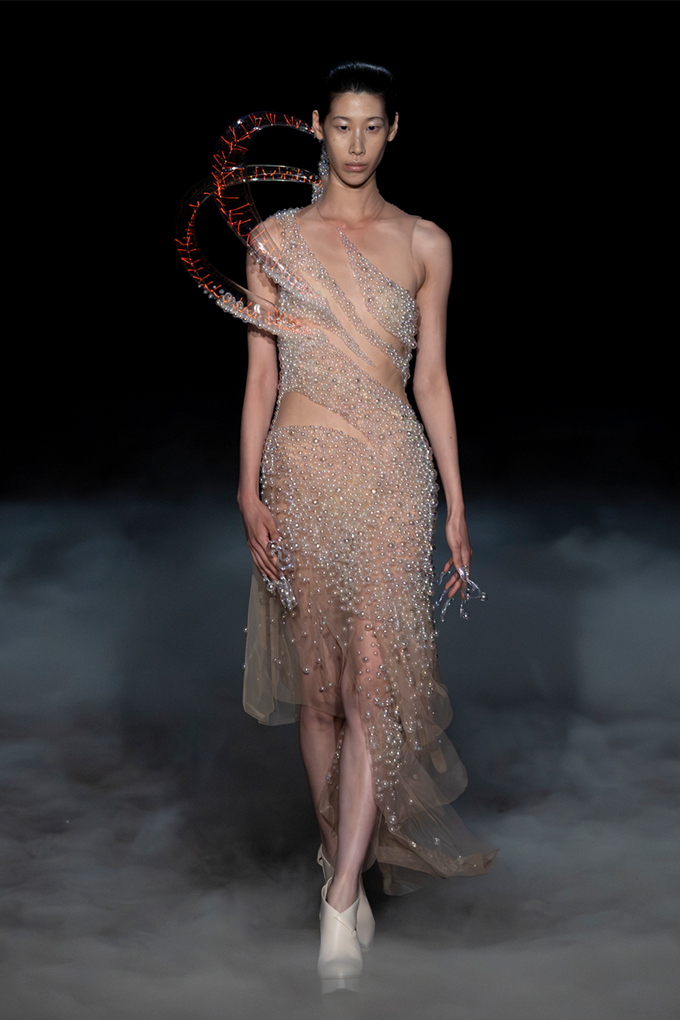
On Iris van Herpen’s latest couture runway in Paris, a deep red glow ran through two hand-blown glass forms curved around the body, shifting whenever the model touched them. The mysterious source? Plasma. The fourth state of matter and the same substance that makes up the stars appears in the designer’s Helix Nebula dress, marking its first use in haute couture.
The dress forms part of Sonic Starquakes, sparked by the vibrations that travel through stars and the shapes created by forces usually invisible to us, with exploding supernovae and the spiralling geometries of galaxies also feeding into the collection. Van Herpen translated these ideas throughout the clothes with laser-cut velvet that continued from the garment onto bare skin through embroidery, pleated chiffon suspended within curved carbon-fibre structures and thousands of iridescent glass spheres floating over illusion tulle. The palette echoes the cosmos as well, with the hues enchanting between dark blacks, sapphires and cobalts to illuminating shades like moonstone green, silver and red reminiscent of the nebula.

For Helix Nebula, 10,000 hand-blown glass spheres surround the two larger plasma-filled forms, each fixed onto illusion tulle using UV light. Once someone wears the dress, their body becomes part of its electromagnetic field, meaning the plasma visibly shifts towards them when they touch the glass. “For years, I have been drawn to the idea of creating a garment woven from energy alone,” van Herpen says. “Glass and tulle still hold it to the earth, but we are one step closer to couture that exists as atmosphere alone.”

Plasma appears again in Fractal Universe, although this time its role came about very differently. Days before the show, the dress was charged inside a particle accelerator and cryogenically preserved, trapping billions of electrons within its structure. Van Herpen originally planned for the stored energy to be discharged while the dress was worn on the runway, but in the nights leading up to the show, it began happening on its own. As flashes of lightning branched across its surface, they etched microscopic hollow channels through the three-dimensional structure of the dress and left behind part of its final detailing. The flashes themselves were temporary columns of plasma, the same state of matter found in lightning, stars and nebulae. By the time Fractal Universe reached the runway, an electrical force had quite literally had a hand in finishing it.

Van Herpen has long approached couture with the curiosity of a scientist, and Sonic Starquakes takes that instinct to one of its most ambitious points yet. For all the technology involved, the clothes remain strikingly beautiful. With plasma entering haute couture for the first time, the collection feels genuinely revolutionary, and once again shows just how far van Herpen is willing to stretch the possibilities of dress.