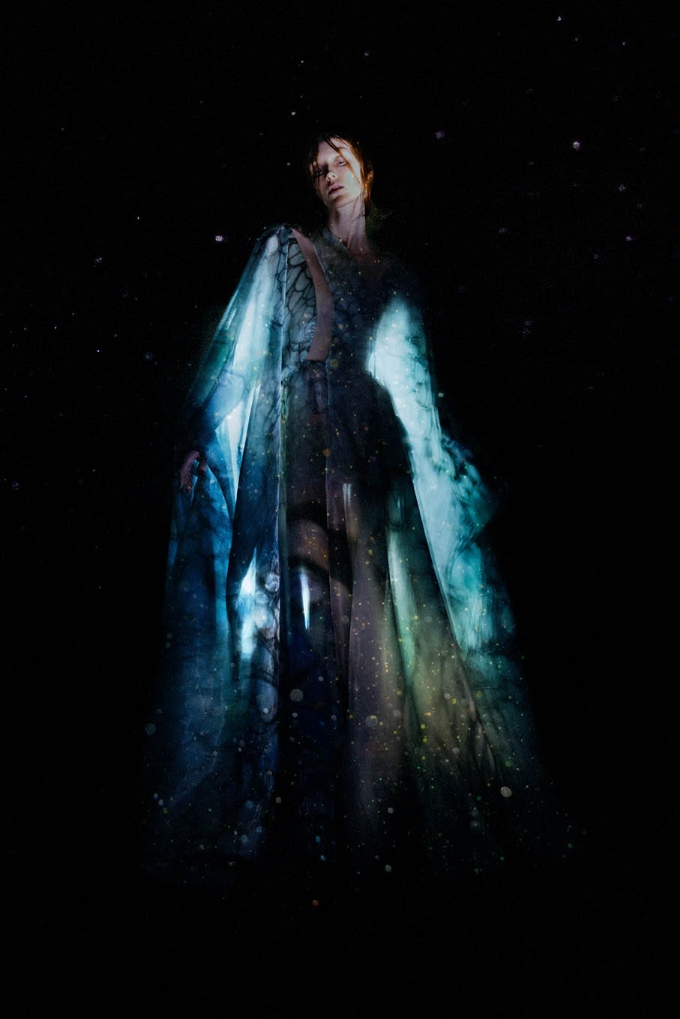
Think of the name Iris van Herpen, and a range of otherworldly creations come to mind. The culturally defining moments areas ever-evolving as her designs—ranging from the plumed and fluttering visions worn by Björk to the intergalactic armour gracing Natalie Portman, which van Herpen refers to as muse moments. Yet, beyond these star-studded encounters, lies a deeper testament to the work of the 40-year-old Dutch designer.
Over the past 18 years, van Herpen, an alumnus of ArtEZ University of the Arts, has crafted a singular voice, blending the worlds of fashion, science and technology, and offering uncharted ways to experience the synergy between the body and the clothes we choose to wear. “All of our senses are more connected than we realise. Often, when people see materials like a fabric or a glass, the mind automatically imagines a certain movement or softness. I play a lot with perception, so often the materiality is so new or unfamiliar to people that they are drawn into imagining what they are actually seeing, and what it would feel like to wear or to touch something,” she shares.

The designer draws inspiration from her 97-year-old grandmother, who built a collection of both rare historical costumes and contemporary pieces. “As a young girl, I would sneak up to her attic, where she kept her collection, and I would dress up. Sometimes, it was in grand wedding gowns. When you’re a child, you transform into that story. As adults, we can still experience the same. The artwork you wear has the power to transform you, to embody a vision. I wasn’t conscious of it at the time, but as a young child, I could feel the transformation fashion can provoke. That was the beginning of my love for the art of dressing.” This essence brings itself to Iris van Herpen: Sculpting the Senses. First introduced via the Musée des Arts décoratifs in Paris, it has now made its way to Singapore through Marina Bay Sands and ArtScience Museum, marking the designer’s inaugural exhibition here.
Focusing on the relationship of the body to movement and metamorphosis, the exhibition concentrates on an assortment of over 140 looks and accessories by the brand. Curated by Cloé Pitiot and Louise Curtis, it is organised around nine themes, ranging from the origins of life to water. “That was one of the hardest parts of curating the exhibition because it spans 18 years of being fascinated by so many elements. Each collection has a concept, and even within that concept, there are multiple inspirations and ideas embedded. It was really about extracting the essence of all the influences within my life. Water, for example, has been an inspiration for me. Some of my most well-known pieces, like the Water Dress and The Splash looks with Daphne Guinness, are expressions of this,” the designer notes.

Adding on to this is Adrian George, Director of Exhibitions, Programmes and Museum Services, ArtScience Museum, who notes that this is a pivotal step for the institution as well. “Van Herpen is a visionary. She has revolutionised the industry since 2007, redefining possibilities in fashion by combining innovation, technology and interdisciplinary collaboration with couture-level craftsmanship. But what she does extends far beyond the realm of fashion, sparking meaningful dialogue about nature, art, science, dance and architecture in a world that is, now more than ever, in constant flux,” he shares.
“As an institution dedicated to uncovering unexpected connections and sparking new conversations about our shared future, we feel there is great synergy with van Herpen’s vision and look forward to introducing visitors to her extraordinary designs and unique perspectives. It’s not often that renowned international designers showcase their work in Singapore, so it’s really significant that we are able to provide a platform for a cultural pioneer like her. With Singapore’s burgeoning contemporary creative scene, we really hope that this might inspire a new generation of Asian artists, technologists and designers to continue pushing their work and their creative boundaries.”
As we draw closer to the unveiling of the exhibition on 14 March, Van Herpen looks back on close to two decades of influential design, the strength of travelling on uncharted territory and what a future in Asia might look like for her brand.
Hi Iris, you are currently preparing for your next haute couture show. How have you approached new collections over the years?
I started my label in 2007, and we’ve been showcasing our collections ever since—first in Amsterdam, then in London, and for a long time now at Paris Haute Couture Week. At the moment, my focus is on expanding research and development, as well as interdisciplinary collaborations. We are currently preparing for the July show in Paris and working on two special collaborations, both of which require a few more months of development. Some material developments or collaborations that we undertake with institutes can take up to one and a half years to fully develop a material. It’s really interesting because fashion is used to being so fast, so I’m always juggling in between.
Looking back on 18 years of your career, what have been some of the most pivotal moments for you?
Collaborations with Lady Gaga, Beyoncé, Natalie Portman and Cate Blanchett—when such iconic figures embody my vision, it gains new layers and deeper meaning. My work with Björk has also been incredibly influential, not only because of her collaborative spirit but also due to her multisensory approach to creativity. My first haute couture show in Paris and becoming a member of the Fédération de la Haute Couture were also big milestones. With my studio based in Amsterdam, I was already integrating technology into my work, and it was incredible to see how open-minded the Fédération was in embracing our forward-thinking approach.

When you first started out, did you encounter skeptics while introducing science into fashion?
In fashion, people hadn’t heard about 3D printers, so when I mentioned them, they imagined paper coming out of a regular printer. It became about creating a language that sparked curiosity about other design disciplines and their possibilities. It took time, but fashion journalism has shifted towards a more interconnected approach to the topics it covers. I was fortunate in that sense. I had that vision, but I think the world was already moving in a more interconnected direction anyway.
What was the earliest reaction to your debut on the runways, considering that many of your designs would have been so ahead of their time?
I was lucky to receive a positive response to my graduation collection, and that’s how I was able to start my label. A press agency contacted me right after to ask whether we could work together. Fashion Week in Amsterdam also approached me to do my first runway show shortly after. I then began collaborating with the Groninger Museum here in the Netherlands. They were the first to collect my work, which is always a big risk for a museum when investing in young artists. They were also the first to give me a solo exhibition, just a few years after the start of my label. This led to other museums collecting my work as well. Many museums around the globe have pieces from my collections, which is a special feeling, knowing they will be preserved for decades—and possibly even centuries.

Your work is the embodiment of interdisciplinary fashion. How have you balanced craftsmanship with technology over time?
In the early years, I was focused on traditional craftsmanship—haute couture techniques as well as my own, which I was developing. At that stage, there was no collaboration and no integration with technology. I immersed myself in techniques that fascinated me most, learning from experts and integrating their knowledge into my own process. It was only after a few years that technology entered my work. My first collaboration with architects came in 2010, initiated by the Architectural Center of Amsterdam. They asked me to create a look inspired by the new Stedelijk Museum in Amsterdam. I visited their studio, learned about their techniques and discovered 3D printing, which was being used in architecture for model-making. At the time, I had never encountered it in fashion. I then thought—why not integrate 3D printing into my craftsmanship?
How do you see the future of fashion evolving within this landscape, and how does Iris van Herpen as a brand aim to contribute?
In terms of materiality, there are many innovations happening within the textile industry, particularly in sustainability, which I find exciting. The focus is increasingly on biodegradable materials, and I think fashion will undergo a major transition towards a more cyclical way of working. In terms of technology, there will be an even greater virtual presence, with people having both physical and digital wardrobes. My primary focus remains on innovations within real garments. So much of our daily lives are already digital, and there is a unique quality and emotional connection in the physical world that we are at risk of losing. I love using innovation to bring craftsmanship into the future, but in terms of experience, I believe in the importance of a tangible, physical connection with my work.
“I believe this could be the future of fashion—where materiality evolves over time, has a sense of life, can repair itself and changes as it ages.”
What is your most recent design that has challenged the laws of physics and visualised the invisible?
One of the recent designs that truly pushed boundaries was the look we created for the Met Gala, in collaboration with kinetic artist Casey Curran. It’s beautiful to see how art, engineering and haute craftsmanship blend seamlessly. I believe this could be the future of fashion—where materiality evolves over time, has a sense of life, can repair itself and changes as it ages. Similar trends appear in architecture, where designers move towards creating with nature rather than merely drawing inspiration from it. This is an ethos I have explored throughout my career, and the idea that we are nature is a crucial one.
This brings us to your debut exhibition in Asia. What inspired Iris van Herpen: Sculpting the Senses at the ArtScience Museum, and how did the collaboration come about?
The initial vision for the exhibition was to create a retrospective of my work while bringing people in my universe. It was never meant to be just a fashion exhibition, but rather to explore the intersections between fashion, science, art and architecture. I want to remind people that the origins of fashion and how we dress ourselves are deeply personal—it reflects who we are and what we value. We are excited about bringing it to Singapore and to Asia and I am thankful to the museum for this collaboration. Also, the museum itself is an amazing example of pushing the boundaries of architecture and bringing nature into the design process.

What does this mean for the brand and for you personally as an artist and designer? What was your vision when curating pieces for Singapore?
It’s a big step forward. I hope to do more exhibitions and perhaps even a show in the region to connect with clients and inspire people from all disciplines to view fashion from this perspective. I approach the process with an open mind, as it’s a collaboration with the museum, the curator and an opportunity to learn about regional artists. Iris van Herpen: Sculpting the Senses, the original exhibition in Paris, invited scientists and artists to showcase their works, and part of that is preserved in this exhibition. Many new artworks have also been created specifically for Singapore. We’ve curated pieces that respond to the region, creating a fresh narrative and connection with my work.
Finally, what do you hope for someone to feel when they step into the exhibition?
I hope to evoke a sense of wonder. It reflects an open mind— the excitement of learning something new, of feeling truly connected, of being fully present. I hope the exhibition will draw people into a universe they have never explored before, sparking new hope for the future and inspiring them to envision new possibilities across different disciplines. I believe the interconnectedness of nature is a driving force in my work. As humans, we have the potential to cultivate an interconnected way of thinking—to broaden our vision, to be open-minded to the unknown. That is an important quality, not only to feel inspired but also to find peace.
Photography Stefan Khoo
Styling Jasmine Ashvinkumar, all clothing Iris Van Herpen
Hair and make-up Marc Teng using Oribe and Chanel Beauty
Manicure Ann Lim
Photographer’s assistant Yann Cloitre
Stylist’s assistant Nurul Firdousee
Model Bri/Ave
Vogue Singapore’s March ‘Vigour’ issue is now out on newsstands and available online.