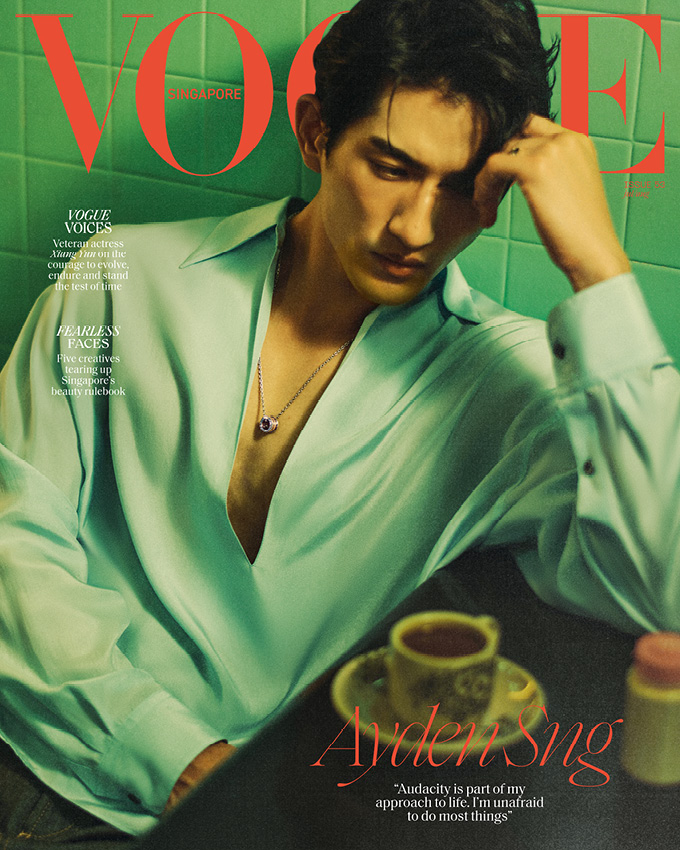
What can’t Ayden Sng do? The Singapore actor made history in May this year when his latest project, the Chinese boys’ love series Double Helix, premiered online. Sng is perhaps the most well-known actor from Singapore to enter the genre, which is a powerful star-making area of entertainment at the moment. The success of shows of such genres from Thailand, Japan, South Korea, China, and even outside Asia with Heated Rivalry, proves its popularity.
At the start of May, news broke of Sng’s starring role in Double Helix. Later that month, he announced a departure from Mediacorp’s The Celebrity Agency, Singapore’s most institutional talent agency that he had been signed to since 2019. It seemed apparent even then that his life was set to change.
And change it has. I noticed that Double Helix had gone live not thanks to promotional material, but from videos online of Sng and his co-star Elio Lv Sitong braving frankly terrifying mobs at the airport. His rapid and remarkable rise in popularity is just as visible on the engagement numbers on Sng’s Instagram page, that unavoidable metric we’ve come to measure famous people by. What used to be four figures on average in the past has ballooned to six figures on average on each post since May.

When I meet Sng for this interview in June, he’s in the intense centre of all this upheaval and change. He landed the night before from Shanghai, where he attended a string of brand events and the city’s film festival. He’s only in Singapore for two days to attend a Bvlgari gala, then he’s jetting off. First to the Annecy Film Festival for an animated film he has a voice role in, then to Paris for Fashion Week.
I learnt that he’s now spending 80 percent of his time in China and lives in an apartment in Beijing. He’s releasing an album of solo erhu music that reimagines the greats of the classical canon. He has his first Chinese single coming out, with lyrics he penned. Before we dive into the interview, we chat about fashion—Sng knows his stuff—and the creative directors whose collections and work he misses. I know, too, that he is a fragrance aficionado, but time is simply not on our side with so much ground to cover. The pressing matter is his portrayal of Lufeng in Double Helix, a complex role with a dramatic arc that Sng says has been the greatest challenge and most exciting achievement of his career thus far.
Let’s start with the big one. Double Helix, your first Chinese BL series, is out. How are you feeling?
It feels good because there’s a lot of recognition for my craft as an actor. A lot of how I was introduced into the public eye was very media- and brand-driven. There were terms like ‘fashion boy’, that kind of thing. Acting, even though that’s my primary profession, has never been something that audiences have been so focused on. But with this show, the acting is probably what most of the audience is talking about.
And that’s been a change.
It’s something I’ve been working towards for a long time. If you ask me what I am, first and foremost and regardless of all the multi-hyphenates, I am an actor.

You’ve made a big shift leaving Mediacorp and moving to take on projects in China. How did this all get started?
Culturally speaking, I am a very, very, very Chinese person. I consume a lot of Chinese content and entertainment. Being able to act in China was a dream of mine and so it wasn’t ambition in that sense. It was more plain and simple: just pursuing a dream. I went to China and got to act in a period show and a xianxia [‘immortal heroes’, a genre of Chinese high fantasy] drama. That was a dream come true.
“Audacity is part of my approach to life. I’m unafraid to do most things.”
Opportunities like that don’t seem to come along very often.
For me, the fundamental thing is that I like to act and I want to be involved in shows that give me that kind of opportunity. This role in Double Helix, for example, is something I would never be able to access. And this role is probably the one I’ve had the most excitement playing. I mean, why do actors act? Is it to become famous? Sure, that’s one of the reasons. But there is a high. There’s an adrenaline rush you get after finishing a painstaking scene and saying, ‘That felt good’.
Did you feel in the past few years that you had hit a wall?
When you get access to roles that allow you to really act, you fall in love with the craft more and more. That rawness, emotion and resonance that you’re able to give people from a role. It’s these moments when I feel that what we do as actors has value.

You’ve been playing Chinese instruments since you were a child. Were you on stage a lot?
Of course, I’ve done at least a hundred performances in my life. I was chairperson in the Chinese orchestra at secondary school and junior college. I was in the Singapore National Youth Chinese Orchestra and other orchestras outside school. When I went to Duke, I started the Duke Asian Music Ensemble. I was the first to introduce the Mid-Autumn Festival to the Duke campus, and we also did a Chinese New Year Festival.
No kidding, you really are Chinese.
Very. I have a solo instrumental album coming out in August. It’s all erhu and it’s all reimagined classical pieces. There’s Chopin, Vivaldi, Beethoven, Saint-Saëns, Rachmaninoff. The greats. I’ve always wanted to do it, but I’d been pushing it back because I felt that I didn’t have enough reach or an audience. I want to use this new platform [that I have] to reintroduce the erhu. A lot of people think of it as a boring fuddy-duddy instrument, but I want to show that it can be interpreted for a new age.

Do you think you’ll perform live with it? And because you’ve been in actor mode for years now, that you might be nervous to go on stage?
Who knows? But I would think so. When this comes out, we will have just finished our first fan meet in Bangkok. That’s a couple thousand people if we sell out, and we have two shows. That’s a lot of people. And I’m releasing my first single tomorrow [18 June, at time of writing]. It’s called ‘别哭 [Don’t Cry]’ and I wrote the lyrics to it. It’s a song about a crazed kind of love. At the end of it, he says that “missing or thinking of someone isn’t a crime/only the crazy ones make it to the end/even if you don’t love me, as long as I continue to love/then this whole thing is worth it”.
There’s a semantic thing I’m picking up on here. You said “he says”. When you’re writing a song like that, are you approaching it also as a character?
There’s a vision of a person who’s going through that kind of love. It would be a lie to say that it doesn’t heavily reference the feelings I had when I acted the role of Lufeng.
Is it autobiographical in any way?
No. In fact, I felt like a lot of it was filling in the blanks [of the character] when four years passed off-screen.

You have a role in an animated film coming out.
This film I do want to talk about. I’m going to the world première in Annecy. In the animation world—and this was news to me because I’m not so into it—the Annecy Film Festival is basically the Oscars for animated films. It’s a historical feat because for the first in history, a Singapore-made film has been nominated for the main competition for the AIAFF [Annecy International Animation Film Festival]. The film is called The Violinist and it was produced and directed by Ervin Han. It’s about a violin prodigy who’s very poor and only got to learn because the young girl from a rich family he was serving was learning the violin too. They become star-crossed lovers, but then the Second World War started. The story is told through the girl after she grows up, voiced by veteran actress Tan Kheng Hua.
I read that it has quite an international cast.
It’s an international production between Singapore and Spain. There are some Japanese voice actors, and of course there’s Kheng Hua, Adrian Pang, Fang Rong and myself on the cast too. But from a nationalistic perspective, this is a huge feat for Singapore because no other Singapore film has ever been nominated at Annecy, and that is a big deal. It’s a big deal for Ervin. He spent 10 years making this film, and that’s a very special moment.

Something I thought was quite interesting about this cast: Kheng Hua and Adrian are respected veteran actors who’ve made their own ways. It feels like you’re doing something similar now.
These two individuals are veterans whom I look up to a lot. It’s nice to have role models to look up to, but honestly, in this day and age, it’s never about modelling your career or path after somebody else. It’s about being comfortable with your own pace and where you are to do things your way. That’s the kind of mentality I have right now. It’s not that I want to be a risk taker or go an alternative path.
Where does the confidence to do that come from?
Confidence comes from failure and from having your expectations for yourself fall through time after time. It gets to a point where you don’t have to rush any more because what will come will come, and what won’t come won’t.

Are you less of a dreamer these days?
Well, I can verbalise my dream. My dream is to act and to be involved in all these projects. But that’s a dream, right? What I live in is a reality where every day you have to work tirelessly to gain access to the opportunities you’re looking for. Nothing’s ever going to fall into your lap.
What’s the most audacious change you’ve made in your life recently?
It might sound cliché, but it’s difficult to pinpoint because audacity is probably part of my approach to life. I’m quite unafraid to do most things. I’m of the belief that if you never try, you never know. After the news that I was leaving Mediacorp came out, one of my veteran friends Dennis Chew texted me saying, “Of the artistes I know, you’ve got the most guts”. I had a slight chuckle when I saw it because maybe that’s how people perceived it outwardly. For me, risk is never about audacity. It’s purely about how I would do what I want to do. It just happens that the decisions I make are perceived to be gutsy.
Was there ever a feeling when you moved to China and made all these changes that this is do or die?
Every day is do or die. It still feels like that. You never know what’s going to happen, so you can only give it your all.

Photography Zantz Han
Styling Nicholas See
Make-up Benji Oo
Hair Christvian Wu
Manicure Rebecca Chuang
Producer David Bay
Producer’s assistants Natalie Dykes and Erika Wong
Set designer Abegail Arendayen
Set designer’s assistant Clarice Teh
Photographer’s assistants Tan Peng Sheng and Sin Yean Sim
Stylist’s assistant Lance Aeron and Beatrice Safavi
Special thanks to Swiss Club Singapore, Ah Chiang’s Porridge and Auto Icons
Cover look Bvlgari B.zero1 necklace and ring; Giorgio Armani top; Brunello Cucinelli pants
The July/August 2026 ‘Audacity’ edition of Vogue Singapore fronted by Ayden Sng is available for pre-order online and will be on newsstands from 11 August.