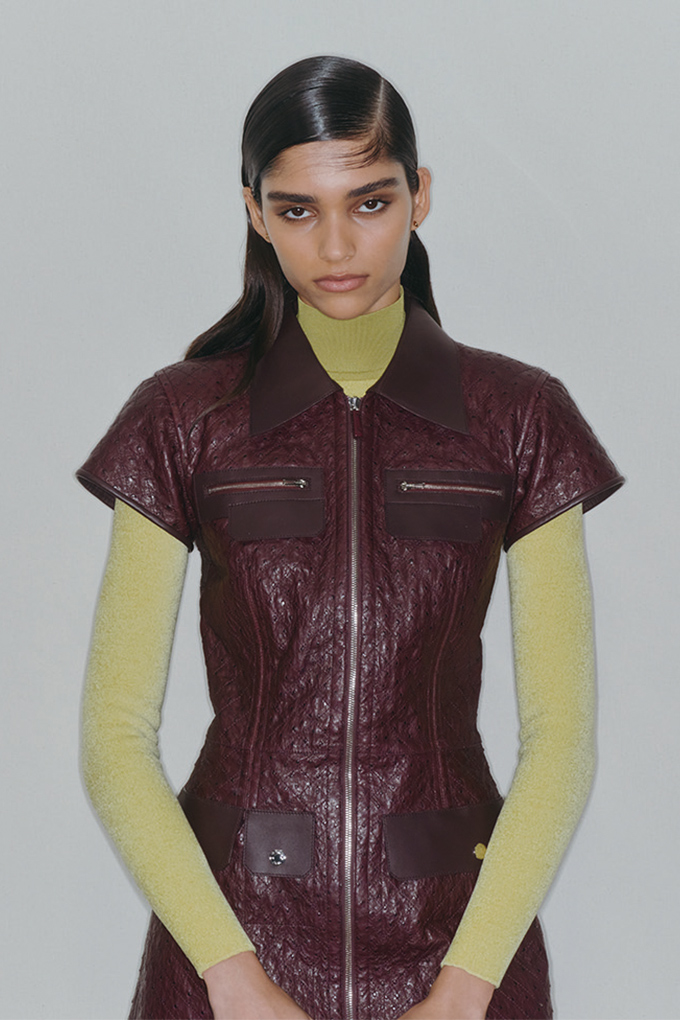
At Hermès, the ephemeral hours between day and night set the mood. Shaped by the shifting colours of dusk, Nadège Vanhee explores what she calls a “liminal realm” for fall/winter 2026. A space between two states, reflected in a runway that moves from the last vestiges of a warmer afternoon, into the deeper, muted tones of a quiet, cooler evening. Presented at the La Garde Républicaine, the final runway saw 63 looks—each one offering familiarity for someone accustomed to the Hermès universe, yet seen through a more atmospheric lens.


The house’s equestrian codes remain central to the collection, though Vanhee approaches them with a sharper, more contemporary sensibility. Jodhpurs are reworked in glossy lambskin, ribbed cashmere and ostrich, while cycle shorts that feel like second skin offers a sportier counterpoint. Thigh-high boots—appearing in shades of black, ochre, racing green and saddler’s red—are among the collection’s most consistent signatures. Paired with elongated coats, fitted dresses and abbreviated hemlines, they lend the collection a distinctly assertive edge.

Leather, unsurprisingly, plays a defining role. Biker dresses, belted trenches, aviator jackets and quilted minidresses demonstrate the material’s versatility, moving between polished surfaces and more tactile finishes. Glossy lambskin sits alongside suede, grained calfskin and textured ostrich, while detachable shearling collars introduce softness to otherwise streamlined outerwear. One standout look layers an asymmetrical, blue-black leather dress over a silk shirt; a flash of quartz blue cutting through the darker silhouette.
The palette follows the same gradual transition. Blue-black and inky blues give way to ochre, cognac and tawny browns, before deeper Bordeaux and forest greens emerge alongside satin and volcanic greys. Rather than relying on bold contrasts, the colours build upon one another, lending the edit its sense of movement from one hour to the next.

That interplay between structure and ease continues in the tailoring. Long equestrian coats and defined shoulders sit alongside zipped A-line skirts, fitted dresses and brushed-denim suits. Dressage-collar shirts, knitted silk ties and two-tone cashmere bring the collection back to the language of riding, without making it feel like a literal exercise in equestrian dressing. The result is a wardrobe that feels rooted in the house’s codes, but not confined by them.
Print is used sparingly, with the A.M. Cassandre’s Perspective motif serving as the collection’s sole graphic. Its appearance across select silk shirts, outerwear and dresses offer a considered contrast to the predominantly solid-coloured looks.


Accessories continue the collection’s balance of familiarity and variation. The Collier de chien chain-buckle belt, finished with a silver Médor detail, recurs throughout, while the Kelly is revisited in canvas and leather. The Picotin takes on a firmer, more structured form, and the Plume mini appears in colourful ostrich iterations, from limoncello to glacier blue and Grany green. Jewellery from the Nausicaa and Boucle Sellier Onde collections adds touches of rose gold and diamonds.
Ultimately, Vanhee’s interpretation of the liminal realm is less about dressing for a particular hour, and much more about capturing the floating sentiment that bubbles to the surface when existing between two. The collection never strays too far from the house’s established codes, but finds new ways of moulding to modern wardrobes through a tastefully tempered palette, sharper proportions and considered treatment of leather. It is a confident evolution of the Hermès wardrobe: recognisable at first glance, yet subtly evolved.