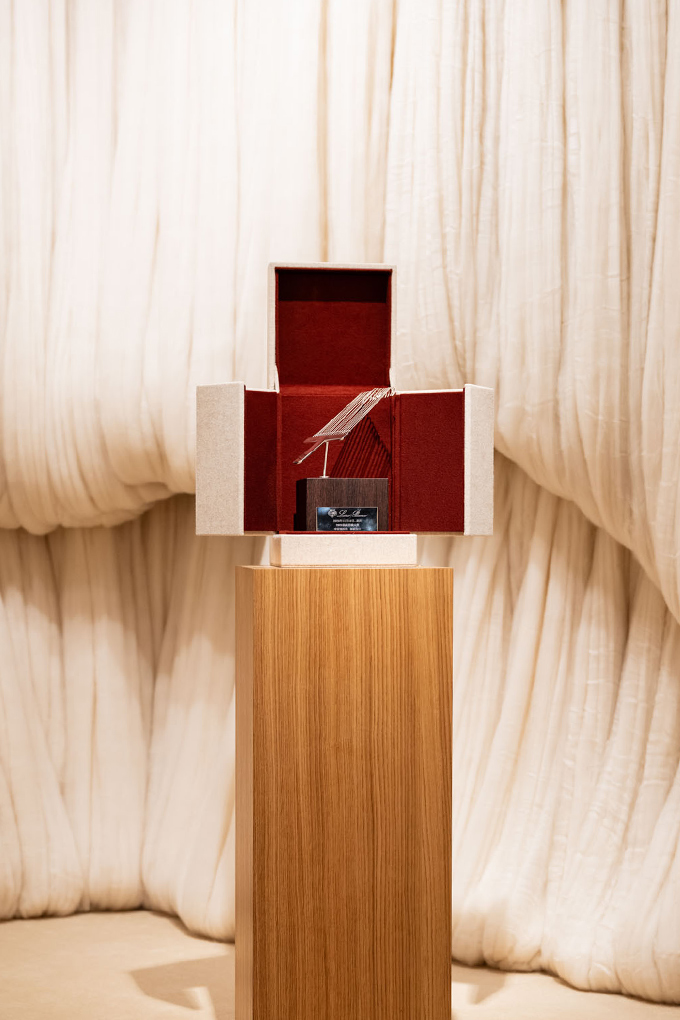
At Loro Piana’s Master of Cashmere exhibition at The Brant Foundation in New York, I stopped at one number. The fibre in the winning bale measured 12.89 microns across. It belonged to Siqingbilige and Hasiqiqige, one of three herding couples from Inner Mongolia honoured at the 11th Cashmere of the Year Award on 10 November 2026. The ceremony recognised their work from the 2025 harvest.
Siqingbilige and Hasiqiqige took the first prize with 135.8 kg of unscoured cashmere. Jiyatu and Gegentuya placed second with 87.1 kg at 13.01 microns, while Lifuqiang and Qiqi placed third with 116 kg at 13.04 microns. The three bales were displayed at the dinner. Each couple received a silver comb, a reference to how the fibre is collected, and a cash prize calculated by weight. Since 2015, the award has judged raw cashmere on fineness, length and performance. I like what it says about seeking less, but better. Fineness is easy enough to put a number on. I wanted to know what it takes to produce cashmere that fine in the first place.

In Mongolia’s Khangai region and the Gobi Desert, a goat’s winter coat does two jobs. Its coarser outer hairs take the brunt of the weather. Beneath them is the soft layer that traps warmth and gives us cashmere. Loro Piana puts the annual yield of that underfleece at around 450 grams per goat. Herders collect it in spring as the animals begin to shed their winter coats. For families who move with their herds, knowing when to leave one pasture for another is part of the job. So is having a home that can move with them. A ger can be taken apart and rebuilt at the next camp.

Then there’s Baby Cashmere. Loro Piana puts the usable yield from a young goat at about 30 grams, with fibres around 13.5 microns in diameter. I’d always thought about fineness in terms of how a finished garment feels. What I hadn’t considered was the problem it poses at the mill, where those short, fine fibres have to be spun into a yarn that holds together. The award’s judging criteria made more sense to me after that. Diameter tells you how fine a fibre is. Length and performance help determine what you can make with it.

In 2009, Loro Piana began a selective breeding programme with scientific partners in China’s Inner Mongolia and Italy to improve fibre quality while helping preserve the local Alashan goat. In Mongolia’s Sukhbaatar province, the company’s more recent Resilient Threads programme addresses a different set of pressures. Severe winters known as dzud can cut livestock off from pasture, with serious consequences for the families who depend on them.
Of all the things I learnt about cashmere, the detail I kept coming back to was a mobile clinic. Launched as part of Resilient Threads, it offers health check-ups for herders and veterinary consultations for their animals. The programme has also introduced training at the Mongolian University of Life Sciences and supports the native Bayandelger red goat, which produces naturally light-grey cashmere. The clinic made me think about what it takes to pass on a craft. An award can recognise the judgement that went into producing a particular bale. For a younger herder, developing that judgement takes years of reading the pasture, watching the weather and caring for animals. It also takes being able to earn a living through those years.