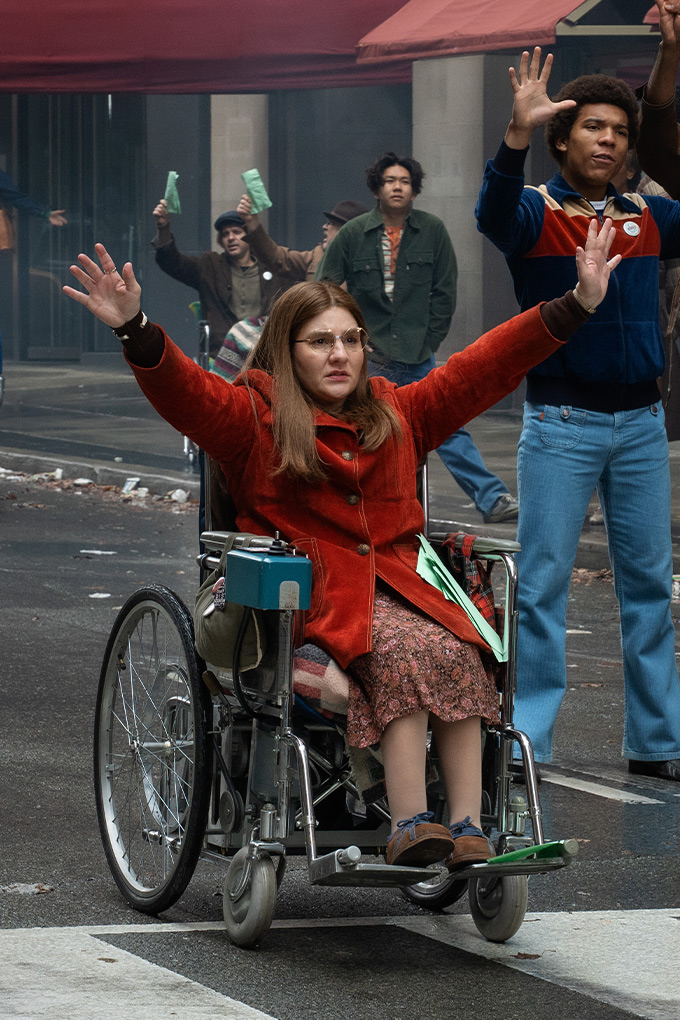
Overstimulating, sticky and claustrophobic do not begin to describe the first thirty seconds of Being Heumann. Director Siân Heder spares little sentimentality in the procession of feet that opens the film, only to be countered by the skirting wheels of Judy Heumann’s small, period-correct wheelchair—a vantage point from which you soon enter, and greeted with the world of stomachs, bodies and car smoke. There is some physical absurdity to living in a world where nobody pays you mind, a deliberately skewed visual hierarchy which, concerningly, strikes me as somebody’s reality. But Being Heumann isn’t interested in solemnity for the sake of it—not fifteen minutes later, the show has already gone on: as fellow activist Kitty Cone tells Heumann: “Go show your cleavage and cry.”
Heumann is prickly, hot-headed, tough as nails, and has a lot of spunk in a very small body. But these are precisely the qualities that would lead her to become the “Mother of the Disability Rights Movement”. At just 22, Heumann was already making headlines in the New York Times as “Woman in Wheel Chair Sues to Become Teacher”. The headline is basic and to the point and that is exactly how groundbreaking the concept even was at a time—that a woman in a wheelchair could go to court and sue the Board of Education. Heumann would go on to become the first wheelchair user to teach in the New York City public school system.
Heumann, who passed away in 2023, had 75 years of a life well-lived, and certainly one well-fought. To understand Heumann is to recognise that, since contracting polio at infancy resulting in the paralysis of her legs—she has only ever known the fight. “She wasn’t born angry,” says Ruth Madeley, who plays Heumann. “Everything throughout Judy’s first few years of life, up until this point, had been a fight.”

Activism is never about just one person—but sometimes it also takes the spunk of one person to make it all work. One thing that can be taken away from Being Heumann is how well it captures the precariousness of this balance. “Judy being someone that understood the power of bringing a lot of people together and being a real connector,” says Heder over a Zoom call, who had worked closely with Heumann on the film until her passing.
Their collaboration was, in many ways, a moment of fate. Heder had just watched Crip Camp starring Heumann, at the behest of a friend who had worked on the production for the docuseries, and subsequently cold emailed Heumann—who wrote back in just 20 minutes and said she happened to be deciding the director for her upcoming documentary in 24 hours’ time. “I had a really amazing relationship with Judy,” mused Heder. “And when she passed away, I really felt that she had entrusted me with her story.”
It paved the way for Being Heumann, which zeroes in on the monumental, nationwide peaceful occupation of federal buildings for three weeks—widely considered the longest sit-in of a federal building in U.S. history. It was a response to the government’s failure to enact civil rights protection for the disabled, and more importantly, to compel Health, Education and Welfare (HEW) secretary Joseph Califano to sign the long-delayed regulations—a role wonderfully executed by Mark Ruffalo in the film. On paper, there was reasoning to Califano’s resistance: signing meant taking on the responsibility of arduous and expensive tasks, including replacing all buses and transit systems to be disability-friendly in a mere 60 days. But the thing about humanity is that it cannot be reduced to mere logistics and monetary concern, and the answer is not one that can nor should be quantifiable.

Even the fact of the movie being made was a first. When I was doing research around the film, I found that, at the time of production, there had been only one wheelchair-accessible trailer in all of North America. This posed, of course, a production problem when a large portion of the cast is disabled, including a crew of disabled artisans and technicians. It meant that the movie, on-and-off the screen, had to reinvent the wheel as to how even people made movies in a way that was accessible.
Even the casting was a first: Madeley, who plays titular character Judy Heumann, has spina bifida and is herself in a wheelchair. Daniel Durant and Russell Harvard are deaf. Michael Patrick Thornton is quadriplegic, after suffering two rare spinal strokes at 24. Madeline Delp is paralysed from the waist down, and Andrew Pilkington has cerebral palsy.
It brings to the pertinence of Being Heumann being released now, at a time where firsts are still being had and parts of Section 504 are at risk of being recalled. Curb cuts may be a much more familiar sight now, but the Disability Discrimination Act was only passed in the U.K. in 1995. In Singapore, the first public bus with wheelchair ramps was only introduced in 2006, with the Code on Accessibility in the Built Environment following in 2013.
It is debilitating to have your whole physicality taken away from you, only for the rest of the world to disregard your vitality, too. And yet, anyone at any time having the potential to become part of this subset. In fact, if we’re lucky enough, we will: we will live until we’re old and grey, and soon see the days of walking in a cane or riding in a wheelchair—reaping the benefits of what Heumann, Cone, and all the Section 504 protestors fought for, from curb cuts to accessible public transportation and bathrooms.

Black Panther Brad Lomax, who is played by Antwan Tolliver in the film, aptly points out he was only affected later in life, with his onset of multiple sclerosis landing him in a wheelchair in his 20s. One of the film’s more telling moments comes when a former Panther encounters Lomax but fails to recognise him: seemingly unable to reconcile the person he once knew with the wheelchair user before him. It is a small but utterly devastating illustration of how quickly someone’s identity can become eclipsed by their disability in the eyes of others.
The presence of the Black Panthers at the historical sit-in was in part due to Lomax—and proved integral to the sit-in’s success, particularly when support from non-marginalised groups was thinning. Joni Breves, on-and-off caregiver for Heumann and part of Dykes on Bikes, was also present in the film. It is an apt decision by Heder, a reminder of how fundamental intersectionality is in civil rights activism. The experience of being denied care, dignity or access may look different across communities, but the underlying mechanisms of exclusion are often familiar—and with that comes a harkening sense of empathy. If one group can be marginalised, what is to stop another? Compassion is a considerable part of activism’s power, and it is wonderful to see this side of the Black Panthers brought to the fore in Being Heumann.
It was also appreciated to see the breadth of lived experiences in being disabled and ways of reacting to disability. There is, really, no right or wrong to it all. In conversation with Madeley, she cited a moment she read about Cone and Heumann which shifted her perspective of the activist. Heumann had once asked Cone: “If you could change your disability, would you?” And when Cone said yes, Heumann had responded, “Well, I wouldn’t. This is who I am, and I love who I am.” It is a fascinating distinction, not least because both positions are entirely valid—but what does it mean to own your disability? “Kitty did have a sense of loss and grief around her disability, and that was part of her experience,” said Madeley. “And Judy didn’t. Judy had this pride in who she was, but that neither is wrong or something to be judged.”
There is criticism that this film is more entertaining than it is hard-hitting—but I would argue that it is precisely what makes it worth watching. I wrote in my notes “wheelchair racing and wheelchair sex”—which, to be frank, was a takeaway I never expected from a movie about the Section 504 sit-in—but one that I largely enjoyed and found refreshing. A large part of the protest is also the joy found in the collective—and disability, in particular, is not simply a condition to be accommodated, but a lived experience with its own intimacies, inconveniences and pleasures.

To open your eyes and experience life in a new way is a rare opportunity, and Being Heumann did exactly that: the necessity of having your hair washed in the sink, the inconvenience of having bathroom doors not wide enough for your wheelchair, the necessity of a ramp to even go up the stairs.
And outside of all of that, Being Heumann has the air and antics of a dizzyingly fabulous ’70s sleepover. There is a disabled sex tent; diagrams of how to have wheelchair sex; smoking of all kinds; and wonderfully blithe, period-faithful soundtrack by Francesco Le Metre featuring Stevie Wonder’s ‘Sir Duke’ and the iconic guitar chord progression of rock classic ‘The Passenger’ by Iggy Pop. Heder’s point that the disabled are not fragile rings clear: it comes through in Heumann’s defiant navigation of New York City traffic in the opening sequence, and again when she initiates sex with able-bodied activist and ex-vet Jim Pechin, played here by Jon Beavers. Being Heumann is refreshingly uninterested in making its subjects palatable, let alone saintly.
Even amidst the FBI cutting their phone lines, the air is gleefully free. The activists have, almost inadvertently, created an environment genuinely catered to their needs, where disability becomes a logistical inconvenience rather than an insurmountable barrier. As in the film and real life, the activists even stayed the extra night even after the protest ended because of that lingering, vibrant spirit found—a true example of when hardship is met with the even greater bounty of joy and community.
One thing to be noticed during Being Heumann is the number of outfit changes by Madeley over the course of the sit-in, while all the other protestors are wearing the same clothes—but this is not so much of a creative liberty as a reflection of real life, for Heumann had a known love of fashion and dressing up, and actually had clothes smuggled in to the federal buildings. It is a small but delightful detail on Heder’s part; and another reminder that part of what made Heumann’s activism so powerful was her reluctance to shrink who she was, to allow her sense of self to be subsumed by the cause.

The film’s willingness to engage with questions about hierarchy and leadership make the ensemble performance all the more real. Heumann’s shortcomings are precisely what make her human. She can be rash in the same way she is hot-headed, and as well-versed as she is on disability rights she can, at times, be insufficiently attentive to the needs of her fellow activists—impulsively agreeing to a sit-in or hunger strike, without fully considering how such decisions might affect those with more complex or intensive support needs than her own. It is an uncomfortable but necessary dimension of her portrayal. Altruism was never meant to equate to sainthood, the complexity of Madeley’s portrayal is precisely what makes it great.
Even in Ruffalo’s Califano—ostensibly the villain of the story as the HEW secretary refusing to sign the papers—could easily have been rendered one-dimensional. Instead, Ruffalo’s portrayal unveils a degree of humanity—a man who believes he is doing his best while remaining unable, or unwilling, to imagine beyond the limits of his own circumstance. It’s easy to point at Califano and condemn him for initially finding himself on the wrong side of history, but how many people, placed in his position, would have done exactly the same? Why did it take only until 1973 for basic legal protections for disabled people to be secured? Califano represents a very real and sizeable demographic: people who are apprehensive of change, particularly when it comes at the cost of the systems and conveniences they have known.
But now, 50 years later and a fair more amount of hindsight, it ever too hard, or are you just limiting yourself with your own beliefs? Now, a wheelchair user can deliver mail because federal buildings have ramps; stroll down the sidewalk even during roadworks because ramps are mandatory; and take public transportation. It feels almost banal to write such a list—and brings to question how everything being asked for in Being Heumann was never meant to be particularly radical at all.
Being Heumann is now streaming globally on Apple TV.