You might have encountered the doomsaying skulking about the alleyways of the internet over the last few years, the cries bemoaning its existence growing louder by the minute: media literacy is dead. Critical thinking is dead. The art of reading between the lines—much less reading those lines themselves—of making sense of what’s shown, but not told, is dead. I’m loath to admit it, but in 2026, this sentiment is not hyperbole.
The continued rise of social media and rampant developments in generative artificial intelligence have led to an insidious democratisation of knowledge that’s made anyone who’s spent even 60 seconds online ‘an expert’. Some wield this power responsibly. Many don’t. Of the latter, a vocal minority (i.e. your average Twitter user) of keyboard warriors have made it clear that the world needs more readers interested in spending time away from their screens and immersed in books.
There’s something about a physical book. Its tangible weight in your hands, the feel of its pages—whether crisp and new or faded and worn—flipping beneath your fingers. It takes up space, which means you have to take the time to think about where it lives, an important distinction from the billions of videos on YouTube lurking nebulously under your phone screen. Even those books without words have merit. Whether through the veneer of black and white photos or digital concept art drafted on Photoshop, they all have stories to tell in their own way. They all force you to take a beat.
Where to, then? If the local library is a bridge too far removed from your social circles, then perhaps the nearest bookstore might satisfy your latent curiosity for the written word. This is where Singapore’s newest home for the paperbound, Two Two Bookshop, comes into the picture, straight from the heart, mind and soul of one of our most seasoned creatives: photographer Khoo Guo Jie.

Khoo is a local industry staple. If you’ve ever dabbled in any creative work even remotely adjacent to the practice of photography, chances are you’ve heard of him—either seen his work or encountered the brands he has worked for. You don’t become one of the Aman Group’s go-to photographers without the chops to back it up, and Khoo has been honing his skills since he first dipped his toes into lomography at the age of 23.
Khoo’s not one to boast, though. The now-41-year-old has been in the game for a while—and come out the other end quieter, more composed and self-assured. He doesn’t have anything to prove to anyone else; only the desire to continue pursuing the concept of identity in artistry, which has long sat at the core of his approach to photography. While an early mentorship with local legend Tan Ngiap Heng helped plant its seeds, like the best artists, it was Khoo’s love for other disciplines, like literature and film, that watered the soil, from author Liu Yichang’s stream-of-consciousness writing to director Hou Hsiao-Hsien’s 1998 film, Flowers of Shanghai.
I’m hesitant to invoke the oft-overused term ‘multi-hyphenate’, but Khoo truly is one in every sense. In 2025, he founded spatial design studio Nous Nous alongside his partner, architect Melissa Tsang. On the distinction between his two practices, he ponders: “I suppose it has to do with authorship. In photography, there is often a degree of negotiation with what already exists. You frame and edit reality, but the subject itself precedes the image. That process is inherently observational.”

Design comes at the notion of authorship from a different angle, but one that Khoo is still careful to think deeply about. In his view: “Design is generative. It requires you to construct relationships between form, function and context. You’re not just interpreting an existing condition but proposing an alternative to it. Photography has taught me to pay attention and to notice details, patterns and relationships that might otherwise go unseen, whereas design has made me think more critically about what happens after that observation.”
The proof is in the pudding. Nous Nous has already designed some of the buzziest spots on the island, from cafe 174Bingo in Joo Chiat to the roastery of Apartment Coffee, the number one ranked coffee shop in Asia. Between his photography and design work, Khoo’s professional life is a well-oiled, if possibly overworked, machine with many moving parts. I can already see the question forming on the tip of your tongue: why add a bookstore to the juggling act?

I understand where you’re coming from. I’ll admit I took a while to get here and it’s not like Singapore doesn’t have its fair share of literary spaces. There are popular havens for fiction like Littered With Books, crowd cult favourites like Basheer Graphic Books and community-focused spaces like Casual Poet Library. However, the context was important because Two Two is not your ordinary bookshop.
Yes, Khoo has put the work in to connect with suppliers and source a wide range of books to sell (his literary stable currently stands at 135 titles and counting). Profits, at least insofar as they enable him to continue operating the bookstore, do play a part in his decision-making. However, beyond the need to keep the lights running, the space is an extension of the photographer’s creative vision, and his alone.

Two Two’s genesis came about not as a grand endeavour to introduce groundbreaking change to the bookstore format, but as a chance to indulge in some good old-fashioned self-interest. Khoo’s Rolodex of inspiration is constantly changing, growing and adapting to his wide-ranging interests, a by-product of his many years spent working as a photographer, spatial designer and general lover of the arts.
“I simply wanted to bring together things I was interested in and wanted for my personal library,” he remarks. “As Two Two grew, I started thinking more about what might also be interesting to the people coming through the space. But I do still want to hold onto that original impulse of bringing in things that I’m excited about, rather than trying too hard to anticipate what an audience might want.” As such, the space is more than a bookstore. It is a reflection of the slow, steady culmination of his life’s past work, present obsessions and future dreams.

There is a caveat here. Two Two is very small. However, its scant 60 square metres work in Khoo’s favour. Inside, you have a direct line of sight to everything on offer. No book or shelf lies out of arm’s reach. He’s not hiding anything from you because there’s nothing to hide. As the saying goes, ‘good things come in small packages’.
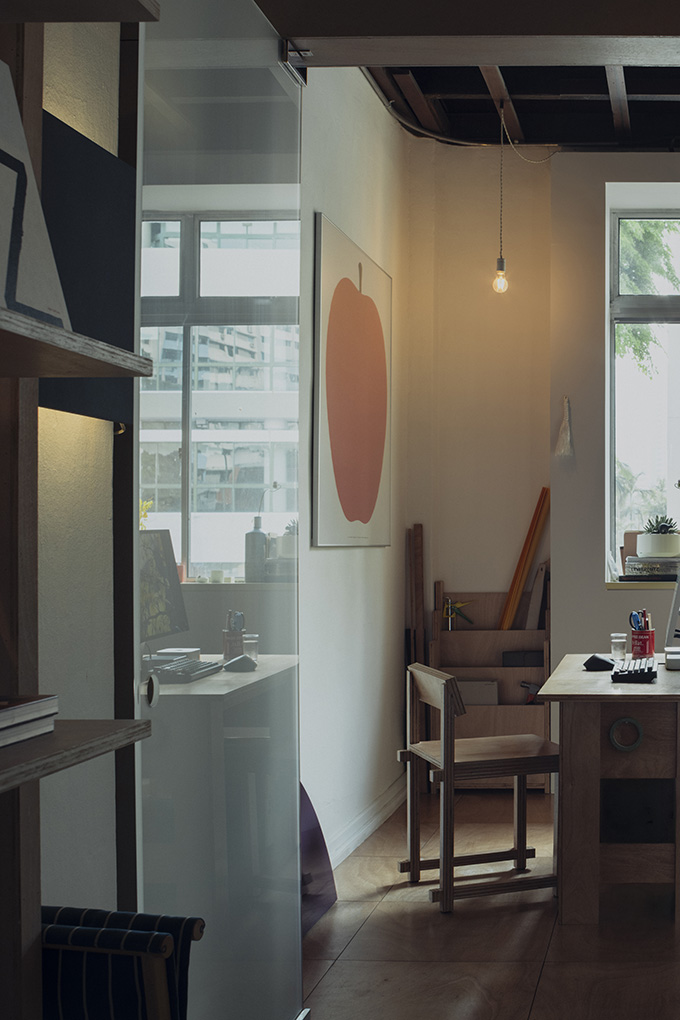
Topping this sentiment off is the location. Situated on the second floor of an unassuming shophouse in a quiet neighbourhood in Serangoon, just outside the office of Nous Nous, Two Two is far removed from the hustle and bustle of the inner city. It’s not a store that you merely stumble upon. Getting there takes intention, as does staying to make the most of it. Nothing but books occupies the compact, but cosy space—there’s no barista to deliver your caffeine fix or baked goods for the peckish—and the books’ subject matters are diverse, to put it mildly.

Khoo is adamant that nothing takes up residence on his shelves that he doesn’t want to. There is no agenda to fulfill, no other ambitions to please, other than his own. He has clients aplenty with his photography and spatial design work. “I’m not here to champion anything. I just want to show what I love.” And, boy, does that passion shine through. If anything, his unapologetic curatorial decisions are borderline selfish. This is a good thing.
There are many witnesses I could call to the stand in the defence of this statement. There’s only one I need: Devotional Cinema, a lecture on the technical craft and contemplative ritual of the silver screen by experimental filmmaker Nathaniel Dorsky—and the first book that graced Two Two’s shelves. No offering in its repertoire highlights Khoo’s vision for the space more clearly. “I found out about Dorsky through Jonas Bak, a filmmaker I met in China. That led me down a rabbit hole as I started watching Dorsky’s short films, discovered he’d written this book and went hunting for a copy.”

Thailand and Japan. Khoo Guo Jie
Unfortunately, Devotional Cinema left print circulation years ago, so Khoo wrote directly to the author’s blog on a whim. “As it turned out, he’d recently started a small press to bring the book back into print. That whole chase—from the curiosity to the dead end to the lucky reply—is part of why this book means so much to me as the first one on the shelf. It argues that film can hold a devotional quality that isn’t religious in the traditional sense, but an opening that lets us experience what’s usually hidden.”
Dorsky’s work serves as an analogue for Two Two’s place in Singapore’s broader literary landscape. As a lecture, Devotional Cinema endeavours to educate and provoke dialogue around film and its meditative qualities. Two Two seems positioned to do much the same for local readers—it’s an exercise in showing, not telling.

is something for everyone at Two Two. Khoo Guo Jie
In Khoo’s view: “The space is a small, but complementary part of Singapore’s literary scene. Many established institutions, festivals, publishers, bookstores and literary platforms are already doing important work, and we’re not trying to replicate it. Instead, our role is to create an intimate and experimental space to encounter one another.” That intimacy is key here.
In a world where our activities are increasingly determined by the programmed rhythms of ever-evolving algorithms, each photo book, magazine and tome on TwoTwo’s shelves is an invitation to turn around and do the exact opposite. Granted, this sentiment is easier said than done, especially in Singapore, but as Khoo sees it, the groundwork has already been laid. “We benefit from the communities and infrastructure that already exist here, and hopefully we can contribute by bringing different people, practices and conversations into the mix. In that sense, our contribution may be relatively small, but it’s about adding another kind of space and another way of participating in literary culture here.”

location in Serangoon makes it a welcome getaway from the bustle of the inner city. Khoo Guo Jie
Put down the phone. Talk to one another. Read a book. All your lived experiences would amount to nothing without your relationships—all the art in the world would be for naught without others to enjoy it with. So long as Two Two can bring a few people together to engage in this shared humanity, Khoo believes the bookstore will have done its job. “The concept of human connection is ordinary, but never fully makes sense,” he muses. “How people meet, misread each other and end up changed by it—there’s something beautiful in that. I’m not hunting for books about connection specifically; just for that feeling, wherever it turns up.”
No hate, but what Singapore needs is not another formulaic bookshop that’s part of a giant chain. We need to think smaller, not bigger; feel more, not offload our cognitive responsibilities to our digital overlords. We need spaces that encourage quietude and reflection, that live in service to intention and authenticity. Taste doesn’t grow on trees. Take a leaf out of Khoo’s book (no pun intended) and let it be watered by the lived experiences of the human beings who surround you. On this front, you could do much worse than visit Two Two Bookshop, peruse a volume or two and see where the day takes you.