The dinner table is a magical place. It’s often where important conversations and memorable celebrations are held. Between family, friends or even strangers, sharing a meal is the great equaliser that breaks down social barriers and encourages bonding. After all, everybody has to eat, right? Yet the related cultural traditions, recipes, skills and social practices that go into a dinner table often go unseen or worse, unacknowledged. And in a fast-paced, cosmopolitan city like Singapore, where quick and fuss-free options are plentiful, our intangible food heritage is sometimes forgotten altogether in favour of convenience.
Now, there’s no denying that traditional local food practices can take time and require remarkable effort. Rendang demands patience and hours of stirring to coax out its deep, complex flavours. Ang Ku Kueh calls for delicate precision, from preparing the dough to shaping its distinctive red shell. These emblematic dishes are not simply recipes to be followed from pages of a cookbook—they signify the memories, knowledge, skill and stories that have been passed down through generations. While our food heritage usually finds itself in the spotlight during momentous events like National Day and major cultural festivities, its preservation is an everyday effort that happens quietly, behind the scenes.
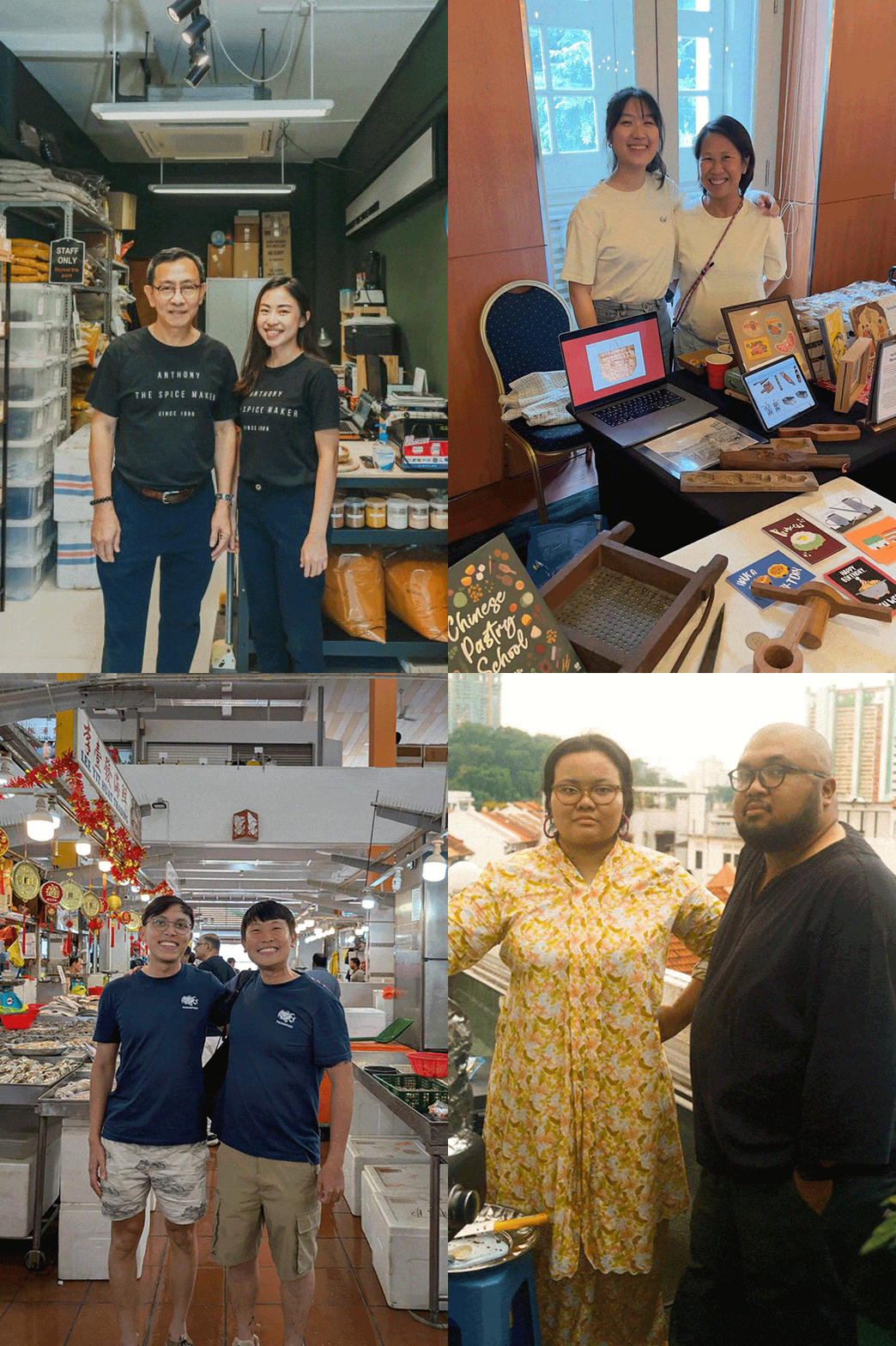
Protecting our food culture is not without its challenges, but there are those amongst us who have taken it upon themselves to ensure these sacred traditions have a place in our everyday lives. Murni and Aqid from Sendok Rakyat, Kenny Lek and Elliott Ong from Pasarfish, Emily and Min from Museum of Food as well as Leow Min Ling from Anthony The Spice Maker are each approaching food heritage in their own way—through making, cooking, teaching, documenting and bringing people together.
For them, food is not simply what ends up on our plates. It’s an identity that calls for a collective community effort to uphold. Here, we speak to them about why food heritage matters and get to the heart of what keeps them going.

1 / 8
Leow Min Ling, Spice Girl at Anthony The Spice Maker
Min Ling first started working for her family’s spice business, Anthony The Spice Maker, in 2016. Established in 2009 by her father, Anthony, the brand began as a humble stall in the wet market at Chinatown Complex. Her father had learnt the art of spice making and mixing from his parents, who ran a spice business at the wet market in the ’70s. For six years, Min Ling learnt the tools of the trade before eventually moving overseas to start Anthony The Spice Maker Switzerland. Together with her husband, she sells spices online and in person at farmers’ markets in the lac Léman region of Switzerland. Last year, Min Ling opened her very own spice boutique under the same brand, where she hosts spice masterclasses for those interested in the art of spice-making.
Can you share more about how you first became interested in Singapore’s food heritage?
I had the privilege of growing up on home-cooked food. My grandma cooked dinner for our family every single day. Some of her signature dishes were Curry Chicken and Sambal Assam Fish. Her Dried Shrimp Sambal Chilli (Hae Bee Hiam) worked like magic in many stir-fry dishes, which I absolutely adored as a kid. I would often hang out with her in the kitchen, ‘assisting’ her—though really, I was just trying to snack on the pre-dinner prep—observing the sauces she added and taking mental notes. Being born into a family of spice makers, I was exposed to rich spices and aromas right from childhood. As I grew older, I realised that heritage food had always been right there on my dinner table, and I felt driven to recreate these dishes to honour my culture and my grandma.
Food heritage is usually passed down through people rather than books. Who has been your greatest teacher?
My greatest teacher is my father, Anthony of Anthony The Spice Maker. He is a no-nonsense man, especially when it comes to his craft. He taught me to work from the heart and craft our spice blends with a clear conscience, giving both home cooks and professional chefs authentic, high-quality spices to feed their loved ones and guests. He also taught me never to let outside noise distract us, because nothing should compromise our recipes or flavours. I’m deeply grateful to him for equipping me with the knowledge and savoir-faire to preserve our family legacy and share Singapore’s flavours with the world—starting small right here in Switzerland.

2 / 8
Leow Min Ling, Spice Girl at Anthony The Spice Maker
Why do you think food is such a powerful way to preserve culture and identity?
Four years ago, I brought my father’s spice business to Switzerland under the name Anthony The Spice Maker Switzerland. Since then, I’ve met so many locals who have visited Singapore and fallen in love with our food. Through our dishes, they learn about our history, culture, traditions and immigrant roots. I love explaining what Bak Kut Teh is and how it was created by coolies back in the day. I also share my Peranakan background, showing customers how intermarriages shaped Singapore’s unique multicultural identity and cuisine.
View this post on Instagram
What do you hope for Singapore’s food heritage scene, 20 years from now?
Even as a cosmopolitan nation, I hope Singapore’s heritage food scene continues to thrive and be celebrated by locals and visitors alike. No matter how food trends evolve, I hope we stay true to our traditional flavours and techniques, keeping heritage stories alive through centres where local cuisine is protected. As much as I enjoy a good vongole pasta, Fried Hokkien Noodles will always have my heart. My biggest hope is that Singaporean food will never be overshadowed by global trends, and that our culinary standards won’t be lost to time.

3 / 8
Min and Emily, co-founders of Museum of Food
Since 2024, the Museum of Food has been bridging the public’s knowledge of Singapore’s food heritage through hands-on workshops, communal dining experiences, as well as a comprehensive gallery showcasing antique cooking tools and vintage cookbooks. Founders Emily and Min first met as fellow authors of heritage food books and were looking to do more than sit back and wait for people to chance upon their books and cook from them. By taking this proactive approach to preserving heritage food practices before they are lost to time, Emily and Min hope to nurture a shared love for Singapore food’s storied legacy and inspire its future.
When did you first become interested in protecting our local food heritage?
Min: I started cooking in university, while studying in London. That was when I craved home-cooked food and heritage dishes and started to attempt making some, like curry puffs and Ba Zhang. After graduating, I worked for a few years before heading to pastry school, where I realised even our local pastry and culinary curriculum was quite Western-centric. There weren’t ready avenues for the average Singaporean to access heritage cooking techniques, especially for those who didn’t grow up with grandmothers who cook—myself included. That’s when I decided to write a book about Chinese pastries, documenting the techniques, historical context and food science.
Emily: My entry into heritage food wasn’t through a culinary school, but through the eyes of children—both my own, as well as those I taught. As an early childhood educator, and thereafter establishing my own children’s cooking studio, I spent years watching how young minds learn about the world through touch, smell and play. Around our shared tables, I began to notice a quiet shift: children could identify trending flavours or packaged snacks instantly, but had almost no connection to the raw ingredients, aromatics, or traditional tools that shaped our local foodscape. That realisation shifted the focus of the work I was doing. I wanted to build a bridge between our youngest generation and the rich, multi-sensory tapestry of Singapore’s culinary history—not as static museum artefacts, but as living, breathing experiences you can roll, shape, smell and taste.
Are there traditions, ingredients or stories that you think deserve more attention today?
M: They all deserve lots of attention! I think there’s a tendency for the media to focus on ‘feel-good’ stories and traditions, or traditions that have greater commercial value. It’s really stark this month—the seventh lunar month—as we also gear up for the following month’s mid-autumn festivities. Everyone around us has started marketing campaigns for mooncakes, some diving into the history a little more than others, some focusing on premium ingredients or packaging. All this is happening while seventh month food practices are glossed over.
Another big one is the art of shopping at wet markets. In our generation, there’s been a huge loss of human interactions and a human touch. Service staff are replaced by QR codes, groceries can be ordered on our phones and we can self-checkout at supermarkets. Wet markets are where we can take our time, see and touch ingredients, ask questions and be exposed to new ingredients.
The list is endless, but one more is cooking from scratch—using manual tools to grate coconuts, squeeze the milk with our hands and pound spices using a stone mortar and pestle.
E: I think we need to bring far more focus to our native regional ingredients, forgotten aromatics and the physical craft of traditional food tools. Beyond the famous hawker dishes everyone knows, there is an incredible world of wild herbs, traditional fermentation techniques and intricate pastry arts that risk fading into obscurity.
We also tend to overlook the story of the tools—the heavy granite pestles, brass woks and wooden moulds. These aren’t just historical items; they are crafted objects that carry the physical memory of generations of cooks. Our museum gallery strives to shine a spotlight on these tools.

4 / 8
Emily and Min, co-founders of Museum of Food
How important is community in ensuring our food traditions don’t disappear?
M: Traditional food and cooking have always lived within communities. Be it large families or the old kampung days, food prep and eating always brought people together. When communities stop hanging out to prepare and eat together, the flavours we once knew would disappear too. Some foods that we once loved become difficult to prepare, because we no longer have a room full of aunties, siblings and neighbours to prepare something laborious together. I think it’s a two-way relationship. With food, there’s community, and where there’s strong community, food traditions will continue to live on.
E: Community is everything. Heritage cannot survive trapped in a glass display case or preserved solely in academic archives; it must live on our kitchen counters, in neighbourhood spaces, and around community tables. When neighbours gather to share recipes, when parents involve their children in traditional preparation and when consumers actively support local food artisans, heritage remains dynamic. The community keeps heritage alive simply by choosing to practice it, talk about it and pass it on in everyday life.
What are some practical steps we can take to preserve our food culture?
E: Don’t be afraid to ask! The best way to preserve our food culture is to step into the kitchen, ask the elders in your family or community for their stories, touch the ingredients and make a mess while learning. Heritage isn’t something we just look back on—it’s something we actively craft together every single day.

5 / 8
Murni and Aqid, founders of Sendok Rakyat
Sendok Rakyat translates to The People’s Spoon in Bahasa Melayu, and was created by duo Murni and Aqid as a way to share, celebrate and document Malay food heritage. Instead of positioning themselves as an authority in the cultural food scene, they take on the role of facilitators—cultivating a safe space where people can engage with and explore cultural food practices as well as connect with their heritage without judgement. You may have heard of them from their hands-on Nasi Ulam workshops, which centre traditional herb preparation and native flavours through communal dining.
How did you first become involved in advocating for our local food heritage?
Aqid has a background in working in heritage and culture and Murni has a wealth of lived experience in the kitchen. Sendok Rakyat lived different lives at the start—at one time it was going to be a private dining experience, then a food blog, and then a home-based business featuring lesser-known Malay food. But our friends from FIN Crafted Goods gave us an opportunity to run a programme for their Teh Tarik Nights gatherings. We were already thinking about the politics surrounding the food that we eat and what it means to be a part of that heritage at the back of our minds, but running a programme and sharing that space with people really opened our minds to what was possible. In-person experiences were a better platform to house that dialogue.
The name Sendok Rakyat speaks to our politics and philosophy of what we believe food should be. We wanted it to signify how people should play an active role in the conversation and the making and consumption of food. Our work also focuses a lot on bottom-up community memories and advocacy. Heritage is an everyday thing, not something reserved for the affluent in museums. We work to ensure that when people see ‘heritage’, they also see themselves reflected in it. At the heart of it, our initial goal was to ensure that the community—whether they had years of experience in the kitchen, pages of inherited recipes, a spice tolerance, or had never even handled a knife—could all equally sit at the same table and find their own way to enjoy and actively engage with food and culture.
Growing up, what food memories have stayed with you the most?
Murni looks fondly on the time she spent with her mother in the kitchen—when gossip becomes conversations around life, morals and everything in between. That time spent in the kitchen really becomes a temporary haven outside of the challenges of reality. While in the kitchen with her mother, being able to use her hands to process the food that they both love allowed them to let their guard down and put aside social positions or responsibilities of running a family unit and speak on a more candid basis, without thinking too much about the conflicting identities or roles that we hold.

6 / 8
Murni and Aqid, co-founders of Sendok Rakyat
Food heritage is usually passed down through people rather than books. Who has been your greatest teacher?
It’s really the people we come across in markets—hawkers and even aunties going about their market routines. The pasar or market is so naturally social that you can just ask a stranger what they plan to cook for dinner and they’ll tell you all about it. You can’t find that kind of casual conversation anywhere else in Singapore. Of course, when hawkers start to recognise you, the conversations start to get really interesting. We’ve heard everything from international delivery patterns and life advice to market and family histories. Unlike a classroom, where you generally know what you’re going to learn, there’s always something unexpected and perspective-altering about community memories.
Why do you think food is such a powerful way to preserve culture and identity?
To us, food doesn’t preserve anything! The ritual of cooking and eating is one where we are active participants. On a simple level, cooking at home is a ritual of domesticity, embodying care and the idea of home for yourself and the people you cook for. Why we love food as a lens to look at society and culture is precisely because food is a site for engagement and re-making. Identity isn’t something that is set in stone but constructed and maintained, evolving through rituals like these.
View this post on Instagram
What do you hope for Singapore’s food scene, 20 years from now?
Fewer franchises. Food retail and restaurants play such a huge part in our food heritage landscape, not least because they provide spatial anchors to our sense of place and belonging. Franchises collapse the sheer variety and vibrancy of Singapore’s culture into a few recognisable and ‘safe’ brands, and take the human out of the equation. As we worry about the longevity of our existing heritage businesses, we wonder if the train has left the station for current businesses to become future heritage businesses. Also, we hope Sendok Rakyat becomes obsolete because food heritage and sustainability would have become so normalised in Singapore! Or at least, we’re a few steps closer to that.

7 / 8
Kenny Lek, co-founder of Pasarfish
Like many Singaporeans, Pasarfish founders Kenny and Elliott harbour a profound love for seafood. What differentiates them, however, is an equally deep passion for environmental conservation. Marrying food heritage with sustainability, the duo created Pasarfish in 2024 to promote environmental care in seafood supply chains and allow fellow Singaporeans to reconnect with their heritage through seafood. Running the gamut of research, educational workshops and wet market tours, Pasarfish’s community outreach programmes are a good place to start if you want to know more about local seafood and the ecosystems upon which the various species we eat depend.
Can you share how you came to start platforming our local food heritage?
My co-founder Elliott and I both met during our work in World Wildlife Fund Singapore. We quickly bonded over our passion for environmental conservation programmes and through our love for local seafood cuisine. During a trip to Cambodia and Vietnam, we found ourselves often making deliberate stops to walk through local markets. We realised that while we often visit wet markets in other countries, this was definitely not commonplace in Singapore. We were both very lucky to have followed our grandparents and parents to the market when we were younger—albeit unwillingly initially—and to have this knowledge and experience, which led to the inception of Pasarfish.
Was there a defining moment that made you realise our heritage food was something worth protecting?
We hosted a small dinner session with some of our friends and decided to prepare some of the fish dishes that we had experienced during our travels and in our childhood. We were flabbergasted when we realised that our group of friends had not tasted or were even aware of many of the dishes that were so commonplace in our lives, despite having similar cultural backgrounds. In our conversation, we came to the conclusion that many of these dishes that were common during our childhood were fairly difficult to get now, much less in the future—since the passing down of recipes is being forgotten due to the availability of overtly commercial and popularised products today. Without intervention, our cultural identity will no doubt be at risk.

8 / 8
Kenny Lek, co-founder of Pasarfish
What can we do as Singaporeans to ensure our food heritage and traditions don’t disappear?
We believe it is about conversations and appreciation—the more we share, even on simple everyday matters that might not seem important, the more others can flag them as something essential to capture and prevent them from disappearing. I truly hope every food in Singapore is well catalogued—not simply the finished products, but rather the ingredients used, names, stories and rationale for each produce. Unfortunately, disappearing heritage is not simply a passing-down issue. Threats like overfishing, climate change and urban development threaten the overall availability of ingredients. Our food supply changes accordingly, leading to a bigger issue of some dishes no longer being viable to be cooked or sold. Often, sustainability and heritage are much more closely linked than we realise, and to protect our cultural heritage is also to protect the natural surroundings around us.