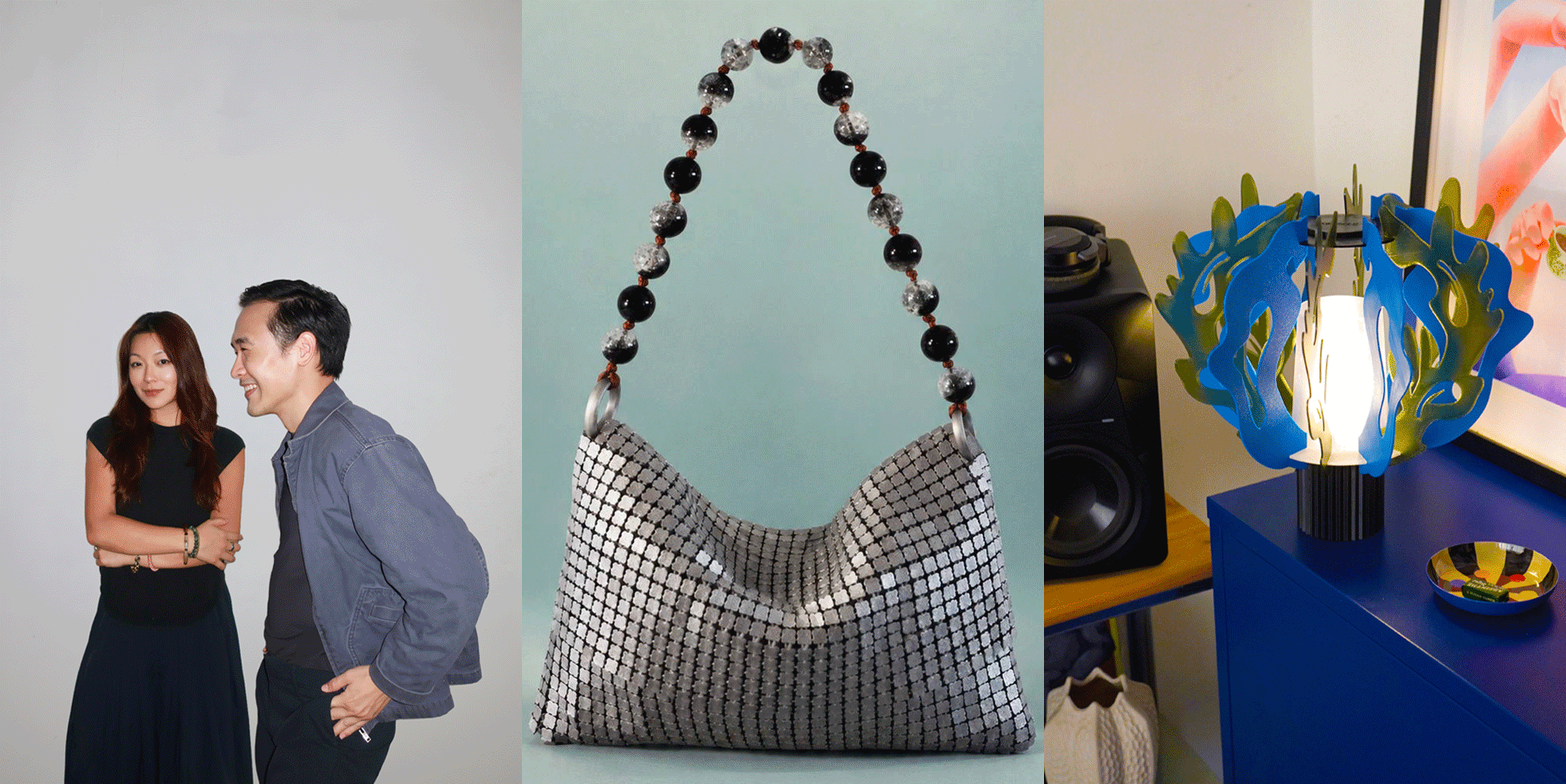
It is a well-worn notion that limitations can set one free. None knows this better than Vessels, a 3D printing design studio that experiments with everyday objects and accessories through a maximalist lens. The brainchild of all-rounder creative Jariel Ann Tan, Vessels was born out of the desire for a one-stop supply chain: the ability to create objects with more immediacy in the process.
Getting a 3D printer made that possible. Ideas sparked in the morning could come to fruition by the afternoon. Tan was fascinated, experimenting with vases and one-off lamps as a hobby. Vessels eventually established itself as a design studio when Tan’s longtime friend Vincent Loh joined as a creative partner. The energy of the practice shifted, as the duo came together to exchange ideas on pushing the boundaries of 3D printing and designing.
“Some of our best ideas have come from things not working exactly as planned.”
As an independent studio centred on 3D printing, trial and error has become an integral part of their day-to-day work. Eliminating the distance of a traditional manufacturer meant the logistics of running a business fell entirely into their hands. The 3D printing process itself leaves much room for experimentation and imperfection, creating opportunities to try and try again.
The infinite possibilities of a 3D printer ultimately led to modularity as a vital part of Vessels’s designs. Tan’s one-off lamps eventually evolved into the studio’s signature Hold Onto This mood lamp series, where each component can be swapped, customised and reinterpreted. Here, modularity gave the owner of the object a sense of autonomy on what it could become.
Technique aside, the duo lean into maximalism visually. “If something looks slightly out of place, we feel like we’re doing something right. There’s something much more fun about an object having a bit of weirdness or personality,” Tan comments. This is undoubtedly seen in their newest collection State of Play. Consisting of the Kuti Kuti animal phone grip and Nokia 3310 lighter holder, the release is rooted in childhood nostalgia and dressed in vivid hues of pinks and purples.
Below, Vogue Singapore speaks to the duo on their biggest takeaways, inspirations and how their creative worlds converge at Vessels.
View this post on Instagram
What made you take the leap of turning a hobby into a studio, and what were some of the initial challenges?
The community has been a big part of why we decided to take it more seriously. Beyond the pop-up events, we’ve been lucky to be approached by local businesses and creative practices that we’ve admired for a long time asking if we could collaborate. Having people whose work we respect trust us with their projects gave conviction that there was something worth building.
These pop-ups also let us meet the people buying our things. Some tell us a particular object reminds them of their childhood; others buy a piece for someone because it meant something to them. That’s when we realised the same object could mean completely different things to different people, and that personal connection is what kept us going.
There was also the less romantic side of turning a hobby into a studio practice: money was tight in the beginning, so we had to be resourceful. We wanted to avoid going through a traditional manufacturer because we love the immediacy of 3D printing—we can have an idea, make it, change it and make it again. But eliminating the distance made us the manufacturer. We do everything: print, assemble, finish, pack orders, fulfil them, handle marketing, product shoots, DMs…we’ve become a Swiss Army knife of skills. Trying to balance the creative side with operations is definitely challenging but it has also taught us a lot. Being resourceful and adaptable has become just as important to us as the idea itself.

What inspires you to create?
We go outside. We talk to people. We touch things. Most of our best ideas have come from wandering, conversations and from paying attention to the world around us rather than refreshing a Pinterest board. That curiosity shows up in the work, and we think people can feel the difference. A lot of what inspires us is the concept behind an object rather than the object itself: why it exists, how it came to be, what experience it was designed around, etc. We look at everyday things and wonder what they could be from a completely different angle. That wondering is where most of Vessels starts.
We’re also deeply inspired by people’s memories. The collections we’ve made have grown out of conversations about childhood, feelings, and objects that stuck around in someone’s life, and why. There’s something in designing for emotional experience rather than pure function that keeps us excited to make things. When someone picks up one of our objects and thinks “this reminds me of something,” that’s the whole point. What ties everything together is intentionality. We try to design from the customer’s perspective—always asking how an object can make someone’s life a little better, more considered and ‘theirs’.

How does your background across different disciplines and industries contribute to your current creative process and works?
We come from advertising and fashion. Between us we’ve worked on global and regional campaigns, events, production, education, consultancy, and a handful of other things because they seemed interesting at the time. That restlessness isn’t incidental to Vessels.
Our background in advertising shaped how we think about making things. Vincent is an art director and conceptual thinker who is always searching for the meaning behind an idea. For him, strong creative work starts with understanding why something matters before deciding what form it should take. We used to tell stories through campaigns. Now we tell them through objects. The medium changed but the method didn’t: everything we make at Vessels is trying to communicate something, not just sit on a shelf.
Jariel is what you’d generously call a generalist—someone who just can’t stop trying new things. She’s moved through more industries than most people visit, and it all shows up in the work. It means we can do most things ourselves, figure out the rest quickly, and approach design without the tunnel vision that comes from staying in one lane too long.
Together we’re creative maximalists at heart. We get excited easily, follow curiosity wherever it goes, and make things that reflect that energy. Our audience tends to be people who are the same way: curious, playful, not entirely satisfied with things as they are. We’re not making objects for people who want safe. We’re making them for people who want interesting!

In your eyes, how do the worlds of fashion and design intersect, and how will it continue to evolve?
What’s really interesting right now is how the lines between fashion, product, art, and interiors are dissolving. People are increasingly thinking about what they surround themselves with as part of a cohesive personal expression—not just what they wear, but what sits on their desk, what lights their room or what’s in their pocket. It’s all part of the same conversation about who you are and how you want to move through the world. That’s what excites us at Vessels. Our objects can become part of someone’s personal space and expression in the same way clothing does: chosen deliberately and carried with meaning. And we’re not done with fashion objects either—we’re going back into that space sooner than you think. We’ve already collaborated with knitwear designer Bryan Yeo on a series of purses made from 3D-printed parts and deadstock yarns last year, which felt like a really natural meeting point between what we do and what fashion can be. That’s a direction we want to continue exploring.

What are some takeaways you’ve gained since delving into 3D design and starting Vessels?
One of the biggest things we’ve learned is that the idea should always come before the technology. 3D printing is simply a medium for us to bring a strong concept to life. It has developed a reputation for affordably producing replicated objects, but it also allows us to create forms and structures that might be difficult or limiting to create through other processes.
Starting Vessels has also taught us to be resourceful and make the most of what we have, especially as a small independent studio. We’ve had to figure things out ourselves and that’s become an important part of how we work. Hailing from a design background, we’ve learned to embrace experimentation and trial and error. Iteration is inherently part of the process. The immediacy of 3D printing doesn’t necessarily mean getting to the final design faster. It also means having more opportunities to try something, change it, scrap it and try again. Some of our best ideas have come from things not working exactly as planned.
“Our objects can become part of someone’s personal space and expression in the same way clothing does: chosen deliberately and carried with meaning.”
We’ve also learned to listen to our community and pay attention to how people use our objects. Something we initially designed as a planter might end up being used as a wine chiller or a desk bin in someone’s home. We really enjoy that. Once an object leaves the studio, people interpret it in ways we never anticipated, and that often influences what we want to make next. Coming from advertising, we’ve also learned how different it is to communicate an idea through a physical object compared to than a screen or campaign. An object has to exist in the real world—you can’t art direct someone’s interaction with it.
Most importantly, Vessels has taught us to design with more intention, to think about why an object needs to exist in the first place, how someone might interact with it, and whether it can add to their everyday life. We don’t want to make something just because we can. The technology makes it possible, but the idea is what makes it worth making.

What’s in store for the future?
There are a few directions we’re really excited to explore. We’d love to grow regionally and see how our work might resonate with audiences outside Singapore, whether that’s through partnerships, pop-ups or working with other creatives across the region. We’re also very open to collaborations: some of the most interesting things we’ve made have come from working with people who approach materials and ideas very differently from us.
We’re also interested in pushing 3D printing beyond being used on its own. We want to experiment with combining 3D-printed components with different materials and techniques, and explore how that can make our objects more tactile, durable and considered. Sustainability is part of that conversation for us too, not just in the material itself, but about how things are made, repaired, adapted and kept for longer.
Most importantly, we want people to experience Vessels in real life. We’ll be doing more pop-ups and physical retail, with Boutiques Singapore coming up in November, which we’re very excited about. We’re also being stocked at a few consignment stores. There’s only so much you can understand about a 3D-printed object through a screen—we want people to be able to pick things up, touch them, play with the different parts and see how they work in person. Vessels is still very young, and that’s something we quite like about it: there’s still a lot of room to play.
Discover Vessels here.