When Jaguar unveiled its E-type in 1961, Enzo Ferrari called it “the most beautiful car in the world”. It was perhaps providence, for the legacy which the luxury British marque would go on to leave behind.
It is not so much a specific look and feel that Jaguar subscribes to. Instead, as Carlee Hardaker, the marketing and communications director of Jaguar will have me know, it is the spirit of reinvention that sits at the core of the brand’s DNA. That mindset—to completely chart its own road – is the only thing that foretells its next move.
Championing originality is one thing, but Jaguar’s approach is irreverent. “It’s about being defiant,” Hardaker tells me. No room for compromise, Jaguar might even say.

So to rewrite the codes for a new era, Jaguar drew the first line. The desired visual language roared to be heard, demanding resonance from the science that initially refused its hand. But the focus was razor-sharp. The next Jaguar that would come to be would be a thing of its own. It would, in every essence of its being, copy nothing.
So the Jaguar Type 01 arrives, with a verve like none other. The low roofline and long bonnet sit on the shoulders of the powerful Jaguar Electric Architecture—a dedicated platform that gives way to a novel approach for design and resists common proportions. It drives like a Jaguar, packed with deep reserves of power worth a thousand horses. Its most aerodynamic model yet, the luxury grand tourer stands as the most technologically advanced Jaguar ever made; the engineering fine-tuned to suit the original design first proposed—the first line drawn.
And it does not arrive unnoticed. Its first moment of celebration came in October, when the car drove through Manhattan at night before arriving at Storied, a creative enclave in West Chelsea. With the city flashing past, the Type 01 appeared like a mystery waiting to be discovered by the people who resonated with its vision. “Our target customer is very much defined by a mindset, not a demographic. We need a new customer base, but we don’t need everyone to like it,” Hardaker boldly claims.
To put it all into perspective, she continues: “We don’t need everybody to love and feel connected to the car. But we do need some people to really, truly desire it.”

Desire, connection, power. Elements which can only take root when one has shaped and built a new world order. True enough, its fierce bonnet and sleek design dare to be different from what is expected of the marque that once produced the E-type.
The Type 01 held the attention of everyone in the room, no matter who stepped in. New York Knicks player Karl-Anthony Towns and his wife Jordyn Woods spent date night at Jaguar’s buzzy launch evening. Sienna Spiro took control of the microphone for a near-closing act – her voice remaining irresistible throughout.
And as for Florence Pugh? The English actress arrived with aplomb, slipping seamlessly into her latest role as the inaugural brand ambassador for Jaguar. It’s been such a banner year for Pugh that this role feels like kismet. Like the British marque – embarking on a new era – the actress has made considerable moves in her acting career with a series of compelling roles. At press time, Pugh’s latest performance as Cathy Ames in the sprawling historical drama East of Eden has garnered critical acclaim for the psychological duality she portrays on screen. Soon enough, the world will see her reprise her role as Princess Irulan in Denis Villeneuve’s epic Dune: Part Three. As Hardaker puts it: “She has a way of reinventing herself for these different roles.”
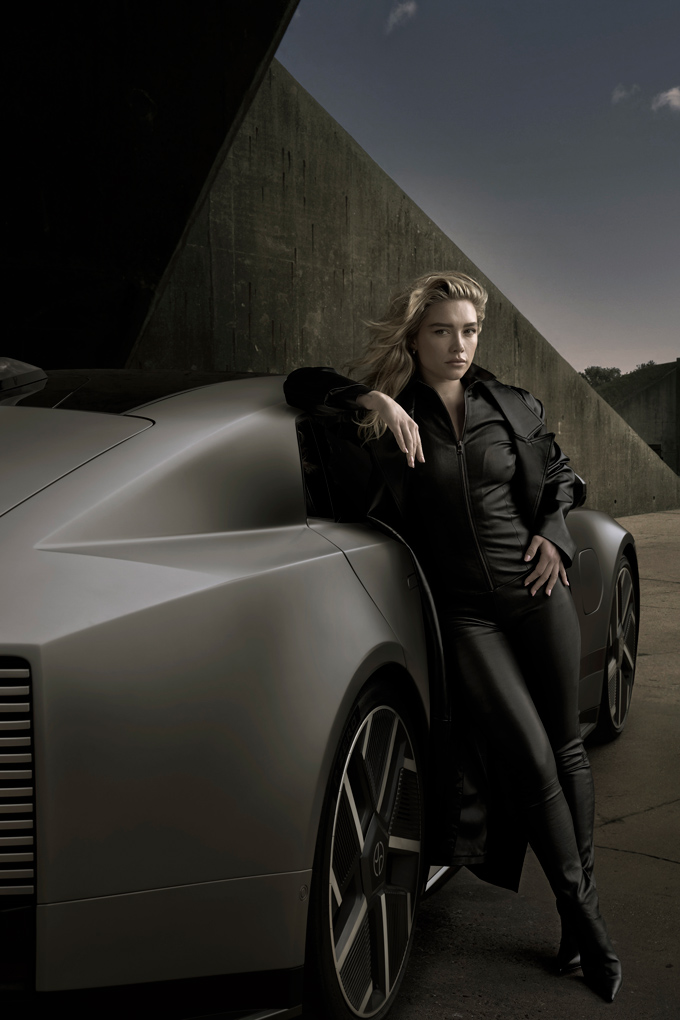
Working with Pugh, however, was just part of the fuller narrative. Jaguar wanted to design a moment that would truly become its own. So Pugh met Jaguar, and together, they met the prolific photographer, Annie Leibovitz.
“Florence Pugh is the face of our new era. Annie Leibovitz is the lens. Together, they capture the fearless creative vision that defines Jaguar today,” Hardaker explains.


Few image-makers are as renowned as Leibovitz; her photographs are known to incite conversation and stir up emotion from within. Likewise, it was an opportune moment for Jaguar to be recast in a different light. If anyone could view Type 01 as a character of its own – rather than a mere accessory to a human subject – it would be Leibovitz. “It just felt completely right. Looking at the kind of portrait photography she’s done and how she’s constantly reinvented herself to keep up with the times – it’s synonymous with what we’re doing,” Hardaker adds.
Leibovitz says: “What interested me most about this portrait series was photographing two extraordinary and contrasting subjects. Florence brings warmth, presence and humanity, while Type 01 is sculpted, precise and striking in its form. Rather than treating the car as a backdrop, I wanted to photograph them both with the same curiosity, exploring their relationship as two distinct characters within the frame.”

The result speaks for itself. Leibovitz captures sleek lines poised against shapely curves, and eyes that draw you in before giving way to unexpected depth. Pugh’s presence is emboldened by a spirit of freedom. In Leibovitz’s lens, she and the Type 01 have the world before them and an uncharted journey awaits them both.