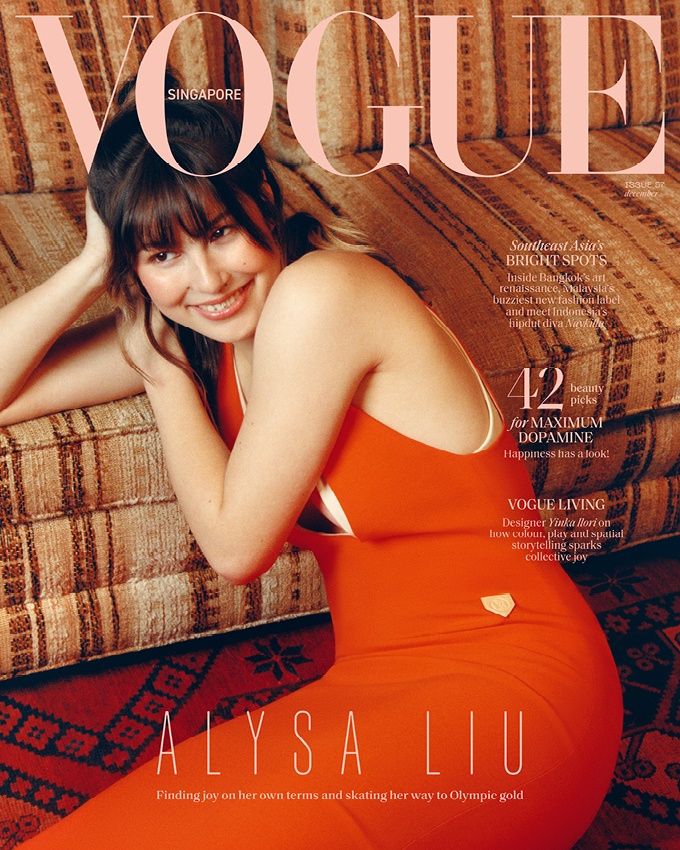
Alysa Liu holds many records. At just 12, she became the youngest female figure skater in history to land a triple Axel at an international competition. The technically demanding jump requires three-and-a-half rotations in the air. At 13, she became the youngest woman to win the US Figure Skating Championships. At 14, she became the first American woman to land a quadruple Lutz in an international competition and won gold at two Junior Grand Prix events. By all accounts, Liu was a figure skating prodigy.
Then, at just 16, she made what she calls the best decision of her life to date: she quit.
“It didn’t take that much guts to do it, I was already at my breaking point,” Liu says of the life-altering choice that would change the course of her entire career.
It is midday when Liu, the 21-year-old figure skater, dials in for our call from her home in Oakland, California. She appears on screen with a broad smile, her signature halo-striped hairstyle impossible to miss. I catch the ease of a young woman who’s come into her own. She seems comfortable and at peace with the life she’s designed for herself. Happy, even.
It’s difficult to believe that this is the same girl who just four years ago was driven to the brink—to the point where she had forgotten all the reasons she loved figure skating in the first place.“I was doing a job that I had lost love for purely to make the people around me happy, whether it was my coaches or my parents.” Liu was facing immense pressure to perform. She placed sixth at the 2022 Winter Olympics in Beijing and fell short of the podium. “It had been festering in me for a long time, and I had been wanting to quit for two years by then,”Liu explains.

The life of an athlete is relentless, defined by gruelling hours of practice on and off the ice. Figure skating, particularly, pushes young women to perform and look a certain way that precludes taking proper care of their pubescent bodies. “I was actively told not to gain muscle because muscles weigh more than fat, and I wouldn’t want to be heavy,”Liu says. Most girls around her age, she adds, leave the sport because of eating disorders and body dysmorphia. During the pandemic, Liu was at her unhappiest. So what if she was destined for the ice? The sport had lost the joy that five-year-old Liu experienced when her father first brought her to the rink.
So she left the only life she knew. She enrolled to study psychology at the University of California, Los Angeles. She swapped her workout clothes for her first pair of jeans. “Up until 16, I didn’t really own a normal wardrobe. I exclusively wore workout attire. When I quit, I realised I actually had to buy some clothes. I was like: ‘Oh my God, I have a pair of jeans! I’m wearing a skirt and a T-shirt’!” she recounts candidly. Compared to a life spent in practice, she now had time to explore new hobbies and hang out with her friends. She was even perhaps reclaiming the childhood she never had.
In 2024, a pivotal ski trip to Lake Tahoe with her friends would set her on an unexpected path back to the ice. Out in the mountains, she relished speeding down the slopes.“You’re cold, your legs hurt, you’re going super-fast—so I fell in love with skiing too,” she says. It was undoubtedly a moment of euphoria for this adrenaline junkie, but there was something missing. “The mountains are really far and inaccessible, and I’m thinking ‘there aren’t that many artistic elements in skiing’.” It makes sense for Liu, who has a creative spirit at her core. She even thinks she loves dancing more than anything else in the world.

So it clicked. “Maybe I should try figure skating again and see if I like it,” she recounts with a sheepish smile.
“Quitting was easy, but coming back? Coming back to figure skating was a very hard decision. I needed a lot of guts for that,” she says, taking a deep breath. This, after all, would be Liu’s second act and the stakes were higher returning to the sport that had been the source of so much tumult when she was younger. If she was going back on the ice, however, she was going to do things differently.
She gathered a team that would support her creative choices: her skate programme, her music, her costumes. Above all, listening to her body. When she discussed her comeback in an interview with Olympics.com this year, she said that she would skate more if she felt like she could, and less if she felt like it was too intense. And nobody could tell her what she could or could not eat.
What has been most apparent about Liu’s return is how healthy and radiant she looks on the ice. With maturity comes a better understanding of what her body is capable of and how far she can push it. “You don’t have to look a certain way to be an athlete,” she says, “but there are so many coaches who don’t even know this and feed young kids or students the wrong information about nutrition and body composition.”
Landing a single jump on the ice requires three key elements: strength, power and balance. Her first step was regaining the muscle that she lost during time away from the ice. “Muscles are the one way we stay healthy and strong in such a rigorous sport, otherwise we’re going to get injured.” This was especially important for Liu, for whom the triple Axel is a signature. Thankfully, she had maintained her flexibility even in her two years away. “I stretched every day when I wasn’t figure skating because my dream is to be able to do the splits even when I’m super old,” she says.

It was also about getting back in the competitive momentum. The figure skating season runs from September to March, so Liu worked with her trainer to get her strength up to peak by the end. “I might not be as good in the first half of the season, but it’s very intentional in that way,” she explains. “We have a slow upwards trajectory before we plateau for a bit, and then by maybe January or February, it rises to the point I want to reach.”
In 2024, the same year she chose to return, she clinched her first gold since her comeback at the CS Budapest Trophy in October. She followed this with another victory at the 2025 WorldFigure Skating Championships in Boston, before claiming gold again at the ISU Grand Prix Final in Nagoya. Then came February 2026 and the Olympic Winter Games Milano Cortina.
Liu hit the rink in Milan to Donna Summer’s ‘MacArthurPark Suite’ for the women’s singles event. For four spectacular minutes on the ice, she held the world’s gaze. “I was just really excited. I really liked my programme and I really liked my dress—it was specifically created for the Olympics so I was really excited for everyone to see it,” she says. I remember the casual ease with which she flew across the ice, and that moment in the choreography when she slid across on her knees and threw her arms wide open—it almost seemed instinctual. The high energy was palpable, and right after completing her skate she jumped for joy right into her coaches’ arms.
Back at the top of her game, Liu clinched two gold medals for Team USA at the Olympic Winter Games: one in women’s singles and another in the team event.
“I remember a lot about that day,” she says of her historic Olympic triumph, “but it was the performance that was the most memorable. Being alone out there on the ice is like no other feeling.There’s no other experience that I would compare it to. The energy in the arena was really good and I will forever remember that.”
Liu won gold with her skate to Summer, but it was her exuberant programme later at the Winter Olympics’ exhibition gala to PinkPantheress’s ‘Stateside’ remix featuring Zara Larsson that went viral online. Although vocal music has been permitted in singles and pairs figure skating programmes since the 2014-2015 season, classical compositions remain a familiar choice among competitive skaters. Liu’s choice to reject the musical norms of figure skating by choosing a pop hit catapulted her to viral popularity. “I love moving my body and I think songs really tell you how to move,” she says.

Her vision is the name of the game now. Liu tells me that she’s an avid lover of manga and anime, and a fan of mangaka Ai Yazawa. Much of Liu’s personal style and her figure skating costumes have been influenced by works like Nana or Paradise Kiss. “I love fashion in anime and in figure skating costumes. I just think they’re so pretty,” she quips.
The shimmering navy outfit she wore for the Exhibition Gala, she tells me, was heavily inspired by Puella Magi Madoka Magica. “Puffy shoulders, tutu-esque skirts. I wanted to take those aspects and put them into a dress at the Olympics.”
Her newfound fame has also allowed her to explore new facets of the fashion world. Liu was invited to attend her first fashion show with Louis Vuitton in Paris, and she is now a proud ambassador of the house. Excited by this new world, she recalls:“I’ve always been into fashion, but to witness it like this in person was such a different experience altogether that has only made me more interested.”
As we chat about the sporting industry, her wish is that more girls—like her—would be able to take up and stay in the sports they love. “With the visibility and coverage we got at the past Olympics, I think women’s sports are going to be so much more popular now, which is a hundred percent deserved.” At the 2026 Winter Olympics, American women won 17 medals, compared with 11 won by their male counterparts. “There were so many achievements by women that we could celebrate, and I think it’s super inspiring for girls all over.”
Liu teems with glee and optimism; she even admits this about herself. “I don’t necessarily look at the negatives to people and things. Maybe it’s because I can appreciate so much of life, and of so many artistic mediums. There’s always something to appreciate.” Her positivity, I think, is one of the reasons she’s been able to return to the ice with such grace. Liu is taking a break from competing in the upcoming season, but she plans to and is excited to go back to training soon. “I just have so much fun doing it, and I’ll keep going back to do it.” That’s enough.
Editor-in-chief Desmond Lim
Photographer Vince Aung
Stylist Katie Qian
Local producer May Kielany
Producer David Bay
Director of photography Zach Shea
Movement director Marly Phillips
Lighting director Christian Scutt @christianscutt
First assistant camera Chirag Chopra @xhiloyxir
Hair Anh Co Tran
Make-up Tami El Sombati
Talent Alysa Liu
The December 2026 ‘Happy’ edition of Vogue Singapore fronted by Alysa Liu is available for pre-order online and will be on newsstands in December.