Zara Larsson is everywhere. Case in point: on a Friday night in Singapore, our feeds are flooded with clips from her sunrise sound check for the Today show in New York, where she casually tears through ‘Blue Moon’—the soaring new single from her fifth studio album Midnight Sun—as though it isn’t barely daybreak. The reaction is unanimous. “Imagine having vocals like this at 6am???” TikTok creator @sontvn writes, with thousands more echoing the sentiment.
At the centre of it all is Larsson’s refusal to manufacture perfection. “Ouffff she’s tiiiiired,” she writes in the comments in reference to herself, with the candour of a friend texting a group chat. Paired with her real admission of a 16-hour daily screen time—maybe a lot on paper, familiar in practice—it feels like an honest metric of life. It speaks to something she seems to understand instinctively: modern pop stardom is as much about proximity as it is performance. The result is a rare alchemy, fast-rising success met with genuine affection.

And the momentum is undeniable. A Grammy nomination, a Billboard Global 200 number one for ‘Stateside’ and a presence at the Winter Olympics have positioned this as a career resurgence. PinkPantheress’s track ‘Stateside’ featuring Larsson was used at the 2026 Figure Skating Exhibition Gala, performed by American Olympic figure skater Alysa Liu following her gold medal win at Milano Cortina 2026, adding another meaningful flashpoint to its growing run. ‘Midnight Sun’ notched a peak on the Billboard Hot 100, further cementing its global reach. In a world where the parameters of success, fame and visibility are constantly shifting, Larsson is embracing it full throttle.
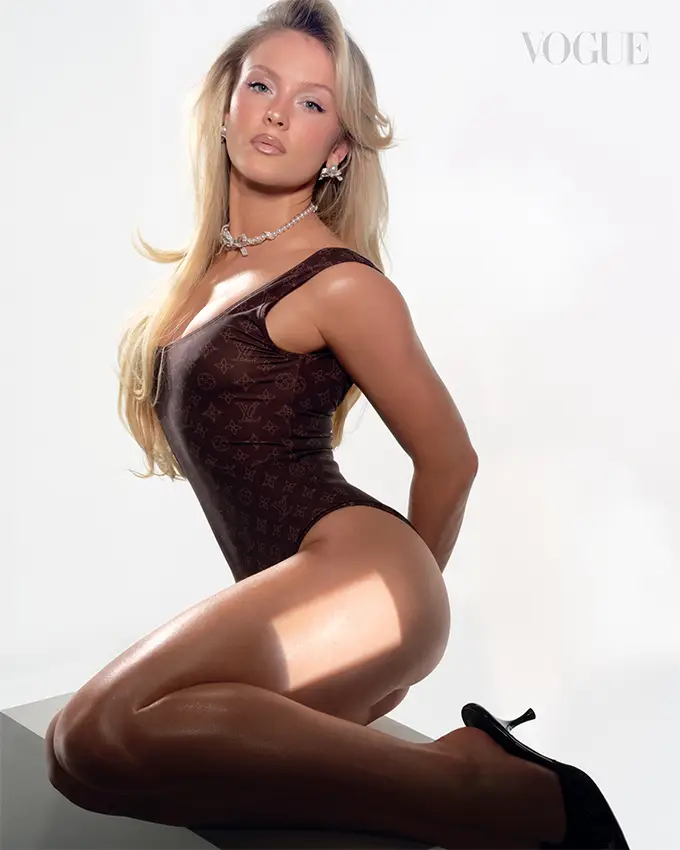
As the dust settles for a bit, she is currently in a retreat in upstate New York, taking time off before things start back up again. “Sometimes I forget that to go hard you have to rest hard,” she says. A glimpse into her day and Larsson—who’s known for being a night owl—is quick to puncture any illusion of stardust. “It’s not as glamorous as people might think. When everyone goes to sleep, my second ‘workday’ starts where I’m listening and commenting on production for the remix album, going through notes for creative decks, looking at merch, basically anything creative that I can do from my computer. When the clock hits 6am, I try to go to sleep. On the US tour, I think I had two days off so most days sort of blended into each other, like I was in a strange magical bubble.”
As of May, her 2026 touring is unfolding as a global run, moving through festival-led chapters across the UK and Norway, alongside major appearances including Lollapalooza. “Performing live is my biggest passion, so it’s been quite emotional and very rewarding. You can look at numbers online, but when a room gets bigger because more people want to come and dance and sing with you, that’s something different. It feels like people are not just listening, they’re rooting for me. I feel very grateful.”

This is nothing new for Larsson, however. At just 10 years old she won Talang, Sweden’s version of Got Talent, in 2008—a clip now circulating on YouTube with a renewed surge of affection. Born in Solna, Stockholm, she attended the Royal Swedish Ballet School and Kulturama.
“It was huge because it gave me proof very early that this dream could be real,” she reflects on Talang. “At 10, you don’t understand the industry, but you understand the feeling of being seen. I think it gave me confidence, but it also made me grow up with this idea that performing was my place. It wasn’t just a hobby, it was very real.”
I ask her about her musical foundations in Sweden, a country with a long historical arc in global pop—one that stretches from the international breakthrough of ABBA in the ’70s, through the late-’80s and ’90s songwriting revolution led by figures like Denniz Pop and Max Martin, whose work helped reshape the grammar of modern chart music. Over time, that lineage has evolved into an embedded pop infrastructure: one that treats melody as craft, songwriting as engineering and emotional clarity as an export language for the global mainstream.

“Sweden has such a strong pop tradition, and I think growing up there definitely shaped my ear for melody. Swedish pop can be very clean, very direct, very emotional without being too complicated. But I also always looked outward. I wanted the big global sound. So I think my music has that Swedish melodic foundation, but with this very ambitious pop-girl energy,” she shares. “As a child, I was determined, obsessed with Lego and dancing in my room, dreaming about being special and listening to Beyoncé mostly. I listened a lot to Carola as well, a Swedish royalty on the music scene. For as long as I can remember, I would pretend I was on stage in a huge arena. I think certain people are just born to entertain, it’s just something that’s in them from birth. I’m definitely one of those people.”
She tells me her personal Mount Rushmore is Beyoncé, Celine Dion, Christina Aguilera and Whitney Houston—names that reflect her grounding in glamour, power, femininity and vocal precision. With more than 18 years in the industry, the 28-year-old still leans into challenges as a creative instinct. Give her a demanding riff, something that takes repetition to land, and she’ll stay with it until it clicks.

tights; Dolce&Gabbana
top; Area shoes. Benjamin Vnuk
She has also had to navigate an industry that can be quick to label as much as it is to listen. At different points, even ‘flop’ has been thrown into the discourse around her. What she has developed in response is a kind of resilience that doesn’t romanticise the highs or collapse under the lows, but keeps moving through both.
Looking at negativity online can seem like par for the course, but it’s something that has derailed many. With the mounting pressure following breakthroughs like ‘Lush Life’ and ‘Never Forget You’ in 2015 and her international debut with So Good in 2017, momentum was widely expected to build in a straight line.
“It taught me that you can’t let strangers define your timeline,” she shares of people who deemed that her career was over. “Pop is brutal because everyone wants to declare something over so quickly. But careers are long if you keep showing up. I had to learn that a quiet season doesn’t mean failure. It can be a rebuilding season, a learning season, a becoming season.”
“I’ve never been able to imagine not doing music. Even when I’m frustrated with the industry, I’m still in love with performing. That love always pulls me back.”
Has she ever wanted to throw in the towel? “Not quit forever, but I’ve definitely had moments where I felt exhausted or discouraged,” she shares. “Moments where I thought, why is this so hard? But deep down, I’ve never been able to imagine not doing music. Even when I’m frustrated with the industry, I’m still in love with performing. That love always pulls me back. I could never not be a singer. I love how it makes me feel in my body. I think one of the reasons why I’m such a happy person is because I have the privilege of having a talent that allows me to fully express my emotions. It’s like screaming out, but in a way that won’t damage your vocal cords as much. Happiness, anger, sadness, whatever I feel, I express it all through my singing. It’s woven into the fabric of who I am as a human being.”
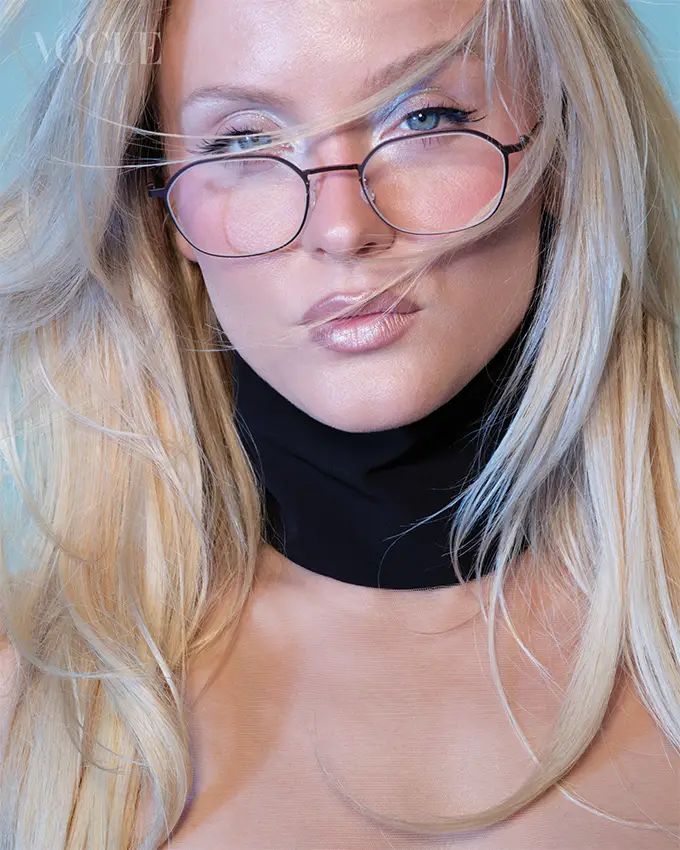
And as for the fans who have been with her throughout this journey? She couldn’t be happier to have them along for the ride. She speaks about them with immense love. “I was walking down the streets of New York City a few days ago and I got so many hugs from people. They were embracing me like an old friend, saying how proud they are of me. They wished for me to have a good day and then they kept going. Some people didn’t even ask for a picture, they just wanted to connect. It felt really beautiful. I think I have a parasocial relationship with my followers as much as they have one with me. I feel so lucky that my fans are funny, smart, protective and chaotic in the best way.”
Now, Larsson is in a different era. A dolphin-symphony meme here, a vision board there—sun, water, movement, mermaids, metallics, glitter, pastels, neon, skin, sweat, glowing orbs—as she puts it. She’s past 13 million daily streams and has become the first Swedish musician to surpass 70 million listeners monthly on Spotify.
While ‘Midnight Sun’ has taken on a life of its own in terms of popularity and virality, her remix album, released in May, brings together an impressively powerful line-up of female artists—from Shakira and Tyla to Robyn and PinkPantheress—an extension, arguably, of Larsson’s longstanding advocacy for women and what her music stands for.

“I felt it in the studio. My senses were tingling,” she says of recording Midnight Sun and its impending resonance. “I think it’s because we were all so fully connected and present when we made that song. Sometimes the songs that feel the most magical in the studio are the ones you have to trust. It sounds pretty much exactly the same as the day we made it. We were really in a flow state, fully locked in.”
As for who else she’d love to collaborate with? “I’m not scared to slide into a DM. Sometimes you have to shoot your shot. I’ll keep the name private for now because I believe in a little manifestation, but she starts with S and ends with ZA.”
With all these iterations and tours unfolding, what matters most to her is how people feel when they leave her shows and when they are out there singing her songs. “Alive. Hot. Free. Like they danced, screamed, flirted with life a little. I want them to leave feeling more confident than when they walked in.” She adds: “To embody something is to actually live it, not just perform it. When I’m on stage, I want to embody confidence, pleasure, movement, femininity, strength. I want people to feel like they can step into their own bodies more fully too. Less shame, more presence.”

This brings me to an important arc of Larsson’s career and presence, which has long been her advocacy. “Having popular songs is amazing, but being part of the conversation is different,” and for Larsson this means being a pivotal force in talking about causes close to her heart, from LGBTQ+ advocacy to reproductive rights.
“I want to stand for freedom, equality and people’s right to live with dignity. I don’t think pop music has to be separate from having values. I’ve been vocal throughout the years on my views on a lot of things, especially women’s rights, and that care truly comes from the love for humanity. The older I get, the less I subscribe to the hateful rhetoric that humans would be inherently bad. I believe the opposite. I say that while still believing that many things need change. I would love to shine a light on issues on my social media while still delivering some sort of escapism through pop music. Sometimes you need to feel happy and recharged to face the darkness of the world. It’s about balance. Joy is also a form of resistance! One of my favourite quotes from Dan Savage says, ‘During the darkest days of the AIDS crisis, we buried our friends in the morning, we protested in the afternoon and we danced all night’ and I think that’s so powerful and necessary to sustain our spirits.”
As she steps into this era of embodiment and new resonance, I’m excited for what comes next. Larsson has always been that girl, but now she feels like she’s arriving at it on her own terms, louder, looser and entirely in motion.
Photography Benjamin Vnuk
Styling Xander Ang
Hair Sonny Molina/Streeters
Make-up Sophia Sinot/The Wall Group
Manicure Mamie Onishi/See Management
Set design Jacob Burstein/MHS Artists
Producer Sam Haywood and ChrisHaney/Art Production
Tech assistant Mark Jayson Quines
Photographer’s assistants Arjay Estanislao and Sangwoo Suh
Stylist’s assistants Jacob Washington, Sabrina Toh and Delphine Schowalter
Hair assistant Dylan Silver
Get your copy of the June ‘Embody’ issue of Vogue Singapore online.