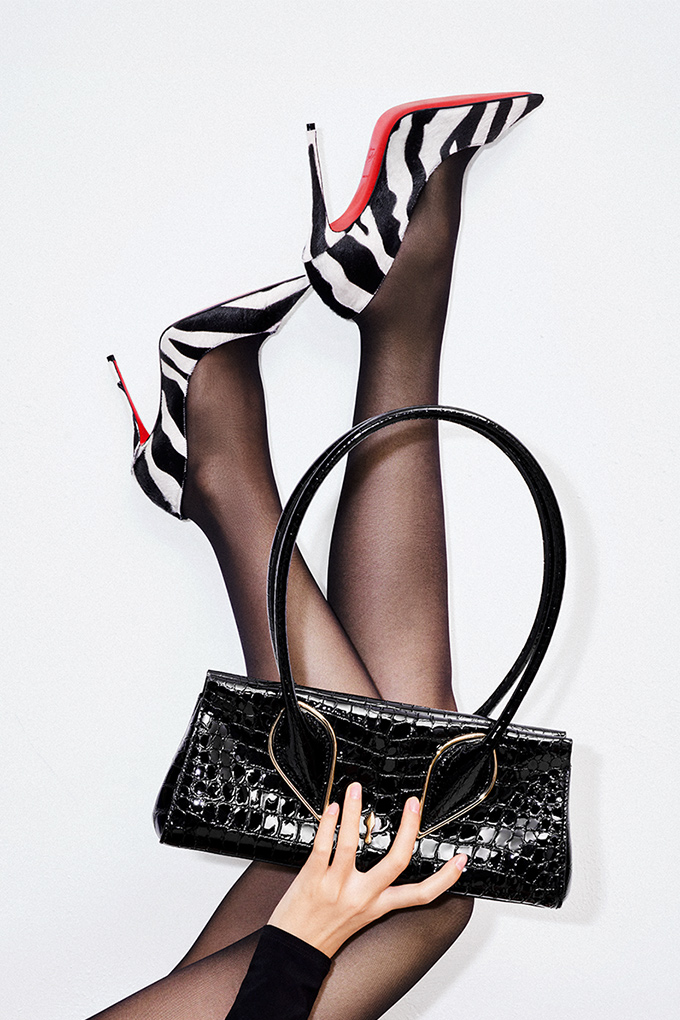
A flash of lacquered red beneath a heel, and one name immediately comes to mind: Christian Louboutin. Few design signatures in fashion have acquired quite the cultural currency of the iconic red sole, and the story of how it came to be is perhaps all the more fascinating for its simplicity. In the early ’90s, while working on a prototype of his Pensée shoe inspired by Andy Warhol’s floral artworks, the designer felt that something was amiss—the black sole dulled the vibrancy of his original idea. Spotting his assistant painting her nails red, he reached for her bottle of nail polish and painted over the sole. Little did he know that this spontaneous gesture would come to define his namesake maison for decades.

“I never was looking for a trademark. It just happened,” the French visionary recalls as we sit for a chat on the balcony of his suite, taking in the lovely weather and the view of the city—a rather fitting setting, as I’ll soon come to discover. He remembers the famed sole initially serving as a sign of recognition among style mavens, almost as though they belonged to a little club of their own, before it rose to global prominence.
Long before that, however, what fascinated a young Louboutin was how much a shoe could influence the way one moves. As a child, he came across an illustration of a high-heeled shoe on a sign prohibiting stilettos at the Museum of African and Oceanic Art in Paris. It sparked his interest in sketching footwear and, in turn, a fascination with the possibilities of design itself. “Shoes definitely play an important role in body language,” he shares, fascinated by how something he describes as “a small object” could alter the perception of the body and the way one expresses oneself.

His teenage years spent working at the famed Parisian cabaret Folies Bergère further acquainted him with the relationship between footwear and the way women move. Interestingly, when Louboutin sketches today, he never draws the entire body, preferring to focus on the leg: specifically the relationship between the foot and ankle. There isn’t necessarily a particular woman he envisions, either. A design might begin with a single detail, which then dictates whether the shoe eventually takes shape as a heel or a platform. “I don’t have a recipe,” he muses.
Given his early days at the Folies Bergère, it comes as little surprise that Louboutin has a penchant for the theatrical when unveiling collections. During Paris Fashion Week in October, the maison took over the Théâtre du Châtelet for its spring/summer 2027 presentation, Eternal Youth. Drawing from the tale of Snow White, the production starred burlesque performer Dita von Teese, with the signature La Pigalle pump playing a rather pivotal role in the unfolding fairytale. First introduced in 2004, the shoe has since been reimagined with enhanced comfort and a new, more durable Everlasting Red sole.

For all the extravagance of his presentations, the intention behind them is surprisingly simple. “Fashion should be a distraction.” The designer speaks fondly of the fun to be had with fashion and its ability to offer people a moment of respite, describing his shows as “an expression of freedom” and relishing the opportunity to entertain his audience. “It’s really dedicated to pleasure,” he adds.
As our conversation turns to his travels, a longstanding source of inspiration for the maison, it begs the question: what exactly catches Louboutin’s eye when he finds himself in a new city? “One of the first things that I do when I go to a place is observe the architecture,” he remarks. Having last visited Singapore more than a decade ago, the designer was already making mental notes of the changes to the cityscape. Equally enamoured with what he describes as the city’s “lavishness of nature”, he speaks fondly of his recollection of a sprawling park populated by animals. Visiting gardens is high on his list of things to do whenever he’s abroad, and such is his love of nature that he even expresses his wish to bring some seeds home with him, lamenting the restrictions on doing so.
“One of the first things that I do when I go to a place is observe the architecture.”
His fascination with architecture has also led him into the world of hospitality. In 2023, Louboutin opened Vermelho, a 13-room boutique hotel in the Portuguese village of Melides. Its name, quite fittingly, translates to ‘red’ in Portuguese. With its elaborate ceramic detailing and interiors adorned with pieces of art from his personal collection, the hotel offers a glimpse into the creative’s own tastes outside of fashion.
There is a rather lovely symbiosis to the way Louboutin approaches art and design—his appreciation of nature and the intricacies of human movement translate into his footwear, while his fascination with architecture has found an outlet in his hotel venture, in turn affording him a wealth of new references for his work. He speaks of the undertaking as one would a hobby, relishing the liberty that came with pursuing a passion without the pressures of a business objective. It allowed him to approach the project, in his own words, “with pleasure, for sure, and also with a lot of freedom”.

And it is this freedom to indulge in his personal interests that Louboutin so evidently cherishes. For a designer whose name has become synonymous with one of the luxury industry’s most revered trademarks, there is something rather refreshing about his insistence on leaving room for play. After all, it was this very willingness to experiment that gave us the cherished red sole in the first place.