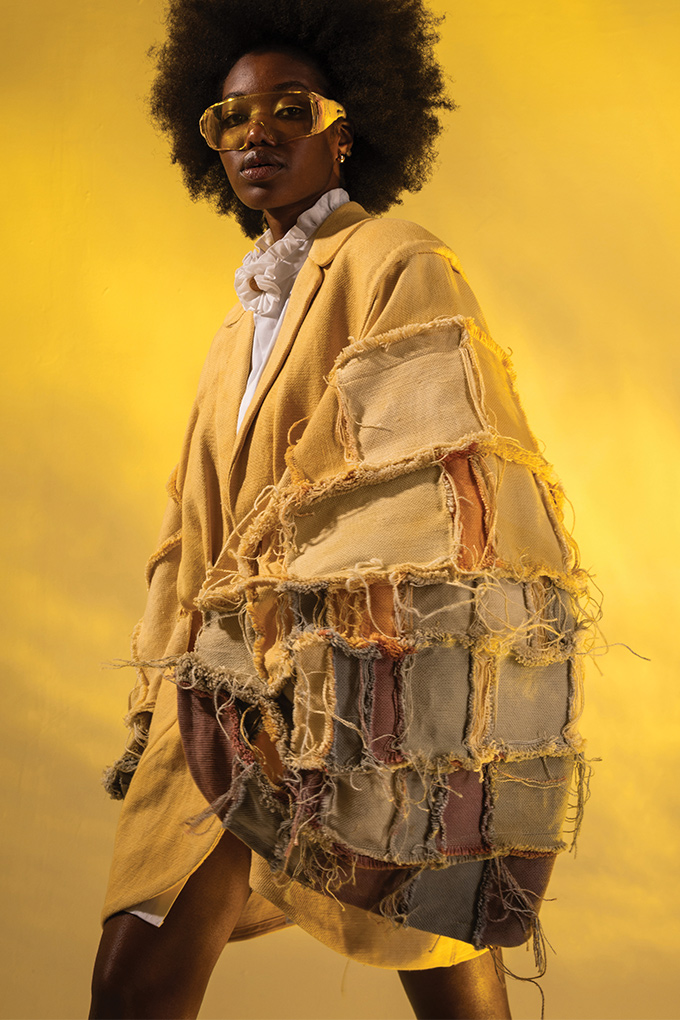
In Kassandra Lim’s world, clothes are something of an experiment, with each creation treated as a ‘specimen’ and the designer herself taking on the role of ‘Elkhemist’. The Singaporean designer, who also works as an architect, describes El Khemie as an imaginary world that has grown out of her relationship with the city she calls home. It is both an escape from Singapore and an affectionate portrait of it, inspired by a tropical city where artificial light so often outshines the sun.
Before turning to fashion, Lim trained as an architect and worked in filmmaking, two disciplines that taught her to build whole worlds and tell stories. Fashion, in turn, gave those stories somewhere to live and her final-year project played out like a small performance, marking the first time she had seen the Elkhemist come to life through an actual person.

Much of her experimentation today involves natural dyes, whose unpredictable hues depend on what she can coax out of familiar ingredients, and she is equally curious about the shapes a piece of clothing might take on the body. She approaches El Khemie as a laboratory, allowing herself to explore whatever has caught her interest, however peculiar the initial idea might seem.
For all its fanciful language, El Khemie keeps its feet firmly on the ground when it comes to the realities of working life. Lim has described the practice as an “anti-corporate meditation”, a way of thinking through the expectations she encounters as an architect without dismissing a profession she genuinely enjoys. She calls the impulse behind it “gentle rebellion”, finding in fashion a way to break free from prescribed structures and question the conventions of everyday life. Following her London Fashion Week debut with Department of Nocturnal Affairs, she speaks to Vogue Singapore about the world she is building and what it means to share it with an audience far from home.

What drew you from architecture and filmmaking into fashion?
Architecture gave me the most liberal wings for world-building. Filmmaking nurtured my instinct and language for storytelling. Fashion gave me the body for stories to inhabit—something that carries personality close to the heart, drapes against the skin and comes alive in movement. For my final-year project, instead of staging a conventional runway, I sat on a stool surrounded closely by the audience, and read from a diary artefact about the Chamomile vessel I had built, while a model in my chamomiledyed Elkhemist Coat slowly circled the space. In that moment, the Elkhemist stopped being just a character on screen or on paper, and came to life through the body.
Tell us about El Khemie as a fashion laboratory.
El Khemie is experimental and I am the Elkhemist who is obsessed with deconstructing norms, reconstructing soft structures, working with the body and brewing colours. I hesitate to call these outcomes ‘clothing’. Perhaps they are more like specimens? Each carrying a hypothesis, a process and a little evidence of the world of El Khemie.
What are you rebelling against through your ‘anti-corporate meditation’?
Gentle rebellion! Against the physical confines of the office, the endless routines of working life, the prim-and-proper codes of business attire. But the more important word for me is meditation. Anti-corporate isn’t about rejecting everything corporate. Do I understand the rules of that world? Yes, and I have no issue functioning within them. But I can also acknowledge the tensions they create, make space to sit with them and imagine how things might be otherwise.

Tell us more about your latest collection.
This year’s collection is special because the theatrics of the runway allowed me to interpret meditation as a process that unfolds in time, rather than as a static expression or a finished state. So Department of Nocturnal Affairs was conceived in six acts, following a worker from the exhaustion of the working day into the private freedom of night, and eventually towards an awakening dawn. The familiar navy pinstripe suit begins in a state of caffeine intoxication, with raw coffee residues seemingly purged from the body. Black tea offers respite, chamomile introduces calm and butterfly pea brings a sense of fascination. Through these successive infusions, the hand-dyed silk organza shifts from dull caffeine brown into illuminating gold, before deepening into botanical greens and earthen shadows, until the corporate uniform gradually dissolves into an abstracted dawnscape. For me, the night is that brief territory where duty recedes and imagination is allowed to wander a little further.
What was it like preparing for your London Fashion Week debut?
Honestly, always racing against time. The process was necessarily slow because every material layered into the navy corporate suits received its colour through repeated natural dye cycles. Most nights, I was working out of the kitchen and bathroom of my parents’ HDB flat, planning dye experiments around my work schedule. Natural dyeing has its own clock and you have to respect it. You can’t put a pot on, decide you’re tired and go to bed. It’s a bit like simmering soup, except somehow all those ingredients have to make the suits flavourful by show day!

What did it mean to bring your perspective as a Singaporean designer to an international stage?
I want to offer an authentic and intimate glimpse of Singapore beyond the postcard skyline—a city that works, and works very, very hard, but also a city full of possibility when we dare to dream beyond the fluorescent lights. At the same time, bringing El Khemie abroad reminded me that a Singapore designer does not have to be defined only by what is commonly accepted or immediately legible at home. I have always wished that our design scene can hold many different voices, including the peculiar ones. I’m at a point where I need to venture farther to build my community, so it was extremely humbling at London Fashion Week to discover that a voice and aesthetic so personal to me could resonate and even be celebrated somewhere else.
What drew you to natural dyeing and how did it influence this collection?
I probably don’t talk about this enough, but my relationship with colour began with a fairly uncomfortable question: where do the colours we wear actually come from? Years ago, while filming a documentary at a garment factory in India, I witnessed dye effluent being discharged into a polluted river. That image stayed with me. Natural dyeing is an old craft, but I am interested in giving it a new proposition, by using ingredients that already carry meaning and letting time, layering, material and new mindsets shape the final colour palette organically. This collection is shaped by the coffee and tea that came directly from the rituals of working life, not predetermined industrial colours specified through formulas.

Did your background in architecture influence the way you design clothes?
Volumes and voids come from my gut. I see clothing as soft structure, something that works symbiotically with the skeleton and skin rather than simply sitting on top of the body. People were pointing out the way I build shape and space into my clothes before I realised what is in my blood. And it works the other way too. Fashion has made me look at architecture with gentler eyes.
Lastly, what’s next?
This year’s runway collection is only available for rental and customisation. I hope to be able to extend it to a retail capsule next year. But a more exciting longer-term dream is to build my El Khemie laboratory with botanical dye facilities. I am the ultimate Elkhemist—an inspiring working environment is so critical to my creative process.
Vogue Singapore’s November ‘Soft Power Issue’ is now available online and in stores.