When Singaporean designer Danelle Woo founded Aijek in Shanghai in 2010, she was working out of her apartment with a one-year-old son and little formal training in fashion design. Her interest in clothes had begun much earlier, and while working in Hong Kong, she began sketching dresses and travelling to Shenzhen on weekends to have them made by local seamstresses. She soon began designing small collections, eventually building Aijek into a womenswear label known for its feminine silhouettes and lace styles.
After building the brand for almost a decade, Woo stepped away in 2019. During her seven years away, she continued designing in her spare time while spending more time with family and volunteering with communities abroad. A visit to a landfill in Cambodia in 2021, where she encountered families who depended on sorting discarded waste for their livelihoods, would stay with her long after.

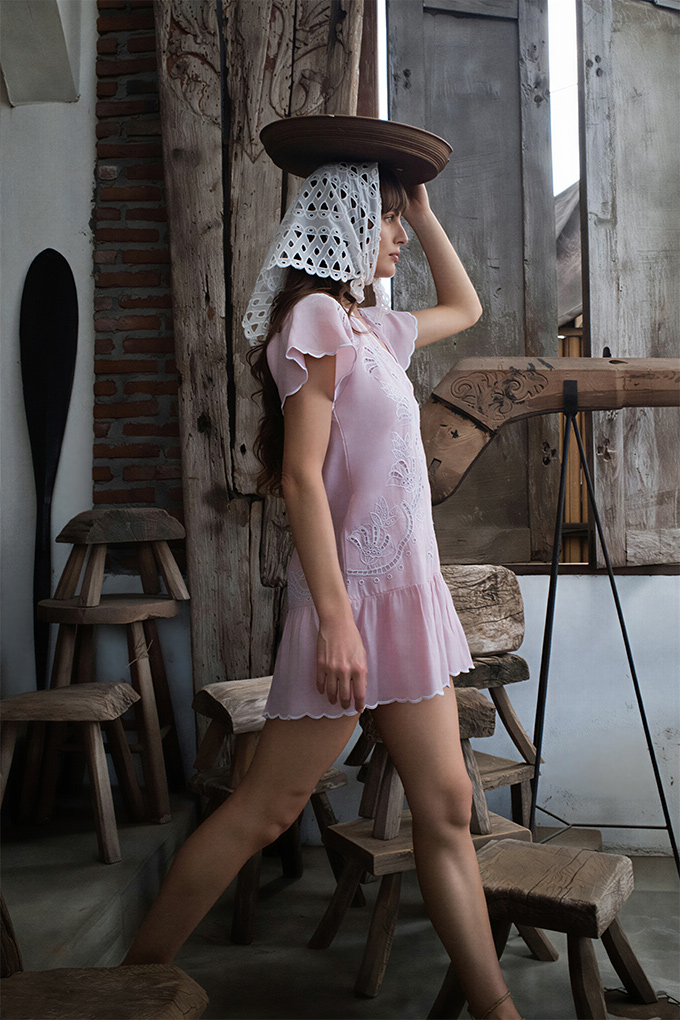
Now, seven years later, Woo has returned with Unfold, her first collection since her departure. It still features the brand’s silhouettes, although much has changed in the way they are made. Working with natural fibres and small family-owned workshops in Bali, she has traded the synthetic lace she once relied on for Kerawang, a traditional cutwork embroidery technique. Across the collection, lotus motifs are embroidered and cut by hand, a reference to the flower’s association with renewal. “If you think about it, it is just a simple A-line dress. Until Kerawang gives it magic,” Woo shares.
Of course, working with artisans also means things take time, something Woo admits she is still getting used to. With each garment requiring hours of handwork, she has also had to cut back on how much she designs and produces. “Two things—restraint and patience,” she says of what the experience has taught her, admitting that the latter has never been her strong suit. Having once set her sights on building Aijek into a global brand, Woo is now focusing on smaller collections and giving each design the time it needs. Below, Vogue Singapore speaks to Woo about her return to fashion, discovering Kerawang and what she has planned for Aijek.

What first drew you to fashion, and how did Aijek begin?
I’ve been around fashion for much of my life. I started working in fashion retail when I was 14, spending many of my school vacations at POIS, a luxury multi-label fashion design retailer in Singapore, where we sold exclusive European high-fashion labels. As a teenager, being surrounded by those clothes made a lasting impression on me. The fabrics, the construction, the way a beautifully made garment could completely change how you felt.
Before Shanghai, I worked in Hong Kong in a marketing role. On weekends, I would bring my amateur drawings and take a train into Shenzhen to get dresses made by local seamstresses. I then sold them online in Australia, where I previously studied and had a good understanding of what the market wanted. When I moved to Shanghai, I continued to do this, except this time hiring freelance models and doing small photoshoots in my rented apartment where I started designing a small collection rather than individual pieces. When my son was born, and without a primary care giver in Shanghai, I left my job to take care of him full-time. I learned very much by doing, sketching, making mistakes, getting garments wrong and trying again. Aijek 1.0 really began from my home studio in Shanghai, with a one-year-old beside me and a lot of trial and error.
After seven years away, what made you feel ready to return to Aijek?
My son is now 18 and independent, and I am much clearer about what I want from this next chapter of my life. For years, I was trying to find a way back to fashion, but I couldn’t reconcile my desire to create with the idea of contributing more waste. About a year and a half ago, I came across research suggesting that natural materials could biodegrade under the right conditions, so I decided to test it for myself. We cut nine pieces of fabric and buried them on my father’s farm for six months. When we dug them up, we found only one piece, which appeared to be the recycled polyester-cotton. Everything else had disintegrated. Of course, without laboratory testing, we can’t say exactly what happened to those fibres or what was released into the soil. But the experiment gave me the confidence to believe that there could be another way of designing.
You visited a landfill in Cambodia in 2021, how did that experience change the way you thought about fashion?
During my seven-year break from Aijek, I spent time volunteering with Color Silk Cambodia, a social enterprise that works with women in rural communities, creating livelihoods through silk weaving while helping to preserve Cambodia’s traditional weaving heritage. While I was there, I visited a landfill and it was a real turning point for me. I had always understood, intellectually, that fashion created waste, but seeing it in front of me was completely different. I walked through the village and met the families who depended on sorting trash as their livelihood, some with health issues, kids not attending school in hope to help their parents earn more income. It made me question my own role as a designer. What was the point of making something beautiful if I wasn’t also thinking about what would happen to it after it left the hands of the person who made it and the person who bought it?
That experience stayed with me throughout my time away from Aijek. I kept thinking about the relationship between beauty and waste, and whether it was possible to create fashion that I could feel comfortable putting into the world. I realised that I couldn’t simply return to the way I had designed before. I needed to rethink the entire process. It also made me realise that perhaps we don’t need to make more things. We need to make things that people value enough to keep.
“What was the point of making something beautiful if I wasn’t also thinking about what would happen to it after it left the hands of the person who made it and the person who bought it?.”
Your comeback collection is titled Unfold—what did you want to explore with it?
With Unfold, I wanted Aijek to feel like a natural evolution, rather than a complete reinvention. The clothes are still feminine, effortless and easy to wear, but the focus has shifted. With Aijek 2.0, I’m much more interested in the story and process behind the clothes, and in creating fewer, more meaningful garments.
We work with natural and regenerative fabrics that have the potential to return to the earth, and there is a much greater emphasis on handwork. The aesthetic is still important to me, but it is no longer the whole story. What matters now is what sits behind the beauty: how something was made, the people involved, the materials we chose, and the impact we leave behind.
The lotus is a recurring motif in the collection, what drew you to its symbolism?
The lotus felt like a very natural symbol for this new chapter of Aijek. It grows from muddy waters, yet rises above the surface to bloom, and I deeply resonated with that idea through my own journey. I was also drawn to the remarkable longevity of the lotus seed. It can remain dormant for more than 1,000 years and, under the right conditions, still grow into a blooming flower. We translated this symbolism onto the fabric through Kerawang, a centuries-old cutwork embroidery technique. It mimics the beauty and intricacy of lace, but is created using natural fibres and traditional craftsmanship. The lotus motifs are cut and embroidered by hand, allowing the pattern to unfold organically across the fabric.
How did you first discover Kerawang embroidery, and what drew you to the technique as a way of reinterpreting Aijek’s signature lace?
I am drawn to embroidery because the process is less straightforward. Like lace, it was delicate and feminine. I was curious to learn about the techniques behind these beautifully created textures made by overlays of threads. My son and I would head to Bali to surf, and the more we went, the more connected I felt to the people, their smiles, the culture and the festivals. I went back the next time alone, and started looking for embroidery factories. They taught me about Kerawang and how it is made, bringing me around their factories and showing me the painstaking processes each garment went through before it landed in my hands. But it wasn’t just the beauty of what they created that drew me in; it was the pride they took in a craft they had spent years mastering and had made their livelihood. That was precious to me, just as much as what they created.

How closely do you work with the Balinese artisans on the Kerawang embroidery?
The process starts with a story. I share the inspiration with the artisan, who then draws the Kerawang motif. For Unfold, the highlight is the lotus motif. I provide hand-sketched ideas and pictures to communicate the silhouette and curvature of the lotus as I envision it. The artisan combines these ideas with his own interpretation, developing the motif further through a Balinese context and representation. We come together to draw, discuss and make changes until the motif is confirmed.
We discuss where the motifs and openwork should be placed, as well as the size, thickness and colours of the embroidery. These details need to be customised to fit the exact placement and proportions of each garment. This collaborative design process is new to me, compared to when I used to design everything myself from start to finish. Now, I think more about the garment from the perspective of providing the artisans with a foundational canva—one that we can build upon with Kerawang to bring the garment to life.
How has working in smaller batches with artisans and family-owned workshops changed your approach to designing for Aijek?
Two things—restraint and patience. Our collaborative work and the time needed for handcrafting mean a longer sampling process, which in turn means I need to design less. We can’t continue producing large collections because the factories simply cannot keep up. Designing less means designing more intentionally—creating pieces that deserve a place in the wardrobe. I edit down more than 100% of my designs, repeatedly, often starting again from scratch. With patience, which has never been my strong suit. As entrepreneurs, we are trained to move quickly. More than anything, I am learning to surrender—to the weather, to the time required for craft, and to the time needed to intentionally communicate with and understand the factories and their challenges, so that we can work alongside one another as a team.
With a greater focus on natural fibres, how do you balance your material choices with the designs you want to create?
I think my starting point has changed. Instead of asking, “What do I want to make?”, I now ask, “What can I make responsibly, and how do I find beauty within those boundaries?” Working with natural fibres does come with limitations in terms of design and construction, but I’ve come to see those limitations as part of the creative process rather than restrictions. Many times I want to create a garment that simply cannot be achieved using natural fibres, and it forces me to think differently and often leads me to more unexpected solutions. There is much more intention behind every decision now, from the fabrics and trims I choose to how a garment is finished. I design with the end in mind, thinking not only about how a piece looks and feels when it is new, but what happens throughout its life and eventually when it is no longer wanted.

What did you want to preserve from the original Aijek, and what were you ready to leave behind?
What I wanted to preserve was the essence of Aijek: timeless, feminine silhouettes, contemporary design, and the thoughtful details in construction and fit that celebrate the feminine form. Lace was also a defining element of Aijek 1.0, so rather than losing that language, we’ve reinterpreted it through intricate handmade Kerawang openwork embroidery. It creates a similar delicacy and intricacy to lace, but is made using natural fibres and plant-based threads.
What I was ready to leave behind was the idea that we have to scale endlessly to be successful. I no longer want to work with synthetic fabrics, unnecessary trims, plastic packaging or harsher processes simply because they are more convenient. We’ve replaced these with natural materials wherever possible, from seashell, coconut husk and wood trims to cotton voile packaging and plant-based threads. We’ve also reduced the number of factories and SKUs we work with so that we can build deeper relationships with the people making our clothes.
Has the woman you design for changed since you first started Aijek?
I think the woman I design for now is more reflective of who I am today. She is design-conscious and curious, with an appreciation for individuality, craftsmanship and thoughtful design rather than simply following trends. She is cosmopolitan and curious about the world, drawn to independent brands, cultural discovery and pieces that have character and a story behind them. Her life moves between work, travel, celebrations and everyday moments, so she wants a wardrobe that can move with her. What matters to her is quality, longevity and versatility. She is happy to invest in fewer, better pieces that feel distinctive but enduring, and she appreciates the details and craftsmanship that give something lasting value. I design for a woman who appreciates beautiful things made with intention, but ultimately wants to make them her own and live in them.
Lastly, what’s next?
In the creative space, I feel like I am just starting out. I am excited to experiment with more colours and different handcrafting techniques, and to bring new forms of expression into future collections. On a personal level, I hope to collaborate with my son, bringing together our shared interests to create a special capsule that merges both of our passions. What I hope my son takes from my journey is that he doesn’t need to know exactly where he is going. I want him to know that it is okay to find his way in his own time, and that believing in himself and having the courage to follow what he genuinely loves can be part of discovering who he wants to become.