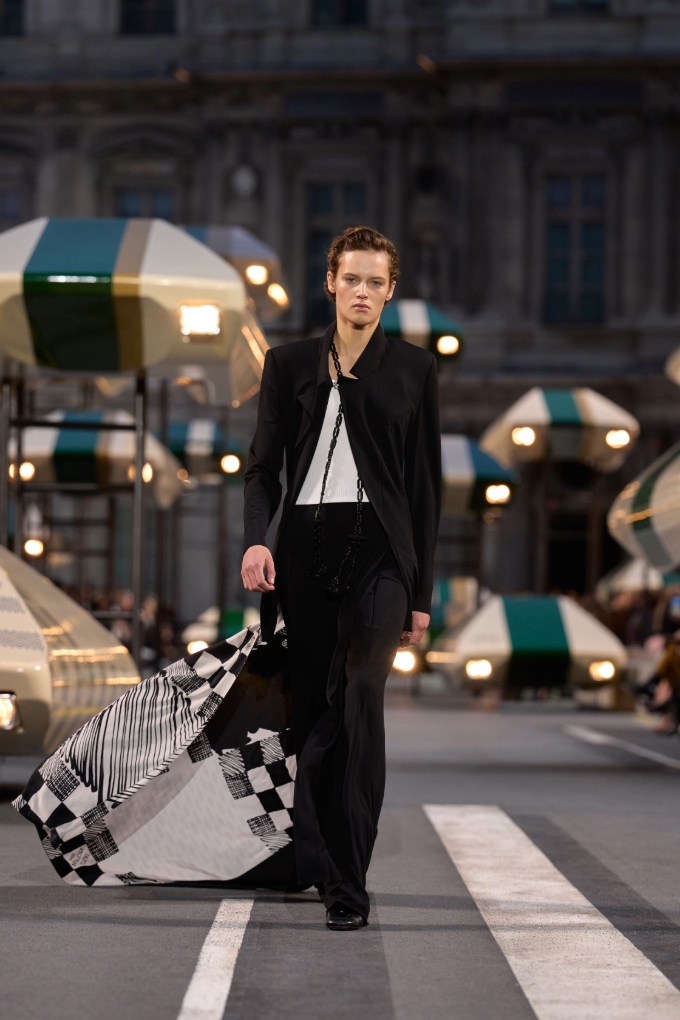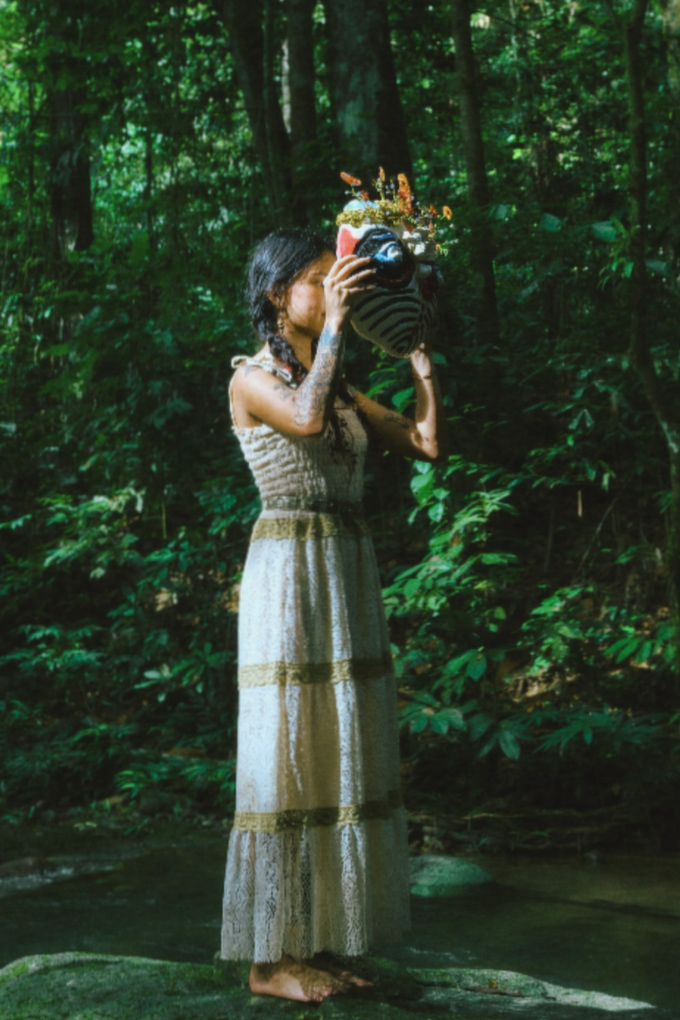
Seeing clothes come down a runway is one thing, but seeing them up close gives a different appreciation for the artisans behind them and the intricacy of their work. Backstage at Huntilanak’s Kuala Lumpur Fashion Week show, the laser-cut feathers, chainmail and songket immediately stirred well-deserved oohs and ahhs. But one piece in particular stood out: a long poem made entirely out of beads, and only up close did it become clear that the whole piece had been painstakingly woven—bead by bead.

Behind this enchanting piece was Sabahan artist Venice Foo, who goes by Chau Xhien online. Beads first entered her work through embroidery, added onto felt alongside other materials before she began experimenting with what they could do on their own. Today, many of her pieces begin as pixel drawings, plotted digitally before she follows them row by row in beads. “The more I worked with it, the more I fell in love with the material because I realised how much potential it had,” she shares.
Growing up around the many craft traditions of Sabah has also shaped the questions she is now asking through her work, particularly around how handmade objects are valued and what separates craft from art. Fresh off Kuala Lumpur Fashion Week in August, Foo rendered songket wholly in beads for Huntilanak, including her largest wearable piece yet: a fully beaded top that she saw on a body for the first time when it came down the runway. Her latest piece recreates the look of ink bleeding into a napkin, continuing her experiments with just how far something as small as a bead can be pushed and what else it might become.

What was your first entry into craft?
The first thing I remember making was origami, especially those little paper stars. That was when I realised I really liked making things with my hands. From then on, most of my free time outside school was spent crafting, drawing or painting. After high school, I tried to make a living from art and started out as a mural painter. I did that for around three or four years before eventually returning to things I had loved since I was young, like sewing and making things by hand. My practice gradually became much more textile-based through embroidery, crochet and eventually beadwork. At the same time, I am also a hand-poke tattoo artist, which is actually my full-time job. When I am not tattooing, I work on my fashion projects and anything related to textiles.
What drew you to beadwork?
It started when I was doing embroidery. I began sewing beads and sequins onto the surface, along with random materials I found interesting. From there, I started experimenting with beads on their own and asking whether I could make something using only beads and thread, without fabric underneath. That was when I began learning bead-weaving. The first thing I made was just a small panel as an experiment. The more I worked with it, the more I fell in love with the material because I realised how much potential it had. A bead is something so small, but if you build enough of them together, it can start becoming almost fabric-like.
What do you enjoy most about its process?
What draws me to slow making is that it slows me down too. When I am not making art, I am someone who is always rushing—I feel uneasy when I am not doing anything. Beading and creating in general help me process my feelings, make sense of my thoughts and slow down. That therapeutic feeling is a big part of what draws me to it.

Take us through your process.
Usually I already have a general direction in mind. Right now, for example, I am working on something that mimics a napkin with writing on it. When you write on a napkin, the ink sinks into the material, so I am trying to recreate that appearance through beads. Once I know what I want the surface to resemble, I choose materials that might give me the right texture once they are grouped together. After that comes all the mathematics. I have to look at the size of the beads and calculate how many I will need to create something at the scale I want. Then I draw everything out. Once the design is mapped out there, I start weaving it row by row.
How would you describe your artistic language?
My work can be quite playful or unserious, but sometimes it deals with feelings that are much heavier. I have always been quite emotional and sensitive. Growing up, art became my outlet. Writing also enters my work quite often. I have a piece based on something I wrote about mourning memories that you cannot keep. The beaded poem I made for Huntilanak was [its founder] Ryan’s writing about his grandmother and her loss of memory. Emotion is still a big part of the direction of my work. Making something gives me a way to process what I am feeling. I might begin with something that feels very heavy, weave it into a large piece and find that by the time I finish, I do not carry that feeling in the same way anymore. There is a sense of relief.

How did your Huntilanak collaboration come about?
One day, I was helping to manage a small art market at my friend’s studio during Peszta, an arts event in Kampung Attap. Ryan suddenly showed up, he came over, said hello and told me he really liked my work and that maybe we could collaborate on something. We stayed connected after that and spoke a few times about different textiles and things he wanted to do. Earlier this year, when he started preparing for Kuala Lumpur Fashion Week, he reached out and basically said, “Venice, we need to start.” He gave me a whole bag of songket scraps and asked me to study them—he asked whether there was a way I could recreate that effect through beads.
I spent around two months working on the pattern digitally before we even got into the weaving process. Normally, I bead entirely with a needle and thread, but because we needed to speed things up for this project, I had to start using a loom. Once the easier sections of weaving were established, Ryan and his interns, Amber and Belle, helped me with different panels. At one point, four of us were constantly weaving the top. I finished the top on the afternoon of the fashion show. The entire thing feels like a fever dream looking back. There was so much happening, and at some points I was genuinely crying while still weaving because it felt like I could never see the end of it. I could not believe how much it looked like fabric. Looking back, it is one of the best projects I have ever worked on.
Lastly, what’s next?
I think what comes next is an extension of what I learnt from working with Ryan and Huntilanak. That collaboration made me realise that beads do not only have to function like pixels. If you choose beads with the right transparency or finish, you can begin to mimic the appearance of another material. Right now, I am working on the napkin piece and trying to recreate the way ink seeps into it using different beads and thread. The line between craft and art has always felt blurry to me. How do we decide what entails artwork? How can I make the time that has gone into something part of the way people understand its value?