There are few pieces of clothing as universally recognised as a pair of blue jeans. What began as hard-wearing clothing for American labourers has become a wardrobe staple, worn by everyone from Hollywood icons to rock stars. Levi’s, the brand that helped start it all, has witnessed much of that evolution. More than 150 years after introducing its first riveted jeans in 1873, the American label remains firmly embedded in fashion and popular culture. Its latest collaboration with Blackpink’s Rosé offers an opportunity to revisit that history, particularly the role women have played in shaping denim as we know it today.

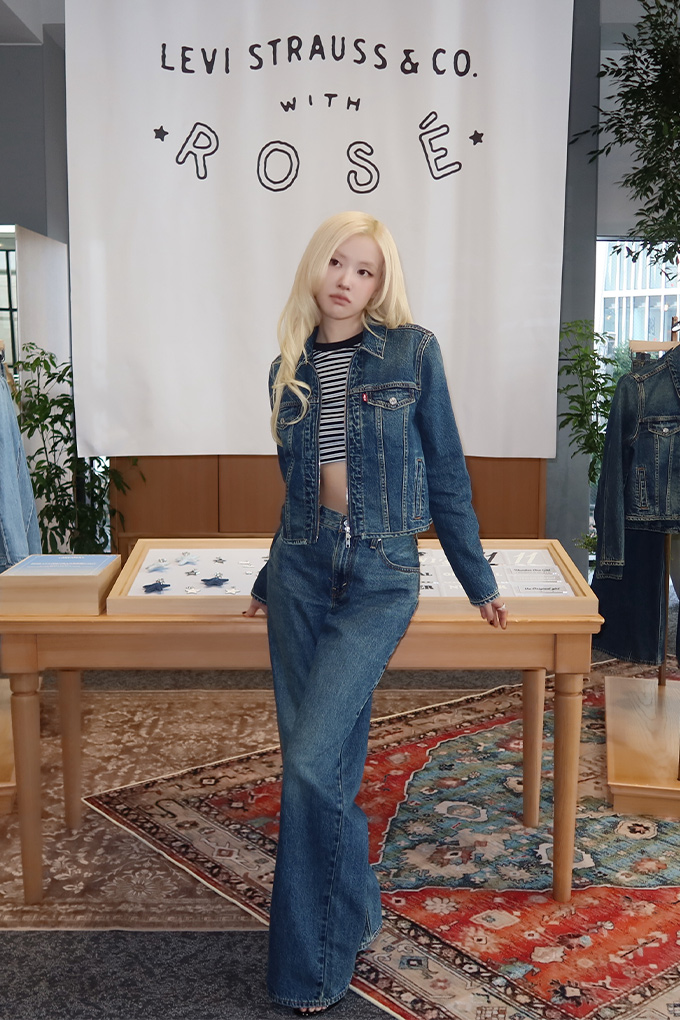
The collaboration made its debut in Tokyo in September, where Rosé attended the launch at Media Department in Shibuya wearing a fitted trucker jacket and relaxed bootcut jeans from the capsule. It was a look that felt entirely in keeping with her personal style, which often favours understated, easy-to-wear pieces. Sometimes, the most convincing celebrity collaborations are not the ones that attempt to introduce something entirely new, but those that build on what someone already wears.
The Tokyo event also offered a closer look at Levi’s history. During a presentation by Levi Strauss & Co. historian Tracey Panek, the conversation turned to the women who helped change the way denim was worn, long before jeans became an everyday fashion essential.

For much of the early 20th century, trousers were still considered unconventional clothing for women. On American ranches, however, practicality often took precedence over convention. Women borrowed men’s jeans because they needed something durable enough for riding and working outdoors. In 1934, Levi’s introduced Lady Levi’s, its first denim trousers designed specifically for women. Just a year later, the jeans appeared in Vogue, signalling how quickly a garment associated with manual labour was finding its way into fashion.
Over the following decades, denim became increasingly associated with independence and changing attitudes towards dress. Jeans found their place in film, music and youth culture, while women began wearing them in ways that had little to do with their original purpose. By 1981, Levi’s had introduced a version of its famous 501 jeans designed for women, further cementing denim’s place in the everyday wardrobe.


What makes this history particularly interesting is that many of these changes began with the people wearing the clothes rather than the brands making them. The women who first borrowed men’s jeans were simply looking for something practical. In the process, they helped establish a garment that would eventually become a defining part of women’s fashion.
Fast-forward to Rosé, whose wardrobe has become a point of reference for a generation of fans. Despite her global celebrity, much of her off-duty style revolves around familiar staples, from simple tops and relaxed outerwear to well-worn denim. It makes her partnership with Levi’s feel like a natural fit, with the collection focusing on two established silhouettes rather than an entirely new wardrobe.


The fitted trucker jacket features a two-way zip and silver hardware, while the loose bootcut jeans offer a more relaxed interpretation of a classic denim shape. Both come in two washes, with a custom label featuring Rosé’s handwriting adding a personal detail to each piece. The proportions feel contemporary without straying too far from the designs that have long defined the brand.
Beyond the clothing, some of the more interesting additions are the smaller accessories. References to Rosé’s music and personal life appear across embroidered keychains, decorative pins and zipper charms, allowing fans to bring something of her world into their own wardrobes. There is also a sense of playfulness to the collection that makes these pieces appealing beyond conventional celebrity merchandise.

In Singapore, the capsule launched exclusively at Levi’s ION Orchard on 18 September. Alongside the jacket and jeans, fans can look out for decorative pins shaped like flowers and stars, including designs bearing the words “The Original Girl”. Zipper charms featuring the Levi’s and Rosé logos offer another way to dress up a favourite jacket, while denim star keychains feature the word “rosie” embroidered on one side and the number 11 on the other, a reference to the singer’s birthday.
There are further references to her music through personalisation designs inspired by “number one girl”, the opening track of her debut solo album. The Singapore launch also included limited-edition collectible merchandise in the form of pin, charm or keychain sets, alongside complimentary heat-press sticker customisation with purchases from the collection, subject to availability. Those who missed the initial launch can enquire at the ION Orchard boutique about remaining styles, accessories and personalisation options.

In many ways, these small details speak to the changing relationship people have with denim. A jacket that might once have been worn for its durability can now become something far more personal, decorated with references to a favourite artist or song. Yet the starting point remains much the same: a familiar piece of clothing that can be worn in countless different ways.
Looking back at Levi’s history, some of its defining moments have been shaped by changes happening outside fashion itself. The women who wore men’s jeans on American ranches were hardly thinking about their place in fashion history, just as the generations who adopted denim in the decades that followed gave it meanings far removed from its working-class origins. Rosé’s collaboration belongs to a very different moment, one where even the smallest details can carry personal significance. It is a reminder that the story of jeans has never really been about the garment alone.
To shop the collection and for more information, visit Levi’s.