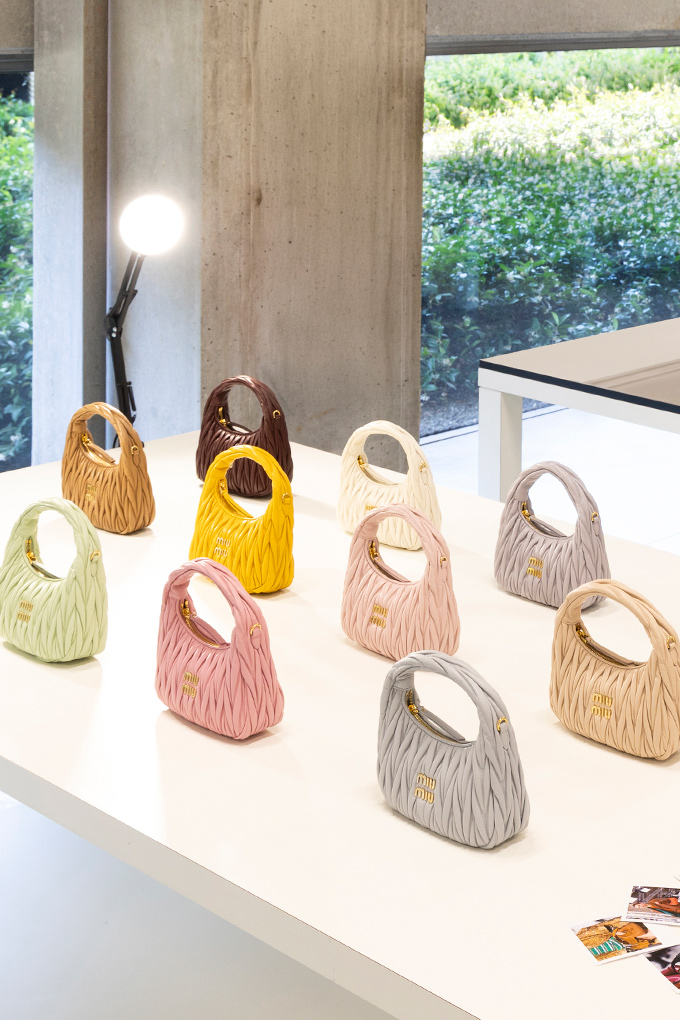
You know a Miu Miu bag when you see one, and much of that comes down to matelassé. First introduced on the autumn/winter 2006 runway, the soft, crinkled leather has become one of the house’s most recognisable signatures. Today, it appears across bags, wallets and smaller leather goods, with its distinctive folds bringing texture and character to each design.
At the Miu Miu and Prada complex in Tuscany, the work behind this familiar finish is revealed. Spanning 30,000 square metres, the site houses an archive of approximately 66,000 leather goods and nearly 80,000 pairs of shoes. It is also where the making of matelassé offers a closer look at the level of precision involved in producing something that appears so relaxed.

The process begins with the selection of leather. Each hide is examined before being cut into panels using digitally developed patterns. Soft nappa is essential, as its flexibility allows the material to gather into the folds that define matelassé. A firmer leather would not respond to the stitching in quite the same way.

The most distinctive stage takes place in the embroidery workshop. Here, a machine fitted with ten embroidery heads stitches through layers of nappa, padding and stretch fabric, all held under tension. Once the stitching is complete, the panels are released, allowing the material to contract and form its characteristic padded surface. This shrinkage is factored into the measurements from the beginning, with each panel cut larger than its finished dimensions.

While the technique was once carried out using hand-drawn patterns and a conventional sewing machine, it has since evolved to incorporate computer-aided design and specialised embroidery equipment. Every bag requires its own quilting pattern, with adjustments made to stitch length, direction and placement according to the silhouette. The technique may be consistent, but its application is far from uniform.
There is just as much work involved in the construction. One bag examined during the visit consisted of 72 separate components, including internal reinforcements that are not visible in the finished piece. The Wander and Arcadie, two of Miu Miu’s best-known designs, also require different approaches. The Wander’s curved silhouette incorporates concealed stitching, while the Arcadie’s more structured shape features piping and sections of smooth leather. Each detail plays a part in determining how the bag sits, moves and holds its form.

What is particularly striking is how little of this work is apparent once the bag is finished. Despite the multiple layers, intricate stitching and careful assembly, matelassé remains light, soft and easy to wear. Its appeal lies as much in how it feels as in how it looks. Behind the familiar folds is a considerable amount of technical knowledge, applied with enough restraint that the finished bag never feels overly constructed. That balance is perhaps what makes matelassé so distinctly Miu Miu.