“Do you know 78% of people who book travel are women?” Jacinta Lim, co-founder of Seek Sophie, tells me. Together with Lina Gedvilaite, the duo established the travel experience platform as a means to tackle issues they faced as ardent travellers—looking for real places that connected them to the local communities. Typical pre-trip research always landed them in the over-commercialised cycle of the same overrated tourist gimmicks that leave an unsettling impression of the destination country. Instead, they were in search of undiscovered gems, meaningful encounters with nature and heartfelt experiences with locals. Soon, they realised they shared the same travel checklist with fellow women too.


Even with a thorough itinerary in hand, women still face the age-old dilemma when embarking on a trip: looking for a travel buddy. The art of traveling with friends is a tough trick to master, and solo travelling is a different ballgame of its own. So where do these women go? On community trips, of course. And on women-only ones too.
While safety and security are a considerable factor for choosing women-only retreats, the main driver is knowing you’re travelling with like-minded people. There are no qualms about the nature or intensity of the trip. Participants all enter with the same state of mind, aware and eager to explore the all-inclusive itinerary that’s been organised by the host. It’s a surefire win; the final step is to pack your bags and go.


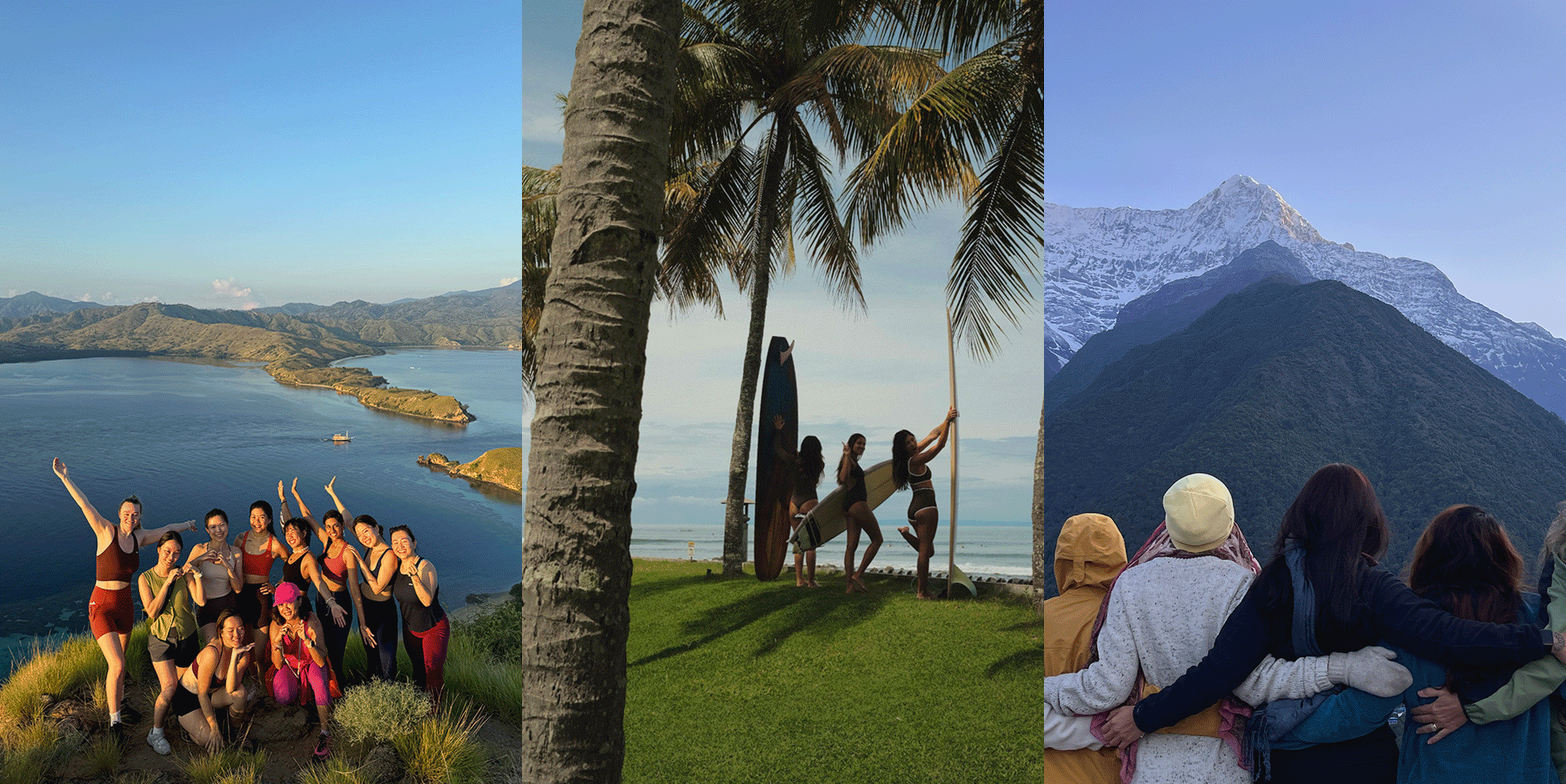
Given a woman’s adventurous and curious nature that drives the travel economy, there’s a women-only community trip for everything under the sun: Seek Sophie hosts culturally steeped trips to Labuan Bajo and Chiangmai that let their guests interact with wildlife ethically and sustainably. Homegrown surfwear brand Haikini’s Beckie Liu organises surfing retreats, as the pro-surfer founder shares her love for the sport with others. Aida Ihsani, on the other hand, uses her own hiking experiences to support other women embarking on their own journey with her multicultural hiking community.
But beyond the logistical benefits of a women-only community trip lies a greater treasure: the power of human connection. There are endless anecdotes by women who return home in high spirits, their horizons broadened and deep bonds fostered with their fellow travelers. Here, Lim, Liu and Aida share their heart, purpose and life-changing takeaways behind the women-only retreats they host.

What led you to initiate women only retreats and travel trips?
Beckie Liu: It was just a fun idea I came up with in addition to running Haikini. I wanted my customers to understand why the brand exists in the first place, and it was all thanks to surfing. I made it solely for women as travelling solo as a female can be challenging. In the past, not many people I knew back home in Singapore surfed so I usually went on surf trips alone. Some trips were great but some were definitely more sketchy—getting sick and lost and not being sure what to do! On my own surf trips I always felt most comfortable and myself when I was surrounded by other women and that gave me the idea of organising women-only trips where it was supportive and, most importantly, safe. Women could learn to surf without any of the usual headaches like figuring out who to go with, where to stay or to go, etc. You can just show up and focus on enjoying yourself and the company. And honestly, I never had a sister growing up; I’ve always wanted one. I think in some way I built myself a whole community of them.
Aida Ihsani: I started climbing after my divorce as a way to rediscover and rebuild myself. Mount Kinabalu was my first climb, followed by Annapurna Base Camp in Nepal, the Mulu Pinnacles in Sarawak and then Mount Rinjani in Indonesia. My first trip was one of those generic open groups where you’re given a checklist and briefing and that was basically it. I was new to this so I did my own research on training and packing, but nobody tells you about the experience on the mountain itself. I thought I was physically prepared but the mountain challenged me mentally, emotionally and spiritually. On that same trip I watched other women struggle with things nobody had warned them about too. Did you know your period is affected by high altitudes? Nobody talks about that! I remember thinking to myself, “I don’t want any woman to have to figure this out the hard way, alone, halfway up a mountain.” So I started a multicultural women’s hiking community and have hiked with nearly 100 women from around the world. I wanted them to feel supported through their journey, sharing insights on training, expectations, and emotional support completely tailored for women. Since then women from Singapore, Belgium, Slovakia, Morocco, India, and all over Malaysia have climbed with me. For me, climbing a mountain was never about how high or how fast you reach the peak. It’s about the whole journey: choosing to climb for yourself, making a commitment to train and letting go on the mountain. I’ve lost count of how many times women asked me “Do you think I can do it?” or “Can I join you to climb too?” in my DMs after I started posting my climbs on Instagram. It came from women who were keen on hiking but had no clue where to start. Some thought they weren’t ‘fit enough’, while others just didn’t know another woman in their circle who was into outdoor adventure. Those DMs really stuck with me because it was never really about hiking—it was about women waiting for someone else to give them permission to try. The real question is whether they thought themselves capable enough to climb a mountain.
Jacinta Lim: We figured it’d be great to bring our community together because we hear from our hosts that Seek Sophie travelers are very different from travelers anywhere else. They’re more open, more curious and a lot kinder. They want to give back to the communities around them. The community trips were a way to see really cool behind-the-scenes things that we’re able to offer them and meet other like-minded people who believe that change in the world can happen.
It turns out 78% of people who book travel are women. Which is crazy because if you think about it, every CEO and founder of travel companies are all male, but the people they’re serving are mainly women. That’s why when we started Seek Sophie, we wondered why there wasn’t any travel company out there that solves our own problems as women travelers, and it’s because they don’t even see it. Travel is very women-led because it’s the women that really care about having the best experience. They’re the ones doing all the research so it makes sense. That’s why we thought it’d be nice to have female-only community trips. We tested one and it sold out within less than an hour. That’s when we realised there was something worthwhile here.

What are the differences you see between a women-only trip and a mixed-gender one?
BL: The main difference is that there is a total lack of ego in an all-female group! I notice everyone takes a lot less time to warm up to each other as compared to a regular group. Nothing feels performative. We bond over girl things, talk about our menstrual cycles, and gossip about our past, present and future. Everyone is open to sharing their life stories too; it’s really nice to learn about their different backgrounds and experiences. I always try to create an accepting space so that everyone can just be themselves and have a fun, relaxing time on the retreat. We encourage each other to make mistakes freely when surfing, especially in my beginner retreats. Let’s all fall together, laugh, and have a good time! I think women have always been naturally in service of others, so when you put a group of us together, the spotlight finally turns back onto ourselves for once.
AI: There’s a distinct feeling of finally being able to let your guard down. The body is instantly at ease when there’s only women around. I’ve heard so many stories from women harassment, getting left behind because they were “too slow,” and feeling uncomfortable to voice their struggles. Many mixed-gender groups are also obsessed with getting to the top and being the fastest. With my groups, I actually tell women to slow down, listen to your body and go at your own pace. We’re so used to hustling and multitasking every single day that slowing down almost feels wrong at first, like we’re doing something bad! But there is no rush on a mountain. Many women have told me they’re scared to join because they’re afraid of being last and slowing the group down. But anyone that climbs with me can take a break without feeling guilty. In life, you’ll wear yourself out trying to catch up with someone else’s pace. On the mountain, you learn that it is not a race.
JL: Bonding happens much faster on a women-only trip. Within the first welcome dinner, people are already best friends, but it takes two to three days for co-ed trips. The things that come up on these trips are amazing; people leave really long essays after about how it changed the way they see the world. Being with the amazing, heartfelt hosts on the trip also inspires people. That’s what really moves them. When you’re with people who care about the same things as you do, it opens you in a completely different way. People talk about their deepest struggles, even crying at the end because these trips open their hearts.

What have been your biggest takeaways from your all female retreats?
BL: That women make everything better, truly. I’m such a girl’s girl, and I’ve had the blessing of hosting some of the most wonderful people I’ve ever met. I feel so grateful that women in Singapore trust me to help them start surfing. One thing I’ve learned is that it’s completely normal for some women to feel more anxious than others in the water. I started bringing girls surfing in my early ’20s, and back then there were times I genuinely didn’t know how to help someone who was struggling with real anxiety out there. I’ve grown a lot as a host now that I’m in my early ’30s. When I get students who feel nervous or scared, I’m much more equipped to help them work through those feelings and still walk away with an encouraging session.
AI: I’ve come to believe any woman can climb with the right training, the right mindset, and the right people around her. I got to witness that with my multicultural women’s community. I’ve watched mums who’d never hiked in their life, plus-size women, women in their ’20s standing next to women in their ’60s going through perimenopause, all on the same mountain. Not because they were the fittest, but because they got to do it together through this community. On the mountain, women are free from society’s labels, stereotypes and judgment. It is then they realise they can do so much more than they, or anyone else, ever gave them credit for. One woman told me before her climb, “I don’t want to just be known as my mother’s daughter.” Even her own family doubted her. She completely changed the way she saw herself once she summited.
JL: It’s very cathartic and energising to be with a group of people who think the same way as you. A lot of the work we do—conservation, protecting the environment, climate change—can be challenging. When you do work like that and believe in a better world it can be quite lonely. With the right people, you feel revitalised. It gives you a whole new lease of life.

What’s something that surprised you on these trips?
BL: The age range of women that come on my surf trips! We’ve had women from as young as 19 to those in their mid-’40s. What surprised me is how naturally everyone steps into the role of a ‘big sister’ when there is a younger person in the group. I expected there to be some awkwardness across a 20-year age gap but there was none. Just last month on our July beginners surf trip, we had a 20-year-old who’d just finished polytechnic, and all the women (including me) were so keen to give her advice on everything from career to romance. We just want to protect our ‘lil’ sis’, that’s really what it comes down to!
AI: How easy it is to make friends as adults. It can be a tricky process the older you get, but I’ve watched these women prove again and again that it can still happen at any stage in life. What gets me every single time is watching total strangers become dear friends even before we reach the top. And it doesn’t stop when the trip ends—they keep travelling and hiking together and showing up for each other’s big moments in life.
JL: What surprises me is the depth they feel. Our community trips usually have people leaving in tears because they’re so moved, and the relationships they’ve formed are so powerful. Months later, the group chats are still super engaged. We’re very intentional with the trips we curate, creating a space for human connection to thrive. For that space to really move people in such a way with the combination of things that have happened and the people they’ve met, it’s like magic that all comes together, and it didn’t just happen for one trip. This is what we see across the board.

How have being a part of these trips changed the way you view womanhood?
BL: Hosting these retreats strengthened something I already believed in. Every time I watch a group of women come together, it reaffirms my belief that society would be so much better if more women were in charge. There’s a different energy when and where women lead; it’s less about ego and more about lifting each other up, and I get to see that play out in real time on every single trip.
AI: Personally, I’m nothing like society’s version of ‘womanhood’. I’m a law graduate who somehow became a self-taught woodworker for ten years and now I climb mountains, which traditionally is very male-dominated. Bringing together women from all walks of life and listening to their stories and life experiences taught me that womanhood is different for every single woman living it. Womanhood was never meant to be one role or one script—it’s the freedom to write your own. Every woman deserves to decide for herself what empowerment looks like, whether that’s being a stay-at-home mum, running a company, climbing mountains, or making art with her hands. On the mountain, beyond reaching the summit, these women reached a part of themselves that was buried deep inside, beneath societal expectations, family obligations and pressures at work. The most powerful thing about being part of the retreat is witnessing their journey inward in rediscovering themselves.
JL: Sometimes it’s easy to see being a woman as a disadvantage, considering we live in such a patriarchal society. What I’ve realised over the years, that’s especially reinforced in these trips, is I’m actually so glad to be a woman. The depth of the relationships that you can have as a female is just incredible. I think the level of support and human connection that you get is really powerful, and that makes me very grateful that I’m a woman. What I also love about these trips is that women aren’t waiting for the right time or for someone to join them. They’re just stepping up to live their lives without anyone’s permission. We are the first generation in history that can do that and I think that’s very cool.

What is the power you see when women come together?
BL: When we lift women up, everyone’s lives get better. I really believe that. It’s not a zero sum game—there’s enough success, joy, and space for all of us. Women can succeed alongside each other without needing to tear anyone else down, and that’s the energy I want every surf trip to run on. We set the tone from day one: it’s never about who can stand up the quickest. Everyone is different, so everyone’s progress is going to look different too, and there’s no reason to feel bad if you’re not where someone else is. During our video analysis sessions, where I go through everyone’s surf clips and show them what to work on, you can really see that mindset in action. When one catches a good wave, the whole group is cheering for her like it’s their own win! It’s the power of celebrating each other instead of comparison.
AI: Every trip has a sharing session, and that’s where I see the power of women coming together as strangers, opening up about things they’ve never said out loud or can’t share with people that have known them all their life. Instead of judgment or someone giving their opinions trying to fix it, they are just met with this quiet strength that builds in that circle, like every woman’s honesty gives the next woman permission to be honest too.

In your eyes, how do your retreats empower women?
BL: For me, it comes down to giving women room to take up space—they can ask as many questions as they want, and make mistakes without being so hard on themselves. We are naturally our own biggest critic, and already have enough to deal with in daily life. I feel that on my surf trips we can make everyone’s lives a bit lighter by creating an environment that is fun, reminding everyone to relax and enjoy their holiday while learning how to surf. I truly believe that surfing changes your life for the better. It completely transformed the way I see the world, and I love watching it do the same for women who come on these trips.
AI: I believe women thrive in a community, but these days women feel more alone than ever. I hope through my retreats, women can come together as a community, and discover themselves through lived and shared experiences. I want women around the world to feel safe enough to challenge themselves to try something new, whether it’s learning a new hands-on skill, climbing a mountain, or going somewhere completely unfamiliar. I have seen through my retreats that just one conversation, one skill or one interaction can empower a woman in so many ways—mentally, emotionally, physically and spiritually. That’s genuinely all it takes sometimes and you don’t get that kind of moment just anywhere.
JL: I think sometimes because we all live in such a patriarchal society, it’s very easy to see being a woman as a disadvantage. What I’ve realised over the years, and I see reinforced in these trips, is actually I’m so glad to be a woman because the power of the relationships that you can have and the depth of the relationships that you can have as a female is just incredible. It’s the level of support and human connection that you get out of that. I think that’s really powerful, and that makes me very grateful that I’m a woman.