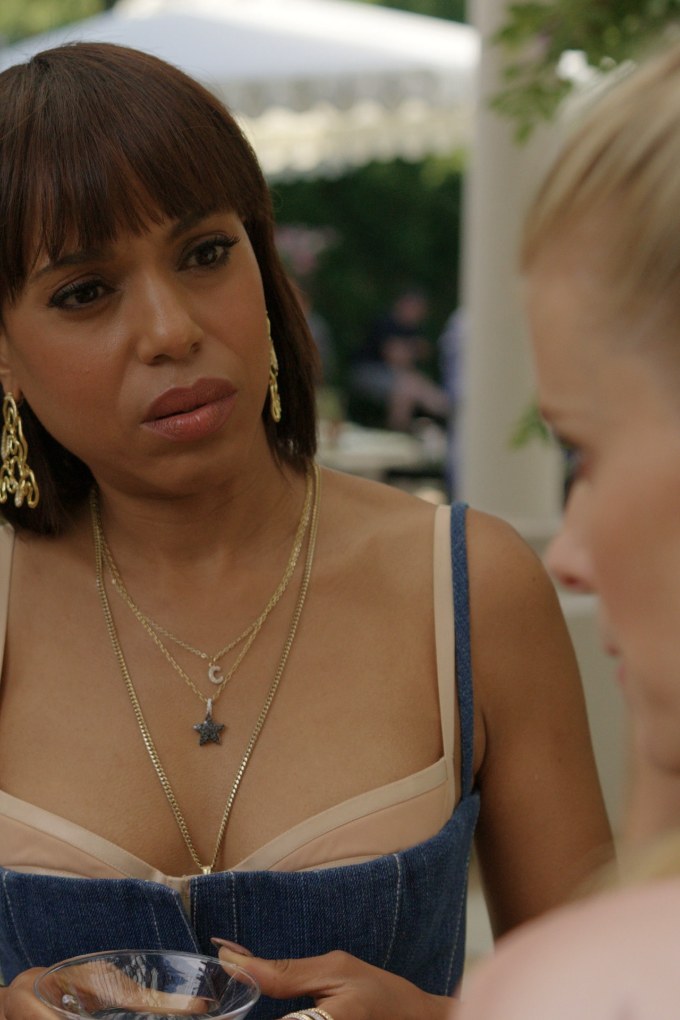
Making friends in your youth is easy. It’s maintaining them even in adulthood—through jobs, romantic partners and the other curveballs life throws your way—that is a true challenge. Yet, the leads of Apple TV’s newest thriller series Imperfect Women, Eleanor, Mary and Nancy, have done it.
On the surface, the decades-long friendship between the women is bulletproof. But their bond is put through the ultimate stress test when tragedy strikes: Nancy, the privileged wife of a wealthy businessman, is mysteriously found murdered. It doesn’t take long before the trio’s friendship comes under the microscope. Emotions bubble to the surface, mistakes are made and devastating secrets are uncovered.
Based on the novel of the same name by Araminta Hall, the gripping drama from Apple TV examines friendship in adulthood, uncovering the web of lies and secrecy that we often find ourselves weaving for others, and for ourselves. The eight-episode limited series stars Kerry Washington as the highly successful and free-spirited personality of Eleanor, Elisabeth Moss as an everyday suburban mother Mary, and Kate Mara as Nancy, the philanthropist living a life of luxury.

Like the source material by Hall, the series takes on a non-linear format, telling this emotionally-charged tale while leading us on a wild goose chase. Rather than following a chronological timeline, the story unfolds in separate parts through the eyes of each of the main characters. And as the circumstances surrounding Nancy’s death only become more entangled, we’re left doubting it all. Questions of desire, betrayal and even revenge plague Eleanor and Mary as they attempt to get to the bottom of Nancy’s death.
As Imperfect Women premieres today on Apple TV, Vogue Singapore sits down with Annie Weisman, the show’s executive producer and creator, as well as Lesli Linka Glatter, the series’s pilot director, to dive into the intricacies and themes behind the show. Here, the pair break down some behind-the-scenes moments from the show, and discuss the complexities of maintaining friendships in adulthood, and how addressing feminine shame is crucial, now more than ever.
Every show tends to begin with an obsession. What was the idea or theme you couldn’t stop thinking about when creating this series?
Annie Weisman (AW): I really wanted to write about female friendship and loss. I had lost a close friend, and I was surprised by how it was harder to express to people how painful it was to lose a friend. It doesn’t have the “status” of losing a spouse or a family member but it really was just as life-changing. So I had been thinking about that, and then this book came along. It was really appealing to me because for a lot of us—particularly women—friendship really is just as important as any other relationship.
What did you enjoy most about being a pilot director for Imperfect Women?
Lesli Linka Glatter (LLG): Well, I really enjoyed working with the cast. I have always wanted to work with Kerry and Kate, and this was the perfect project. Lizzie (Elisabeth Moss) and I go way back, and I had the pleasure of working with her on West Wing. They are all such distinctive actresses playing such distinctive characters, and yet together, they form three best friends that would trust each other with their lives.
In addition to the cast, one of the joys of coming in as a pilot director is that you get to set the tone, look and feel of the show. And one of the things about Imperfect Women is that we get to see the world from each main character’s point of view. Thematically, none of these characters are what they appear to be. You think you understand who they are, and then you peel back the story, the character, and you find out more.
How does the series’s non-linear structure help to tell the Imperfect Women story?
AW: We were all really attracted to that form of storytelling. It felt like a great way to approach a thriller, to shift perspectives. It also gave us a chance to create three really dynamic and appealing roles. The characters each got to have their due, and actors of this calibre really do.
LLG: There are a lot of different layers going on simultaneously, and because of how we’re telling the story, we get to see how these layers impact each of these characters. This way, you get to go on a journey with them in real time.

In your view, how does the friendship between Mary, Eleanor and Nancy reflect modern female friendships?
AW: The events in the book and series are a heightened version of something I think a lot of us experience: that feeling that midlife is pulling you away from your friendships. How isolating and painful that can be, and that inner longing to still have the close, intimate connections you have. Connections that may be easier to make when you’re a little younger, when life is a little simpler and more independent. We’re looking at how to continue to value friendships, the kind that can help to anchor in difficult times, and while challenging at times, can also be life-saving.
What do you wish for audiences to take away from the friendships and portrayal of the three female leads?
LLG: By having about three episodes to explore each of these characters is to reveal that they are not one note; they are layered. There are things they are great at and should be admired for. Then, there are things that are difficult. To show all sides of a character is something that feels very current to me, especially with female characters. Female characters can be as layered and complex as male characters.
What was the most challenging part of creating this series?
AW: The challenge and the thrill of it was getting to adapt it to LA. That was something I wasn’t sure we were going to be able to do, because it is a challenging and expensive place to shoot, but we got a lot of support for it from Apple. After that, the challenge was trying to bring it to life at a time when we had just gotten through the LA fires, which affected a lot of our community.
Why was it so crucial for the story to be set in LA?
AW: Well, I’m a native Southern Californian, and I really like telling dark stories here. I like to do dark things in sunny places, that’s kind of my thing. From there, it was just an opportunity to really show what LA is about, in a more complex way than people often do. We got to highlight the cultural life, the art scene, history and even nature in LA. We wanted to showcase different aspects of the city, especially for a thriller like this.

Do you think it’s important that these characters be liked?
LLG: That’s a good question. It’s important that you are with the characters. Whether you like them all the time or approve of everything they do is a different question. I’m okay with not liking everything a character does if I understand why they’re doing it. Then there is still that sense of empathy and understanding. Or if a character does something they later regret, there is something that is so inherently human. We humans are flawed beings and we make mistakes, but it’s how you deal with those mistakes that counts.
Throughout the series, themes of feminine rage and shame are addressed. Why are these topics important in 2026?
AW: It’s pretty easy to feel rage when it comes to women. Losing freedoms that we’ve taken for granted for a long time, losing control of our own stories, or the kind of slippery relationship that people sometimes have with the truth. So I think it’s important that women use rage in a positive way to reestablish control of their own stories, to tell the truth and to be believed.
Shame causes you to separate yourself from your sources of support, which can often be damaging and even dangerous. In the case of this story, shame really kills because when you stay quiet, you become more at-risk. When you’re loud and own things that you might be ashamed of, you’re giving yourself the opportunity to be believed, heard and supported. It’s risky and scary, but this is what we, as women, can give each other permission to do in our communities: to tell the truth and overcome shame together.
Imperfect Women is now streaming on Apple TV.