Warning: This story contains spoilers of Wicked: For Good.
We are in the throes of a renaissance. Ever since the world saw Jon M. Chu’s first film for his adaptation of the Wicked musical, we’ve witnessed a significant shift in the air. Considering the legacy of its source material, it had certainly been an ambitious undertaking, but if his past experience of adapting the stage musical In the Heights was promising of anything, it was that Chu understood the behemoth task that entailed adapting anything from the stage to the screen.
With Wicked: For Good now out in cinemas, Chu’s entire vision has been realised, and it has been nothing short of brilliant. In the Heights walked, so Wicked could run.
Compared to the musical’s original runtime, the total duration of both films combined may have seemed extensive initially, but perhaps that was precisely what was needed to flesh out the moving tale of Elphaba Thropp and Galinda Upland, who later become known as the Wicked Witch of the West and Glinda the Good.

There are plenty of additional scenes that bolster the overall narrative of Act II, which has always contended with pacing issues and storyline plotholes. This is most apparent in the film’s choice to expound on Michelle Yeoh’s Madame Morrible, and her utterly heinous part to play in the schemes that not only drove Cynthia Erivo’s Elphaba out of Oz but also led to Nessa’s eventual death. And whilst the additional songs ‘No Place Like Home’ and ‘The Girl in the Bubble’ may be forgettable enough, the former fleshes out Elphaba’s continued efforts to free the animals of Oz, whilst the latter does dole out the character growth arc for Ariana Grande’s Glinda, who is finally able to release herself from her own bubble of deception—to look past the beautiful yet cruel world she’s enrobed herself in as a pedestal of Good.
Yet Chu’s vision is the most apparent in his world-building—for something has to be said about the incredible sets created in collaboration with production designer Nathan Crowley. Think the neo-classical architecture of Emerald City; the 58-tonne wind-up train bound for the city; and the whopping nine million tulips planted to recreate the magical fantasy of Munchkinland.
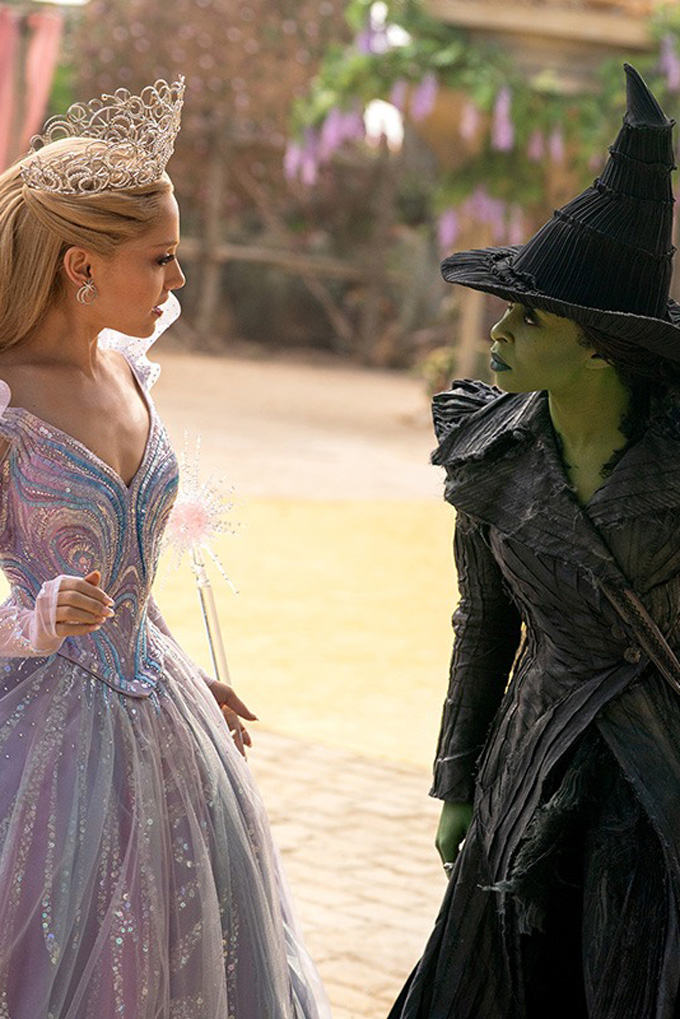
Paul Tazewell too, really outdid himself with the costumes for round two, from figuring out how to costume the four famous friends of Oz (Dorothy, Tin Man, Scarecrow, and the Cowardly Lion), to developing the familiar yet evolved costumes for Elphaba and Glinda’s characters. The costumes, meant to reflect the character arcs, carried with them a sense of arrival and transformation, as they both eventually find themselves through the film.

But a musical wouldn’t be what it is without its song—and that’s where Wicked—and its amazing cast—truly shines. If there’s one thing that can be said, it’s that Chu had his casting down to a tee. There’s Jeff Goldblum for one, his infectious off-screen nature simply synonymous with The Wizard’s campy and showman-like act for ‘Wonderful’. There’s the captivating Marissa Bode as Nessa, a character that’s never been easy to love—and yet her rendition of ‘The Wicked Witch of the East’ was as arresting as they come. Yet it’s Erivo and Grande that really steer the ship.
Grande’s emotional range shines in ‘Thank Goodness/I Couldn’t Be Happier’, showcasing not just a point of internal conflict for Glinda, but the inescapable emptiness that comes with her choices as Glinda the Good. Erivo, who seems to have always been made for the role of Elphaba, delivered a magnificent ‘No Good Deed’, her fiery temperament and wickedness reverberating all through the room.

Still, Wicked is nothing if not a narrative that rests entirely on the eternal friendship between Glinda and Elphaba. If the first of the Wicked films was an introduction to their characters and just how much they impacted each other, Wicked: For Good cuts deep to the core of every friendship between two girls—no matter their prior grievances, Glinda and Elphaba were always willing to sacrifice themselves for the other at some point. But the pair—Grande and Erivo—truly sell it.

In truth, we’ve all seen the clips of the two during the entirety of their Wicked press season for the past year and many wondered if their off-screen relationship has just been a bit to promote the film. Critics might conjecture otherwise, yet anyone who sits through the second film would not be able to deny the unbreakable bond between the two, as if they lived parallel lives to their on-screen characters. So when it came down to the defining song of Wicked: For Good, the emotional resonance was irrevocable—and the tears were unstoppable.
There are bridges you cross you didn’t know you crossed until you’ve crossed them. The wonderful Oz-ian world of Jon M. Chu’s Wicked has been one of them.