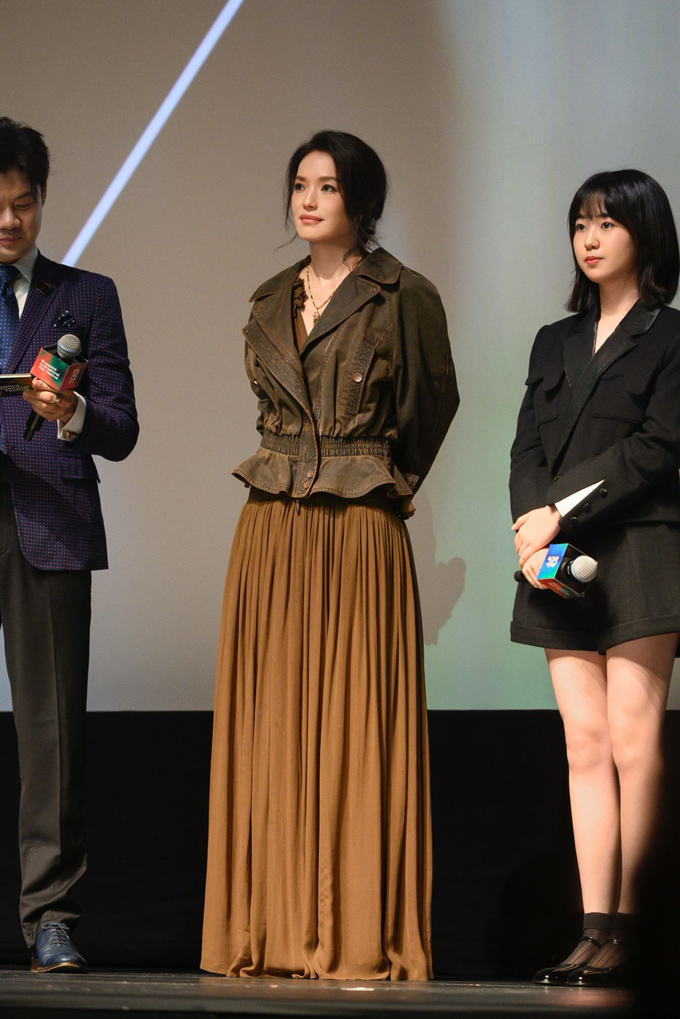
The perils of being a young girl trying to navigate the world are endless, especially when she doesn’t feel safe in her own home. It’s a harrowing—yet often unsaid—experience for the victim who may be put in jeopardy when domestic violence runs amok in the home. And it’s a narrative which household Taiwanese name Shu Qi attempts to narrate through Girl. A compelling, semi-autobiographical film that has been positively received in international film festival circuits around the world, Girl—which has been chosen as the opening film for this year’s Singapore International Film Festival (SGIFF)—marks Shu Qi’s promising debut as a director.

“Being a director never really crossed my mind in the first place, because I was always an actress. It actually took me 15 years to get here. The idea to direct my own film was first seeded to me by director Hou Hsiao-hsien, who asked me if I would ever be interested in directing my own film. By the time I started conceptualisation, it took 10 years to piece all my ideas and thoughts for the script together,” says the actress-turned-director, who is here in town for the Southeast Asian premiere of Girl.
A labour of love, the film follows Ling Hsiao-lee (Bai Xiao Ying), a young girl growing up in Taipei in the 1980s. She lives in anxiety everyday, having to face a tiresome mother (9m88) who constantly chides her, and a deadbeat father who dredges home in a drunken stupor every night. Worse still, she falls asleep in a zip-up closet every night, just to avoid the repeated terror of her father’s abuse—something the film doesn’t flinch away from showcasing.

At school however, she encounters moments of kindness; the school doctor who sends her classmate to buy breakfast for her everyday; the classmate who offers to walk her back to class after her fainting spells; and the spirited transfer student who barges into her life, breaking through Hsiao-lee’s usually private and guarded self. But at the core of Girl is a tale of hardships one can face when growing up—be it the spillover effects of domestic abuse, the strained relationship between an eldest daughter and her mother, as well as the soft, endearing experience of female friendships.
It isn’t everyday that a lauded actress can make an equally convincing switch—to take the helm in the director’s seat. Sitting down for an exclusive interview with Vogue Singapore ahead of opening night at the 36th SGIFF, Shu Qi lets us in on the arduous creative process behind Girl, from how the film first came about to how she casted newcomer Bai Xiao Ying as her Hsiao-lee.
How are you feeling about Girl being chosen as the opening film for the 36th SGIFF?
Now that you’re asking this, I’m actually feeling a little sad that my journey with Girl is coming to an end. But I think it’s a nice closure to it all, after having brought the film to the other film festivals and I’m very happy to be back in Singapore because I haven’t been here in over 10 years.
Tell us more about how the idea to direct a film first came about. How long have you been working on Girl?
Being a director never really crossed my mind in the first place, because I was always an actress and it’s really special being an actress, what I get to do. But the idea to direct my own film was first seeded to me by Director Hou Hsiao-hsien, who asked me if I would ever be interested in directing my own film. I owe it to him, and the whole journey actually took 15 years since I was first seeded the idea. I really started piecing the puzzle together in 2013, but it took me 10 years to write this film.
Over the years, trying to pen down the story proved to be quite a challenge because I’ve never done it before. I had to seek advice and guidance from director Hou. What he told me was to just start with a pen and paper, and jot down whatever ideas that I have. So by doing that, I had all these ideas and stories in my head coming together. Although the first draft was before Covid-19, I only really sat down to complete the script in the summer of 2023. At that time, I had been on the jury for the Venice Film Festival and I was watching so many films so I remember telling myself that if I don’t start filming, the film will never happen. So I really immersed myself for two weeks to finish the script and start preparing everything, from presenting to sponsors, getting a crew together and speaking to my producer.

So how and why did you decide on the storyline of Girl?
The original concept came about when I was talking with director Hou. He had this film, The Time to Live and The Time to Die, which is also a coming-of-age narrative and something I felt that was close to my heart, because it talks about the hardships of growing up. My own story also deals with the feelings of displacement as a child, and themes like domestic violence.
What was it like shifting from being an actress to sitting in the director’s seat?
It’s actually a very busy job. There were so many things that I had to take care of. Be it as an actress or a director, I’m fully committed and immersed, but the preparation that comes with being a director is so different. When it comes to being a director, I have to take care of many more people, but as an actress, I just focus on the role I’m playing. Now I have to take care of the team. Now I have to take care of the actors. I have to take care of the DOP.
But before I started, my producer Yeh Jufeng actually wrote me a letter telling me that my role as a director is very different from being an actress. There are many things that I have to juggle on set. I’m now a different person, you know, I have to take care of the directing, the set and the crew. So initially, I did have some fears. I was questioning my ability and how others might think about me. I had this fear in me, but then I realised that I can also use what I’m really good at: acting. I could act as a director, so the first day went really well.

What were you looking for when you were casting your characters‚ and how did you know Bai Xiao Ying would be the perfect Hsiao-lee?
When I was looking for the cast, Bai Xiao Ying was actually already 18 years old. But in my film, Hsiao-lee is actually 12 years old. By that time, I had spent a lot of time looking at the young actresses in Taiwan to find who would be most suitable, but none of them fit the bill because most of the young kids these days are really well fed. They look fairly chubby, and are very happy having been brought up comfortably, so this generation of kids didn’t quite match. So I realised I wouldn’t be able to find an actual 12 year old and had to find someone who’s older. So when Xiao Ying came, I saw that she naturally had dark circles and somehow really suited this story of a fearful girl who locks herself up and isn’t well fed.
I was really impressed because she originally had really long hair but was very professional about cutting her hair short for the role, and even lost six kilos within a month to really transform into Hsiao-lee. It was really remarkable, her professionalism.

What was the most challenging part about making Girl?
I think writing the script was probably the most difficult because it’s so crucial to the whole making of it. It provides the framework for the whole film. And I did take 10 years to write it. It was also very difficult to find locations to film in, since the film is set in the 80s in Taiwan. It was hard to replicate the essence of the era because we’re living in such modern times now. So we actually filmed it somewhere in the centre and southern part of Taiwan which limited us in terms of filming time.
And the other thing? Keeping my temper in check (chuckles). When you’re rushing, it’s very easy to feel short-tempered. But it was important to me that these emotions don’t roll over to my actors because I didn’t want them to feel stressed or affect their mood. So I had to appear calm and collected—which has done wonders for my own temperament now. It’s really improved and I think I’m so much more patient now.
What was one thing you consistently prioritised in the making of your film?
The actors. It’s important how they feel emotions and also guiding them to get into the role. I think that’s really critical. I guess it stems from the fact that I am an actress myself, so I can understand how they feel. I empathise with them, and I also know the needs that they may have. So this is probably one of the benefits of being an actress and then now becoming a director.

Who do you hope this film will reach, and what do you hope your audiences will take away from Girl?
I’m not sure what it’s like in Singapore, because it appears that the women in Singapore are generally quite free to do what they want. But for other Asian countries, like Korea, China, Hong Kong, the character of Ling Hsiao-lee might be more relatable. My film is not really about self-help or about empowerment for women per se, but what I really hope people can get out of this film is that all of us have our own lives, so accept it, live it well, and live each day well.
And for anyone who might have gone through similar difficulties as Hsiao-lee growing up, or the same kind of environment, they may be hurting but I hope they have the courage to rise above their circumstances and move forward to a better future.
So can we expect to see more of director Shu Qi in the future?
So I’ve started thinking about it, but I’m not sure if it’ll take another 10 years (laughs).