The afternoon sun casts a golden glow on the distance as tall casuarina trees rustle in the breeze. Believe it or not, we are at Jia Curated, an outdoor design festival in Bali that is fast becoming a meeting place for Southeast Asia’s creative community.
Sprawled along Pengembak Beach in Sanur, the fifth edition welcomed more than 18,000 visitors in August over five days—a 50 percent increase from the year before. More than 150 exhibitors, from Bali-based design gallery CushCush to bamboo pioneer Ibuku Studio, pulled out all the stops in designing unique pavilions. Exposed to salt spray and sand, these hardy structures embodied the festival’s theme, Nature Weave, which explores the relationship between man and the environment.
But Jia Curated is as much a forum as a marketplace.Distinguished speakers from around the world, such as Porto-based designer Gabriel Tan and London-based designer Bethan Laura Wood, took the stage for lively conversations, while award-winning design editor Charmaine Chan presented “Architecture in Scale”, an intriguing exhibition of architectural maquettes from 25 studios. While most design industry events would be winding up by late afternoon, the crowds at Jia Curated were still streaming in after dark, buoyed by live music and cultural performances.

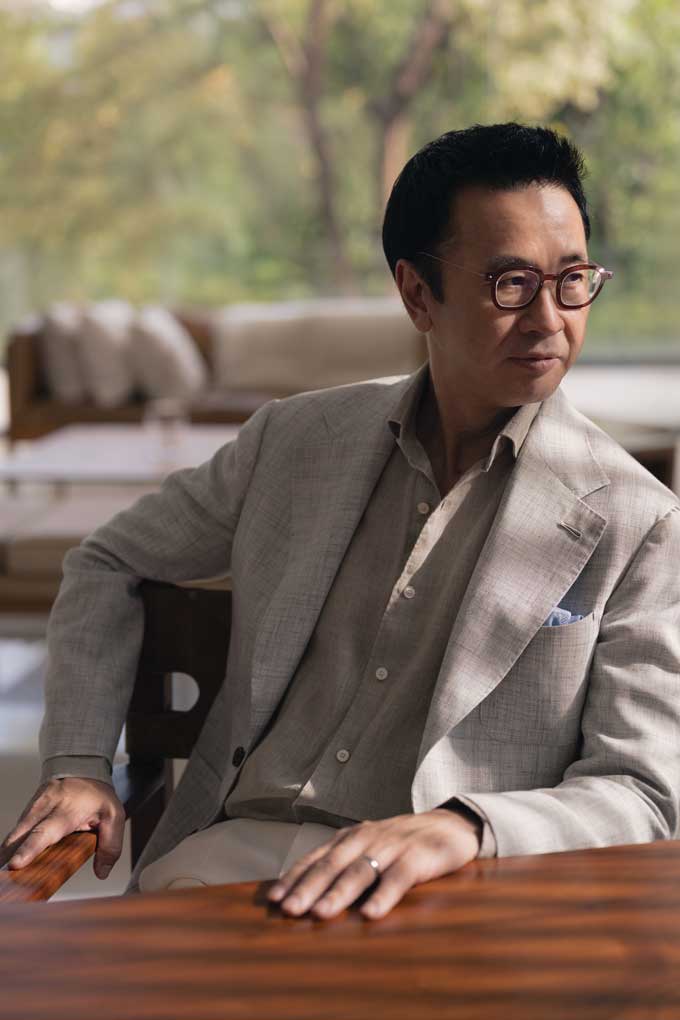
The buzzing atmosphere belies the festival’s humble beginnings. Two years after opening Jia Collective, a lifestyle shop centred around Indonesian design, co-founder Budiman Ong—the Bali-based designer behind lighting studio Ong Cen Kuang—went looking for markets to retail his products, but it turned out to be an uphill task. “A lot of the markets here focused on fast fashion and souvenirs, which is not what we do,” he says. “Since we had 40 brands in our shop, we decided to create our own market.”
What began as a weekend bazaar, Jia Curated Kiosks, has since evolved into the fully fledged festival it is today. The secret behind the festival’s success, according to Ong, is gotong royong—an Indonesian tradition of coming together around a shared purpose. “From the start, we made it about community, engagement and connection with one another,” he says.
This mission in rallying the industry is especially significant in Indonesia because the design ecosystem can feel fragmented. Despite the country’s long-standing reputation as a manufacturing hub, product designers can still be perceived as executors rather than authors, while state funding for young talents remains limited. By bringing different pieces of the puzzle together, from architects to artisans, Jia Curated is fostering a close-knit industry, grounded in conviviality.
Those very challenges in the industry helped spark Millimeter Manifesto, a collective of eight Indonesian product designers seeking to deepen conversations about product design. “We want to set an example for product design in Indonesia because the field is still not well acknowledged,” says Alvin Tjitrowirjo, founder of leading design practice AlvinT and a member of the collective. “There are many grey areas in the industry, from unethical practices to our role as product designers.” Rather than pit themselves against one another, the designers have come together to exhibit new work in different cities.

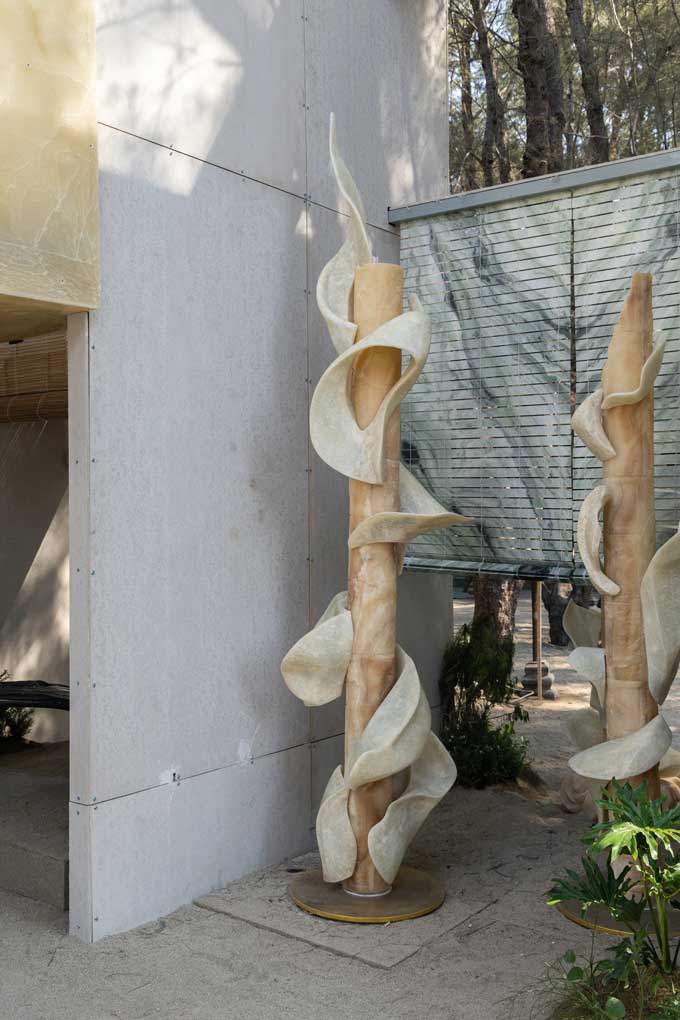
At Jia Curated, Millimeter Manifesto partnered with stone specialist MM Galleri to explore the material across diverse perspectives. Highlights included Jakarta-based designer Handhyanto Hardian’s Pebble lounge chair, whose deceptively hefty form swivels on its base; and Studio Banda’s ‘Lithic Breath’, a sumptuous marble sound sculpture embedded with a soundtrack by local artist Agha Praditya. Alongside renowned Indonesian names such as Wasted by Potato Head and scent maker Oaken Lab, Jia Curated is now a launchpad for emerging local practices.
Suaru, a furniture brand founded by Jakarta-based designer Patrick Luwia, is one to watch. Its name derives from suara, Indonesian for ‘sound’, and its collections are grounded in storytelling. Among Suaru’s latest pieces is the Torii console and bench. Designed for transitional places within the home, its structure and angular edges reference the gates marking the entrance to Japanese shrines.
Luwia, who grew up in Sydney and comes from a family with experience in wood manufacturing, represents a new generation of Indonesian designers who are rooted in the country’s craft heritage yet global in outlook. “I employ local manufacturing techniques such as hand-weaving, but I take an international approach,” he says. “I’d like my work to appeal to a broader audience.” Suaru’s Melt chair, for instance, pairs a woven rattan seat with a contemporary silhouette that would feel right at home anywhere in the world.

Another rising name is Jakarta-based shelving specialist Post+Beam. Indonesian architect Deo Mario Priyatna spent five years researching, tinkering and testing before developing the brand’s modular aluminium system. Magnetic boards can double as book racks while shelves can become mini desks. It is a system built to evolve with the user and to last, in both durability and style.
While uniting the Indonesian design community has always been the starting point, Ong hopes for Jia to build bridges beyond the archipelago. “Our ambition is to continue to grow the event’s impact, reaching further across Asia,” he says. That aspiration has taken shape in Project Benih, a new initiative that connects makers, manufacturers and designers from Indonesia, Japan and Taiwan. Nine designers, including Taiwanese designer Chang Po-Chieh from Zhēnzhēn Stained Glass Lab and Japanese designer Jin Kuramoto, were introduced to 13 Indonesian manufacturers and artisans working across disciplines including textile weaving, banana paper making and woodworking, with the goal of planting the seeds for future collaborations.

Southeast Asian designers also had a sizeable presence on the grounds, with the Philippines leaving a strong impression. Leading Filipino designer Gabriel Lichauco curated an exhibition featuring 11 designers and 10 heritage manufacturers from the country. Conceived as a personal letter from the Philippines to the world, the colourful showcase included the Seasons lamp collection, a collaboration between designer Selena Placino and manufacturing studio Venzon. Its powder-coated metal plate is punctuated with leaf motifs, creating a mottled effect when illuminated.
Equally mesmerising were the woven Vinta stools by designer Jasser Aguila and heritage furniture manufacturer Calfurn. An integrated backrest doubles as a nifty handle, making it a portable piece of furniture. Its combination of rattan and wood also points to something larger at play: a shared craft vocabulary that stretches across Southeast Asia.
The region may be divided by language, religion and culture, but its craft heritage has shared practices, from weaving and wood carving to ikat and beadwork. Such common ancestry holds possibilities for deeper dialogue and closer collaboration among Southeast Asia’s designers and makers.
Jia Curated may have started as a gathering for Indonesia’s design scene, but it might very well be the place where ideas, traditions and innovations from the region can cross-pollinate and find fresh expressions. And flanked by vessels glinting in the soft light, the setting couldn’t be more fitting. The rising tide does indeed lift all boats.