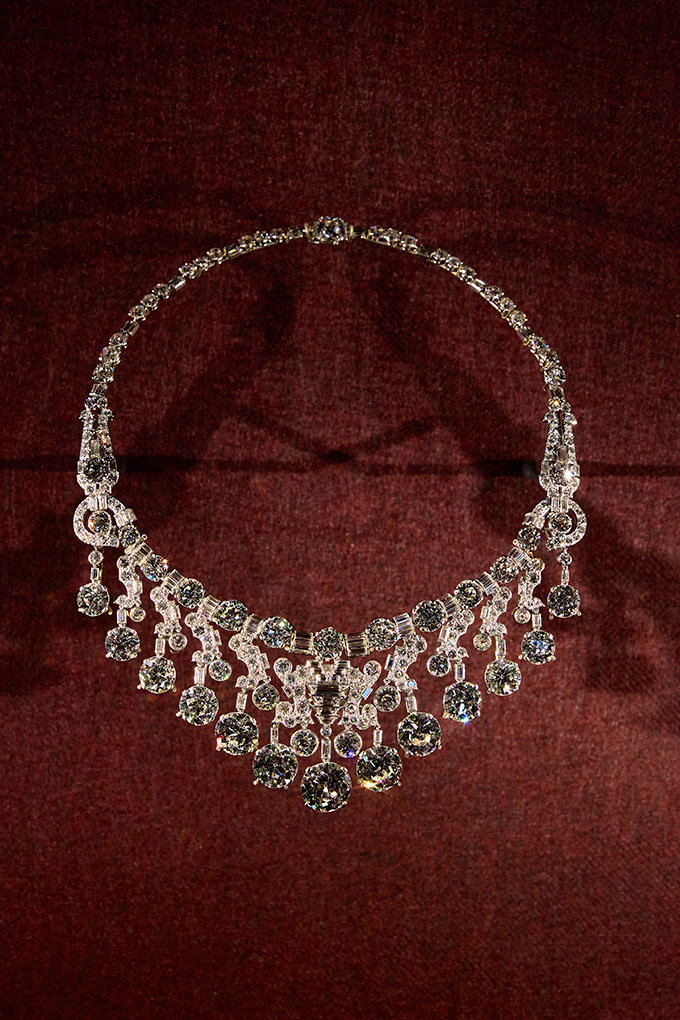
What makes a masterpiece? Or, to put it more precisely, what is it that elevates a mere object of beauty to the level of a masterpiece? That was the question on my mind when I headed to Melbourne earlier this year to view the opening of Cartier, the latest blockbuster brand exhibition on show at the National Gallery of Victoria (NGV), Australia’s oldest and most-visited art gallery.
The Cartier exhibition in Melbourne can be read as a sequel to the heavily attended and sold-out 2025 show in London’s Victoria and Albert (V&A) Museum. In this new edition, part of the NGV’s Winter Masterpieces series, there are a number of evolutions. More pieces and historical documents from the Cartier Collection—the jeweller’s heritage arm that collaborates with museums—are on show; Rotterdam-based designer Sabine Marcelis and architect Paul Cournet worked on the scenography; and the exhibition curation, led by Helen Molesworth and the V&A, features an extended selection of loans from private and international collections.

Cartier opens on a remarkable jewel from 1903: the Manchester tiara commissioned by Consuelo Montagu, the Duchess of Manchester. Pascale Lepeu, the director of the Cartier Collection, was on hand to give a tour of the exhibition. The choice of this tiara to open the show is deliberate. The duchess was born American, married into the English aristocracy and commissioned this jewel from a Parisian house—a triumvirate of locations that mirrors the house’s establishment in the 1900s by Louis, Jacques and Pierre Cartier of its three historical bases. “You have Paris, London and New York all together in this tiara,” said Lepeu. “It illustrates the three branches of Cartier.”

The diamond tiara hides some secrets, too. The Duchess provided Cartier with over 1,000 brilliant-cut and over 400 rose-cut diamonds, but that bounty of gems was, quite incredibly, not enough to complete the extravagant design. Cartier provided additional diamonds and set the backs of the tiara with imitation paste stones—an illusory trick only made possible because of the elaborate hairstyles of the time that would hide the back of the jewel.
Maybe it’s a titbit and story like this that elevates the Manchester tiara from merely an impressive jewel into a masterpiece, and an object worth preserving, exhibiting and talking about more than a century after it was created.

I put the semantic question of a masterpiece to Pierre Rainero, Cartier’s image, style and heritage director. Very often, he explained, that elevation to masterpiece happens because a jewel carries a personal, symbolic value. “It’s at the centre of what jewellery is. We forget sometimes, or take it for granted, that jewellery is made of precious materials. This has a meaning. It means that people invest not only their money but a link to the most important feelings or events in their life. It’s beyond an ornament because it’s linked to and represents something precious to you. That’s why jewellery is as ancient as civilisation.”

So it’s perhaps emotion and the stories of their owners and creation, then, over mere size or grandeur. “I think you can have tiny pieces that could be masterpieces,” offered Rainero, who, now in his 42nd year working at the house, is perhaps one of the world’s foremost experts on Cartier. “In common language, when we want to say that something is beautiful we say it’s ‘a jewel’ of something. Some of these pieces are jewels of jewels, and I want to encourage the visitors not only to see that but to look sometimes at other items,” he added.


One of the most petite yet potent jewels on show from the Cartier Collection is the Duchess of Windsor’s Panther brooch from 1949. Described as an “atomic bomb of jewellery” in its time, it was one of the earliest examples of a jewel by Cartier with a three-dimensional figure of its most symbolic animal. The Duchess of Windsor, Wallis Simpson, was not an amiable personality, and the fierceness of the panther, with its perch on a sapphire cabochon that represented dominion over the world, reflected her individuality. It is a small piece, but tremendously impressive and evocative; and in the show, this jewel of jewels is accompanied by a host of archival gouaches, sketches and printed graphics that show how the panther went from painted renderings to a full-fledged gold, diamond and sapphire creation in three dimensions—a predecessor of Cartier’s contemporary Panthère designs.
What is incredible about the nearly 400 jewels on show is, of course, the vastness of Cartier’s prolific output since its founding in 1847. And it’s not glut and volume for its own sake. Instead, the immense number of jewels, clients and stories in the house’s history—aristocracy, royalty, nobility and celebrities the world over—give one a picture and understanding of how and why Cartier is perhaps the most powerful jeweller in the world.

There are two other lines of thought in Cartier at the NGV that contribute to a full picture of the maison.
First, examples of how Cartier captured the artistic and cultural ideas of the moment. There is a section of exquisite Egyptian designs, accumulated by the Cartier Collection over 40 years, with some recent acquisitions. The jewels and jewelled objects date to the Egyptomania of the ’20s, after the rediscovery of Tutankhamun’s tomb, and reflect a design period when the house mirrored high society’s excitement with ancient Egypt. There is also a section dedicated to art deco, the hugely significant ’20s and ’30s art movement that Cartier helped to shape and was influenced by. Both Egyptomania and art deco, coincidentally, are experiencing a resurgence now after a century.

The second is a particular clientele who encouraged and gave the maison the audacity to create one-of-a-kind masterpieces. Tastemakers and jewel fiends like Daisy Fellowes, Barbara Hutton, Grace Kelly, María Félix and Bhupinder Singh the Maharaja of Patiala, whose commissions were so opulent that the legendary jewels they had Cartier make are scarcely imaginable today. The exhibition includes photos and videos of these individuals wearing their jewels.

In particular, films of the Maharaja wearing the famous Patiala necklace (one of the largest orders in Cartier’s history); and photos of Grace Kelly wearing her private collection. “It’s paradoxical to see jewellery in a window,” admitted Rainero of the limits of showing jewels in an exhibition. Movement, he added, better illuminates the exquisite quality of a jewel, and he expressed to me a fondness for seeing these pictures and films in the exhibition.


As much as taking a closer look and reading into the stories of each piece can make for a richer viewing experience, the expansive exhibition nonetheless closes on two sections that are easy to appreciate. The first is a room dedicated to special gemstones and the big four of diamonds, sapphires, rubies and emeralds. The second is a section devoted entirely to tiaras—crowning Cartier jewels commissioned by the powerful and wealthy. There is a pair of turquoise sister tiaras reunited and exhibited for the first time together in nearly a century; and even one belonging to Queen Azizah of Pahang. The opulence of tiaras in this room, such a fairy tale kind of jewel to the vast majority of the world, evokes almost entirely by instinct oohs and aahs. It’s perhaps the quickest litmus test of a masterpiece, and at Cartier there are certainly many.


Cartier at the National Gallery of Victoria in Melbourne runs from 12 June to 4 October 2026.
The September 2026 ‘Beyond The New’ edition of Vogue Singapore is available online and on newsstands.