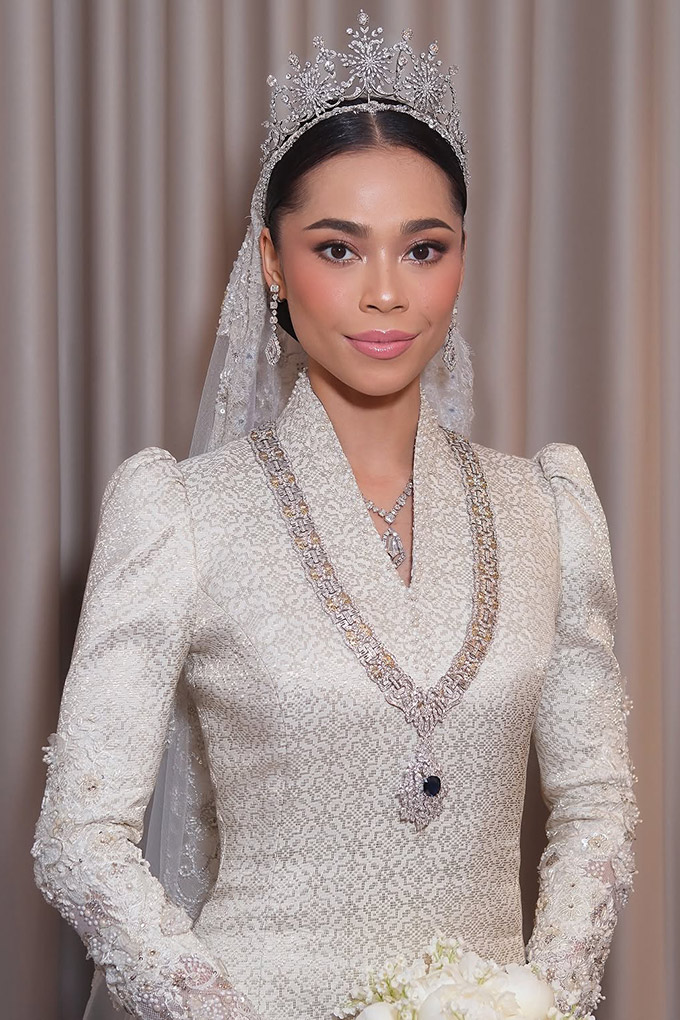
Royal weddings are always a special treat, and lest you forget it: there are royals aplenty in Southeast Asia. The latest to tie the knot are Princess Ilyana of Pahang and Christopher Lionel Froggatt, who wed in Kuala Lumpur this past weekend.
The 29-year-old bride Princess Ilyana, or her formally styled title Yang Amat Mulia Tengku Puteri Ilyana Alia, is the daughter of the Sultan Abdullah of Pahang, formerly the Malaysian king from 2019 to 2024, and of the former model and actress Julia Rais. The groom, 32-year-old Christopher Froggatt, is a British race car driver who co-founded and drives for the Tempesta Racing team.
As with any royal wedding, the jewellery sightings are on another level of glamour and opulence. We saw that in 2024, when Princess Anisha Rosnah of Brunei wore a fabulous tiara crafted by Singapore jeweller Flower Diamond. We might tend to associate incredible ceremonial jewels with royalty and nobility from Europe, but royalty in Southeast Asia—though it’s lesser covered or well-known—have spectacular jewels in their collections as well.
View this post on Instagram
The Pahang royal family do not disappoint. At Princess Ilyana’s wedding, the bride wore two elegant looks, both by Malaysian couturier Radzuan Radziwill. Her jewellery included a number of significant heirloom pieces on loan from Queen Azizah of Pahang. For her solemnisation look, the Princess chose an art deco diamond tiara, a long pendant and tassel diamond necklace, as well as a set of diamond and emerald earrings and a necklace that she wore under her gown.
For her wedding ceremony, though, Princess Ilyana brought out one of the more emblematic jewels from the Pahang royal family’s collection: an antique tiara, designed in what appears to be the 19th century garland style, entirely in white precious metal with neoclassical leaf and scroll motifs and set with diamonds.
View this post on Instagram
The diamond tiara that Princess Ilyana wore has been loaned to several members of the Pahang royal family for weddings. One of its more recent bridal appearances was in 2024, at the wedding of Princess Afzan Aminah. She held three days of ceremonies and celebrations, and wore around four distinct sets of jewels—one of which was indeed this diamond tiara.
Both the art deco and garland style tiaras belong to Queen Azizah, who, it must be said, has a beautiful collection of jewels. One of her tiaras, as it happens, is on view at the moment at the Cartier exhibition at the National Gallery of Victoria. Its connection to a lost tiara of Queen Mary was made by Saad Salman, the jewellery historian and editor-in-chief of The Royal Watcher, and the provenance of the piece was ascertained by jewellery historian and curator Helen Molesworth.
View this post on Instagram
One of the more fascinating details of the diamond tiara is how it has been modified and altered in recent times. The original design might appeal more to modern royal brides because of its airy openwork—dramatic, elegant and feminine without being imposing or overly grand. For a little more oomph, though, three diamond stars were added to the tiara when Princess Iman Afzan wore it at her wedding in 2018. The stars appear to have been removed when Princess Afzan Aminah wore it in 2024, and seem to have returned for Princess Ilyana’s more recent nuptials.
Justin Daughters, managing director of London vintage and antique jewellery dealer Berganza, offered Vogue some insights: “People can be quite precious about historic jewellery and assume that changing it somehow damages its importance. Royal jewellery has been altered for generations. Pieces were reset because fashions changed, because a new wearer wanted a different proportion, or simply because the family wanted to keep using them.”
View this post on Instagram
It speaks to an undersung aspect of high-end jewels: transformability. The term is used very heavily in high jewellery design, and indeed the point of grand, fancy pieces that can be transformed is so that you open up many more ways of wearing the pieces in a collection. “The stars are a good example,” Daughters said. “You haven’t lost the original jewel, but you’ve given it another life. That is often why these pieces survive.”
Princess Ilyana wore two necklaces for her wedding look. One, a rivière with a kite-shape diamond pendant worn under her gown. The second, more spectacular piece, is an elaborately linked white and yellow gold necklace with a sapphire and diamond pendant. It might, in fact, be two distinct jewels. The white and yellow gold necklace, with its more traditional style, has been spotted before at Princess Afzan Aminah’s wedding.
View this post on Instagram
The sapphire and diamond brooch, meanwhile, appears to be part of a necklace that belongs to a suite of jewels by the grand Lebanese jeweller Mouawad. It’s been worn, completed, as a pendant on a matching sapphire and diamond necklace—by Princess Afzan Aminah, and by Princess Afzan Shakira Nabila at her wedding in 2015.
There is, in the warmest sense, almost a tradition of bridal jewels that Queen Azizah lends her family—and something very endearing indeed about these signature heirloom pieces that make repeated appearances. What is especially chic, though, is how these jewels can be reinterpreted and worn differently over the years. Daughters, who deals in jewels that range from decades to over a century old, appreciated the extended lives of the Pahang royal family’s pieces. “These pieces have not been left untouched in a vault,” he said. “Every time it appears at another family wedding, it collects another association. That is part of the appeal of an heirloom. That is how historic jewellery stays relevant. It keeps being worn.”
That sapphire brooch in particular brought a real lightness and modernity to Princess Ilyana’s wedding look when worn with the large link necklace. As they say to brides for luck, after all, one needs to wear something old, something new, something borrowed, and something blue—all the better if it’s a fabulous sapphire.