It’s a rare thing when high jewellery causes the mind to leap to philosophy. Whether by design, that was nonetheless the connection Chanel made when it named its latest collection of high jewellery Signes & Symboles. It conjured up the works of Ferdinand de Saussure and Charles Sanders Peirce, whose theories of semiotics explore how signs and symbols, such as words, images, icons and objects, become vessels of meaning.
The workings of sign and symbol are particularly apt, given that Chanel design is influenced even today by a set of core motifs. The lion, the star sign that Gabrielle Chanel was born under, was chosen in 2012 to represent the apogée category of high jewellery for the maison. The camellia, which suffuses nearly every part of the brand—as a cosmetics ingredient, fabric flowers on paper bags, or haute blooms crafted by its métiers d’art ateliers. The comet, inspired by the starry Aubazine night sky that Chanel grew up under and which was the main motif in the couturier’s first and only high jewellery collection in 1932. And sun rays, which reference coastal light and the resort towns of Deauville and Biarritz where she opened her first boutiques, and Roquebrune-Cap-Martin where she had her idyllic getaway villa La Pausa.

The lion, the comet, the camellia and the sun are potent, but these are, semiotically, signs. They become symbols when they move past the literal and represent more than themselves. The lion as a representation of dauntlessness and power; the comet as dreams and ambition; the camellia as soft, geometric perfection from nature; and the sun as a restorative, energising source of life.
Chanel herself used to say that “My jewellery represents an idea”, and Signes & Symboles runs with that approach, taking these talismans of the couturier’s life and turning them into a horde of symbolic treasures. The collection marks a radical evolution for high jewellery at Chanel in several ways, chief among them the combination and use of several motifs at once in a single design.

The most prominent example of this is the collection’s masterwork: the Imprimé Lion necklace. Designed as a plastron, the necklace is centred by a sculptural lion’s head and a 20.66-carat octagonal unheated and untreated blue sapphire, with fil-couteau cascades of camellias, comets and sunrays, terminating in a step-cut triangular diamond at its end. A combination of five types of diamond cuts (numerology and fives are one more Chanel-ism) create visual rhythm and a waterfall effect, embedding these motifs into a harmonious whole. If ever there were a singular jewel to contain Chanel and the symbols in its universe, this might be it.
High jewellery deals with preciousness too, of course, and the symbols of rarity and significance in this realm are one-of-a-kind gemstones. Though relatively young, Chanel’s jewellery creation studio has imposed such stringent excellence on the gemstones it chooses to use. The house’s creations, as a result, come with an implicit expectation of truly special gemstones.


The big four of diamond, ruby, sapphire and emerald are represented beautifully in a quartet of cocktail rings. On the Symbole Camélia Rose, Chanel has evinced the purity and grace of the camellia flower with a 10.32-carat oval-cut D FL Type IIa diamond, the single most outstanding diamond in the collection.
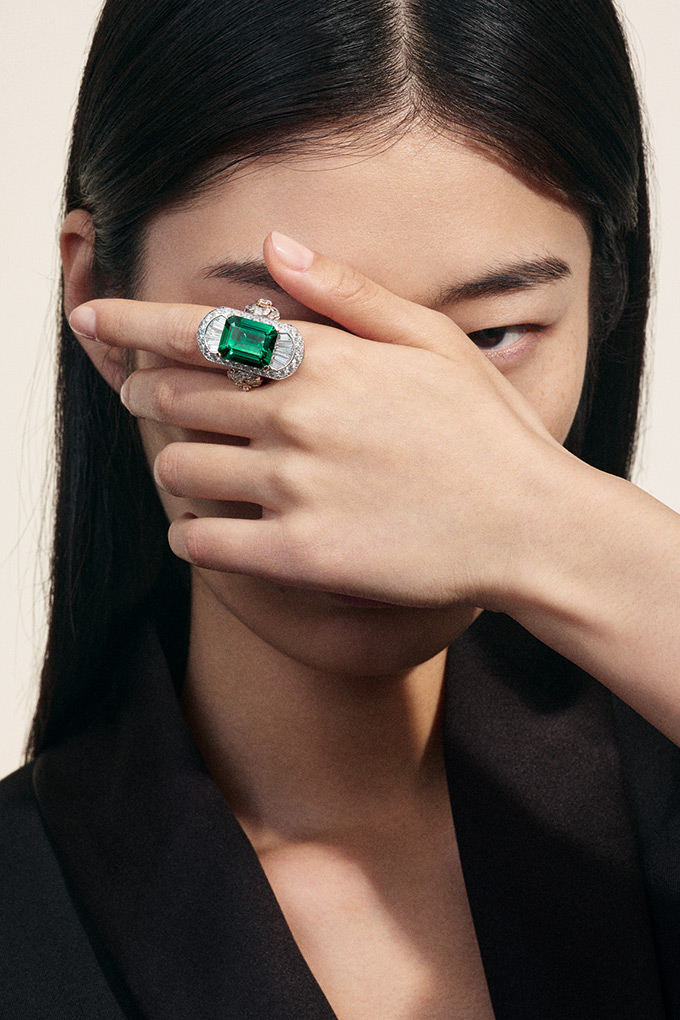
On the Imprimé Émeraude ring, a 10.44-carat untreated Colombian emerald is so vibrant and clear that it casts shadows of green. The ruby finds its place on the toi et moi-style Lion Millénaire, with a 9.41-carat oval-cut Mozambique ruby set like a treasure on one side against a diamond-and-onyx lion on the other. And gem-lovers will find the Symbole Emblématique most enticing, with a 7.12-carat octagonal Kashmir sapphire set in a fringed diamond design.

The excellence of these major coloured gemstones reflects in some way the second major evolution that Chanel has made with this collection. Colour is a central element—a vibrant opening up for a house that considers black and white its most representative shades. Signes & Symboles, in fact, has probably the house’s largest variety of gems so far.
In addition to classical precious gems, there are fine stones like topazes, beryls, tanzanites, and spessartite garnets; and decorative ones like turquoise, carnelian, chrysoprase and onyx. Chanel is uncompromising here too: the turquoise it chooses are impeccably spotless, carnelians have a remarkable depth and intensity to their red, and chrysoprases are unerringly vibrant and lively.

More subtle still is a connection Chanel has drawn to the old world, or ancient Egypt in particular. Signes & Symboles is dotted all around with flat-ended oval cartouche shapes, a silhouette most fulfilled and realised in a quartet of Talisman Gabrielle rings. These rings in white gold and diamonds are designed and offered as individual jewels, but they read more tantalisingly together as a set: a star design with chrysoprase, the sun with onyx, the lion on turquoise, and the camellia on carnelian.
Like emblems of good fortune—or indeed personal talismans drawn from the ethos of Gabrielle Chanel—they have a whiff of elegant superstition to them. It’s perfectly apt and no coincidence, perhaps, that ancient Egyptian cartouches contained hieroglyphs, a pictorial, visual language of signs. Mysterious at first, but, once unlocked with meaning, transformed into potent and powerful symbols.
The September 2026 ‘Beyond The New’ edition of Vogue Singapore is available online and on newsstands.