When it comes to high jewellery, you’ll find more than just precious stones and metals. Symbolism and sentiment are inseparable from a jewel’s preciousness, and that’s most apparent in the animals that have appeared over decades and centuries of jewellery design. These animal designs, many of them first made over a century ago, become a part of the jewellery maker’s history and culture, and an inseparable element of its provenance.
Jewellers often use signature motifs that reference their past as a way of imbuing their identity on a piece in a visual, recognisable way. Recurring ideas or values established across collections build up to a perennial importance, and can take shape in a plethora of forms.
The natural world has provided quite a bit of inspiration—plenty of fauna have landed leading roles as house motifs. Take Cartier’s emblematic panther, for example. Donning a cat-head Panthère de Cartier bracelet has never been just an act of accessorising. Putting a piece on is tantamount to wearing over 170 years of the house’s history, and embodying the allure and mystery that the panther has been crafted and moulded to represent.
From wild beasts to critters du jardin, explore the animal motifs of these high jewellery houses.

1 / 7
Bvlgari’s sensual snake
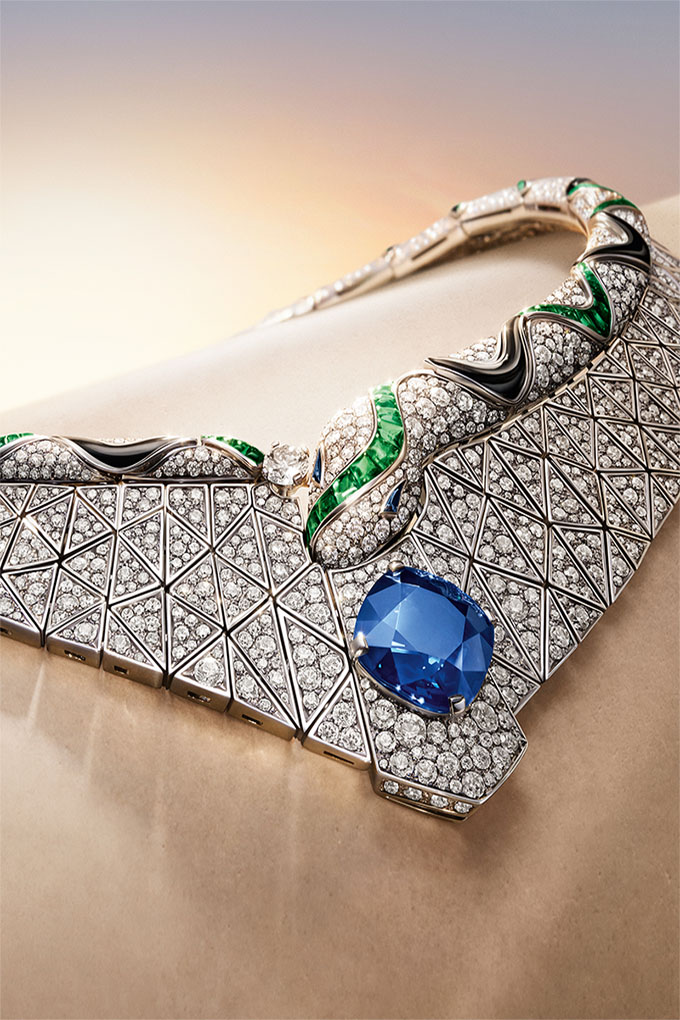
The serpent has slithered along as a talismanic motif in Bvlgari’s history after its introduction in 1948. Rendered first as a timepiece, the ever-seductive Serpenti now coils around the necks, wrists and fingers of wearers, gleaming in precious gold and the wide variety of coloured gemstones that the house is famous for.
Part of the Eclettica high jewellery collection, this Serpenti Illusio necklace is an arrangement of diamonds, emeralds and onyx, with a 14.01-carat Madagascar sapphire set in the centre.

2 / 7
Boucheron’s darling pet
Not many household pets achieve fame and glory, but Wladimir the cat is a historical exception. After being adopted in the 1970s, Wladimir became a mainstay at the Boucheron flagship at 26 Place Vendôme. He featured in an advertising campaign in 1978 wearing a high jewellery necklace, and is now the brand’s beloved animal motif.
From Boucheron’s Animaux collection comes the Wladimir the Cat ring in white gold, and set all over with round diamonds. The feline figure wears a necklace with a 0.15-carat pear-cut tsavorite, an ode to Wladimir’s jewellery campaign from the ’70s. His eyes are crafted from layered tsavorite, black sapphires and mother-of-pearl to create lifelike depth and a sense of playful mischief.

3 / 7
Cartier’s fierce predator
The panther has had a place at Cartier since 1914, drawing inspiration from the formidable Jeanne Toussaint. Toussaint was the Paris jeweller’s first female creative director and a muse to Louis Cartier; and her personality and nickname of ‘la panthere‘ influenced the house’s embrace of the fierce feline. As a motif, Cartier’s panther represents and expresses a host of attitudes: powerful, enigmatic, tender, and even playful.
Part of the Le Choeur des Pierres collection, this white gold Panthère Kentia necklace depicts a panther sitting gracefully atop a mesmerising 50.13-carat cabochon-cut Ceylon sapphire, its paw curled over the gem like a relaxed guardian. The panther’s spots are formed, in the Cartier high jewellery tradition, from diamonds and onyx, and its eyes are made of emeralds.

4 / 7
Chaumet’s regal bee
The bee symbolises order, legacy and power, having been selected by the Emperor Napoleon Bonaparte and Empress Joséphine as the family’s imperial emblem. Empress Joséphine was one of Chaumet’s most important clients and muses, and the bee was eventually incorporated into Chaumet jewellery—a symbol that has reigned for more than a century.
Not just a matter of the past, this emblematic Bee de Chaumet brooch embodies the jeweller’s naturalist eye in design with a pair of honeybees perched on an 11.08-carat cushion-cut Ceylon sapphire. The bees, made in white gold and covered with diamonds, celebrate nature’s vitality and radiance.

5 / 7
Chanel’s protective lion
A direct nod to Gabrielle Chanel’s fiery zodiac sign of Leo, the house of Chanel’s lion represents fierce courage and raw power. The king of the jungle served as a protective talisman to Chanel, and she kept a variety of lion statuettes and figurines in her Paris apartments.
Reflecting the founder’s bold character, this Lion Emblématique brooch from the Signes & Symboles high jewellery collection features a plethora of gemstones: onyx, emeralds, diamonds, sapphires, and rubies, with a 6.13-carat ruby set in its centre.

6 / 7
Hermès's noble steed
Hermès’s horse is a direct nod to its equestrian roots as a high-end Parisian maker of harnesses and saddles. As a motif, the horse symbolises majesty, elegance, strength, and, at times, a whinnying playfulness.
This year, Hermès paid homage to the horse in its high jewellery collection Into the Horsescape. It introduced this Chevauchée necklace in rose gold, with white diamonds, cabochon-cut rose-brown tourmalines, and an oval-cut one-carat white diamond set in a smoky quartz cabochon.

7 / 7
Tiffany & Co.’s feathered friend
The jewellery designer Jean Schlumberger joined Tiffany & Co. in 1956, and introduced perhaps his most famous design in 1965: the Bird on a Rock. Renowned for his vibrant and whimsical creations, this feathered icon has become the house’s most recognisable brooch, and an embodiment of joy, optimism, and freedom.
What was once a single brooch design became a full-fledged Bird on a Rock jewellery collection in 2025. This Bird ring is sculptural yet light and airy, crafted in platinum and yellow gold with diamonds in homage to Schlumberger’s original creation. The bird retains its spiky crown and hand-engraved feather textures, details that express the everlasting beauty of nature.