The wristwatch no longer has a monopoly on telling time. If anything, the time is—quite literally—omnipresent in the gadgets that surround us: on phones and laptops, microwaves and mirrors. That ubiquity has made the timepieces on our wrists even more romantic, charged with personal meaning and worn as an extension of the self. And so, the value of one’s first luxury watch—as a milestone achievement—continues to endure, and is even gaining strength amongst the 20-somethings of today.
But what should that first watch actually be? I posed the question to a handful of friends, expecting straightforward answers—instead, a surprisingly spirited debate ensued. Curious to see whether the sentiment extended beyond my own circle, I turned the conversation into an informal survey, asking Gen-Z professionals at the start of their careers as to what they believed made the ideal first watch. The responses poured in from mutual friends, mutuals of mutuals, and strangers alike. From sectors ranging from sustainability and LNG to luxury fashion, finance, and tech, one thing became immediately clear: there was not a single neutral opinion on the topic.

Buying your first luxury watch has long been tied to milestones in one’s personal and professional life, a measure of both sentiment and status. For those fortunate enough to have made the plunge, the first luxury watch often arrives as a reward or milestone; tied to one’s first “adult” pay cheque or bonus at work.
The most vigilant audience of a watch is, of course, its own wearer. With each glance at the wrist, it is a personal reminder and reflection of taste, aspiration, and identity. For those of us in our 20s, it can represent who we are in the present as well as, said Lily, a 25-year-old talent manager, “alluding to who you wish to be”.
Or, as 28-year-old tech product manager Alex put it: “A great watch match is like great sex. You’re gonna feel it in your soul, and it should reveal something about yourself.”

With how crowded the market is with options, though, navigating the choice of a first luxury watch to splurge on can come with challenges. The territories of where you work or what your lifestyle is like, for example, can make a difference. Alexandra, 23, a financial analyst, felt that certain watches come with stigmas. “You never want to be the intern wearing a Rolex. I almost need to feel like I’ve earned it before splurging, or accomplished a major life milestone. It can’t buy a status that you don’t have.”
Ahead, we surveyed and compiled the responses of 16 Gen-Z respondents on the watches they are buying, or thinking of, when it comes to their first luxury timepiece. All questions were open-ended, and our respondents were free to respond with any brands or models they liked. Names have been changed to protect the privacy of individuals.
View this post on Instagram
Finding the “one” that is uniquely yours
When I asked about what Gen-Z professionals are looking for in a first watch, the most consistent response was a desire for individuality. Unsurprising for a generation raised on personal branding, Gen-Z consumers want a watch that feels unique and speaks to its owner’s personality.
For Yuliana, a 23-year-old digital project assistant working in fashion, this comes through in one particular detail. “For me, it’s the dial that makes a watch truly special. I love when a watch has a unique detail that gives it personality,” she said. “My first watch was a two-tone vintage Rolex Datejust with a Roman numeral dial [the more classical and common Datejust dials come with baton indexes], and to this day it’s still my favourite piece of jewellery in my collection.”

A design sensibility can also guide one’s eye. 33-year-old writer Micah is partial to Bauhaus design. His first watch, purchased at 26, was a minimalist Form A by German watchmaker Junghans. “I had just moved back to Singapore and bought it as a gift for myself after getting my first job here,” he said. Now, his eyes are on other proponents of German design, like the Tangente and Metro collections by Nomos Glashütte.
The summer of sport has even made its way onto people’s wrists, though sports itself is optional. Athletic-style watches and the Casio Baby-G appeared repeatedly throughout the responses—though their appeal, our respondents explained, was more aesthetic than functional.
“I’ve always been drawn to athletic style watches. My first watch, that I’m still wearing a decade later, is a Timex Ironman women’s watch in a vibrant, warm-toned pink,” said 23-year-old gender studies student Sydney. (I followed up with Sydney on whether she considered herself an athletic person: “Not really,” she replied. “I don’t even like athletic clothes.”)
View this post on Instagram
Beyond status and luxury, nostalgia and sentiment can play a part too. Pratham, a 23-year-old business student, recounted that the first watch he bought himself, during his national service, was an engraved G-Shock collab with Eminem. It was, he said, “a watch I had wanted since I was a kid. The moment I had some money put away, I purchased it. Now, it’s my reliable travel and hiking watch.”
Product manager Alex also shared a range of preferences from the whimsy to elegant. “On the whimsy side, I’m eyeing the Peanuts x Timex Marlin Automatic Space watch, where the characters are floating around the space station-themed face,” he said. The other elegant end of his spectrum: a pink gold Jaeger-LeCoultre Reverso, with a matching Milanese bracelet.

Strap or a bracelet?
“Classic round dial, leather strap,” said Christopher, a 30-year-old senior associate in sustainability, on his preferred wrist-wearing configuration. The lightness of leather on the wrist was appreciated, too by Jude, a 23-year-old trade analyst in LNG. “It can’t feel heavy on the wrist, and it’s an easier weight than carrying a log around.”
The choice of either a leather strap or bracelet can change the look of a watch immensely. The former can give a more classic, timeless effect; while the latter can look either more sporty or jewellery-like. For some, the appeal of a metal bracelet is the glint of sculptural adornment on the wrist. “I love mixing metals,” said Lily, the talent manager. “The bracelet must be metal, because nobody needs a watch any more. I like to make a statement of it.”
Emil, a 24-year old working in investor relations, is drawn to classics that hold their value. “I usually look for a silver metal bracelet with a timeless design. Not too much going on with the dial, just a solid dark colour—maybe a chronograph. I’m looking for brands that ideally don’t devalue too much,” he said. 21-year-old real estate intern Rufus concurred, with far-sighted values: “It allows me to think I’ll be able to wear it for a long time or pass it on to my children when that time comes,” he said.
View this post on Instagram
Size does matter
The wrist-to-watch ratio appeared to be a widely observed detail. “Sometimes a watch can swallow a person’s wrist,” said Emil. Micah, the writer, had a similar opinion: “There’s definitely such a thing as too big. Get a watch that dwarfs your wrist and you’re basically wearing clown shoes on your arms.”
Smaller watches, as it happens, are back in fashion; across all genders and sexes. “When in doubt, smaller is always better,” advised Ben, a 29-year-old account executive in public relations.
Yuliana, the fashion digital project assistant, said that she is now drawn to watches with case sizes around 26 to 29mm. “Smaller women’s watches are definitely having a moment right now, which I love,” she said. “But I could also see myself gravitating towards larger pieces in the future as my style evolves. I don’t really believe there’s such a thing as ‘too big’ if the person loves how it looks and feels on them.”
Though it may be a matter of simply trying it on. “I think something people undervalue is actually trying watches on. Looking at watches online versus trying them on in person are completely different experiences,” said Pratham. “There have been many watches that I loved the look of, but didn’t like the feel of when I tried them on. Ultimately, that became the deciding factor in whether I purchased them.”

Cartier leads the aspirational pack, with Omega and Jaeger-LeCoultre following closely
The Parisian maison Cartier, unsurprisingly, sits at the top of most wishlists. In Morgan Stanley and LuxeConsult’s annual report on the Swiss watch industry, Cartier has held on to its second position in market share since it climbed to the spot in 2021. The brand’s collection of refreshed modern classics has a very strong appeal among Gen-Zs, and was the most mentioned brand out of the respondents.
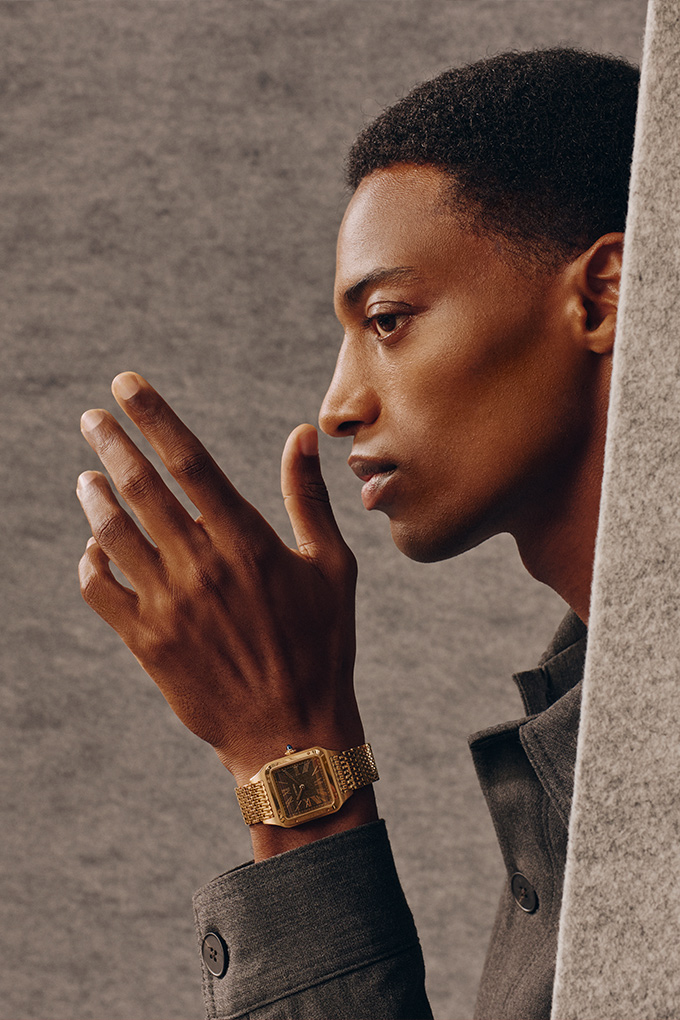
The story of Cartier’s Santos watch, especially, left a mark on two unconnected late-20s respondents we surveyed. Alex, the tech product manager based in San Francisco, was drawn to the Santos because of its history as a purpose-built watch for aviator Alberto Santos-Dumont. “If I like the story, then I would start looking at the aesthetics of a watch,” he said.
Ben, the public relations executive over in Singapore, found that flight narrative too fitting to ignore. His first “big boy watch”, as he put it, was a dress-style Santos Dumont acquired by himself as a graduation present. “As a literature major, I found the symbolism apt—that the watch to mark my ‘taking flight’ from the academic world into the corporate world should be the first watch made for pilots.”

Other Cartier classics were also popular and mentioned repeatedly, like the Tank Must in both contemporary and vintage editions. What might work in the favour of this brand is that its pieces have an intrinsic style borne of its roots as a jeweller. “I’m looking to find something that works with my existing pieces, rather than centring my jewellery around a watch,” explained financial analyst Alexandra.
“The Cartier Panthère on a stainless steel bracelet is definitely at the top of my wishlist,” added Yuliana—referencing the slim, jewel style watch that is almost endlessly spotted on the wrists of celebrities.

The Jaeger-LeCoultre Reverso is also on the minds of watch fanatics—though it remains, with its higher price point, at an aspirational level. “My friends and I have been sending each other notes about the Reverso,” said Pratham. One model that seems to have landed is the Reverso Tribute introduced in 2025 with a gold Milanese bracelet. “It is just a really beautiful watch that blends its rugged polo origins with the delicateness of monochrome pink gold,” said Alex, the product manager.
View this post on Instagram
Omega, meanwhile, represented a mix of first-watch accessibility and future aspiration. Rufus, the real estate intern, shared that his first timepiece was a De Ville Automatic on a brown crocodile leather strap. “I like the classic pieces, specifically the ones that aren’t too busy or chaotic,” he said of his tastes.
Yuliana, the fashion assistant drawn to smaller watches and special dials, has recently “fallen in love” with an Omega Seamaster Aqua Terra, with a Tahitian mother-of-pearl dial. “To to this day, I haven’t seen another watch quite like it. I think Omega is a brand that should be on more women’s radars,” she said.
Christopher, the sustainability associate, similarly has some of Omega’s icons on his list for the future. “I would love to eventually get a Seamaster and Speedmaster,” he said. “But until I can really afford to splurge, I’ll just be sporting an F-91W by Casio.”
View this post on Instagram
Before luxury becomes available, though, it’s Seiko and Casio that appear to be the most popular choices. John, a 24-year-old law student, still thinks fondly of his first, a preloved Seiko Chronograph that, he said, “got me introduced to the watch world.”
Regardless of the brand, perhaps the most important part of a watch is that it is yours. Alexandra, the financial analyst, puts it quite aptly: “What you’re wearing can be an expression of confidence, style or personality, but it can’t buy a status that you don’t have. The general consensus is that people don’t care what you wear, but they care more about your mind and personality.”
The value of one’s first watch lies in the patience that precedes it, and the milestone that accompanies the purchase. This sentiment, rather than just status, is one that endures beyond brand, model, or dial. “I’ve gone on to buy quite a few watches,” shared Pratham of his experience delving into horology, “but that feeling of accomplishment and delayed gratification, where you feel like you’ve truly earned something, is hard to replicate.”
With thanks to: Alex, 28, tech product manager; Alexandra, 23, financial analyst; Ben, 29, public relations account executive; Christopher, 30, sustainability investments associate; Emil, 24, investor relations; John, 21, law student; Micah, 33, writer; Jude, 23, LNG trade support analyst; Lily, 25, talent manager; Oliver, 25, national service; Pratham, 23, business student; Rufus, 21, real estate intern; Sydney, 23, gender studies graduate; Viraj, 24, business graduate; Yuliana, 23, luxury fashion digital projects assistant.

1 / 14
Tank Must de Cartier small model in stainless steel, $4,950

2 / 14
Santos de Cartier medium model in stainless steel, $11,200

3 / 14
Panthère de Cartier small model in stainless steel with diamonds, $12,200

4 / 14
Omega Seamaster Aqua Terra 150m in Moonshine gold and steel with diamonds, $26,600

5 / 14
Omega Speedmaster Moonwatch in stainless steel, $11,800

6 / 14
Casio G-Shock 30th anniversary x Eminem limited-edition

7 / 14
Seiko Chronograph SSB447P1 in stainless steel, $446 from City Chain

8 / 14
Tissot Lovely Square in stainless steel with diamonds, $495

9 / 14
Tissot PRX 40mm in stainless steel, $535

10 / 14
Casio F-91W in resin, $22

11 / 14
Junghans Form A in stainless steel, $1,600 from The Hour Glass

12 / 14
Timex Ironman

13 / 14
Peanuts x Timex Marlin Automatic Space in stainless steel, $510

14 / 14