Some things you can recognise in an instant. A distant look at a wrist can reveal, quite quickly, what timepiece someone is wearing. The not-so-immediately obvious give? Not a dial, case or bezel, which often needs a closer look. It is more often than not the look of an iconic bracelet that gives a watch away.
If a fine watch is, as they say, the equivalent of jewellery for men, then the design of a bracelet is a nonpareil detail worth paying attention to. Especially since the modern category of luxury integrated bracelet sport watches are–even if it was pioneered in the ’70s—still going strong as the leading style of today.

Rolex: The Flat Jubilee and Settimo, newcomers to the brand’s canon
A Rolex watch is one of the most feverishly desired things around. Part of it is the reliable excellence that the Swiss brand offers, the luxury of a finely made workhorse. One other part of the Rolex appeal is, indubitably, how recognisable its timepieces are. That’s because the watchmaker is not one for short-term changes and redesigns, and never a trend-chaser. Its aesthetic hallmarks—the waterproof Oyster case, the fluted bezel that reflects light, the magnifying Cyclops lens—are useful, beautiful and so time-honoured they’ve become instantly recognisable. The same can be said of its bracelets.
Some proof of Rolex’s persistent (perpetual, even) language of design can be found in its bracelets. There are, in its present catalogue, just six kinds. The famous five-link Jubilee from 1945 released to celebrate the brand’s 40th anniversary; the robust and fundamental three-link Oyster, with design precursors from the ’30s and officially introduced in 1948; the elegant three-link President, offered exclusively in gold or platinum, which debuted in 1956; and the rugged Oysterflex of 2015 which combines rubber with flexible metal blades for comfort without sacrificing structure.

The years between when these bracelet styles were introduced should paint a picture of how decidedly Rolex sticks to its signatures. Which is why it was significant in 2025 when the brand launched two new styles. The Flat Jubilee to accompany the new Land-Dweller collection, and the Settimo for the 1908 dress collection.
The Flat Jubilee is designed to integrate with the Land-Dweller, with a continuity of bevelled and polished edges from case to the two outer links to create the look of an unbroken line. Its outer links are satin finished, while the middle links are polished and slightly raised so that while there is an impression of level flatness, there is simultaneously a visual rhythm to the weave.
The Settimo, meanwhile, is designed to dress the elegant 1908 collection. Its name, Italian for ‘seventh’, reflects its seven links, which are crafted from yellow hold and polished for brilliance. The evenness and purity of the bracelet is matched with a nearly invisible Crownclasp, which registers to the eyes as an almost merely decorative motif.

Breitling: The Rouleaux, a modern-retro icon revived
Unlike many bracelet designs that started life as objects of beauty, the Rouleaux of Breitling’s Chronomat began with a squadron. The Frecce Tricolori, the Italian Air Force’s famed aerobatic team, were searching in the early ’80s for a chronograph that could do double duty: handle the G-forces of their loops and rolls in the sky, and look sharp at official functions. The result that Breitling delivered was the Chronomat, which came anchored by a bracelet style that was as much an instrument as a style statement.

Named the Rouleaux, French for ‘rollers’, the cylindrical link style is nicknamed ‘the Bullet’. When it was delivered, Frecce Tricolori pilots were promised a bracelet tough enough to even be placed under a boot for traction in the snow. In the late ’80s, the Rouleaux-ed Chronomat had evolved into a style symbol, even gracing the pages of Vogue; though by the ’90s and 2000s, Breitling began phasing this design out. Instead of fading into obscurity, it became something of a collector’s cult favourite.
Fast forward to 2017 when Breitling leadership landed in new hands. CEO Georges Kern eschewed contemporary prototypes in favour of a design tinged with archival inspiration. Enter the modern Chronomat, which revived the Rouleaux bracelet—now with a smoother, slimmer, lighter and more tapered design. Its style cred has been embraced not just by Breitling, but also by its collaborators. When fashion designer Victoria Beckham and footballer Erling Haaland were invited to design their own models for the brand, they opted for the Chronomat, giving the modern-retro icon and its unique bracelet new days in the sun.

Zenith: Climbing the Ladder
In the field of watch bracelets, one name you must know is Gay Frères. Originally a Swiss chaîniste company founded in 1835 that specialised in chains and jewellery, it supplied horology brands with fine gold chains for pocket watches. In the 1930s, the Great Depression forced a shift in tastes from precious metals like gold to steel. Watches worn on the wrist, too, initiated a new norm. While many chaînistes of the time failed to adapt, Gay Frères managed to pivot and become the preeminent supplier of creatively designed and finely crafted bracelet styles for Patek Philippe, Heuer, and Vacheron Constantin. The company was a major supplier to Rolex, which acquired and integrated Gay Frères into its in-house production capabilities in 1998. All this to say that the company was highly respected, and even today original bracelets with the Gay Frères maker’s mark stamp (‘GF’, with a chamois goat’s head in profile) can command a premium.
One of Gay Frères’ more idiosyncratic designs is the ladder bracelet for Zenith. It features alternating open-centred links, bridging its sporty aesthetic with a look of airy lightness. Zenith introduced the ladder bracelet in 1968 on a number of sport models, but the next year would be seminal for the watchmaker. In 1969, Zenith unveiled its legendary El Primero, the world’s first integrated automatic high-frequency chronograph movement. It set a standard for chronograph wristwatches, and the brand quickly imparted its El Primero watches with this distinctive bracelet design.
A taste of that fine vintage sense can be had from Zenith’s Revival collection, which brings back historic models from its archives. This year, it’s introducing the Defy Revival A3643, a reproduction of one of the Defy collection’s earliest models from 1969. Cased in stainless steel with a size of 37mm, the signature 14-sided bezel, and a silver-toned dial, the watch is naturally fitted with the emblematic Gay Frères ladder bracelet. Says the brand of the style’s place in fidelity: “When a historic reference was originally conceived with a specific bracelet, restoring that reference without it would feel incomplete.”

Cartier: The industrious style of the Santos
The Santos watch by Cartier is historically significant. Designed for Alberto Santos-Dumont in 1904, it responded to the pioneering Brazilian aviator’s search for a timekeeping device with ease of use that he could navigate the skies with. Santos-Dumont, one must understand, was a celebrity of his time—something like a superstar footballer or F1 driver of our times. When he embraced Cartier’s design, he opened the doors for men to start wearing timepieces on their wrist, pretty much popularising and setting the foundations for the form of the modern watch.
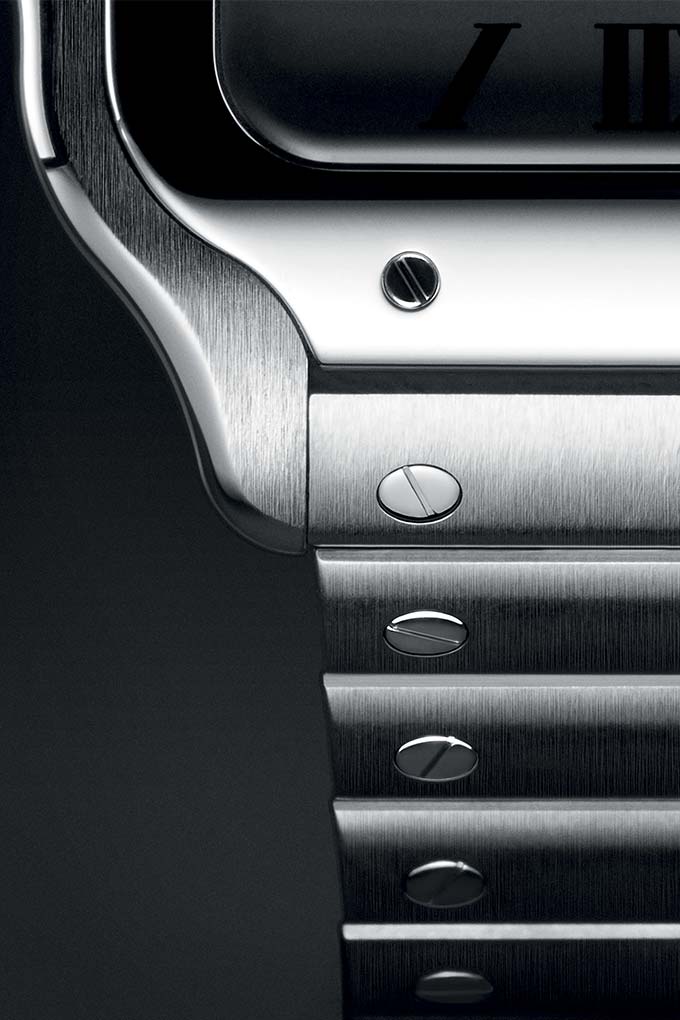
What’s interesting about the Cartier Santos is that the Parisian high jeweller drew not from its wheelhouse of jewelled or ornate design, but referenced instead pure industrial function. A square case, versus the classical round shape inherited from pocket watches, and visible screws on the bezel instead of hiding such functional details. In 1978, the maison unveiled a radical new model: the gently bulked up Santos de Cartier that would define its modern look. It featured, in a first for Cartier, a two-tone steel and gold construction as well as the signature Santos metal bracelet. Broad, brushed links dotted with polished screws, it is a fundamental detail of the popular collection today.

And when Cartier revamped the Santos de Cartier in 2018, it introduced, among other subtle design tweaks, two features to the bracelet that echo Santos-Dumont’s original request in the 1900s for ease of use. A patented QuickSwitch system so that it can be easily swapped for leather straps, and a patented SmartLink system so the length of the bracelet can be adjusted without tools.

Audemars Piguet: True, tapered refinement on the Royal Oak
“When you see the watch on your wrist, the light sings on the bracelet!” Those are the words of farmed watch designer Gérald Genta, in an interview given to Audemars Piguet about one of his and the Le Brassus watchmaker’s crowning achievements: the Royal Oak. This watch is widely recognised as the one that blew the doors open for a new paradigm of luxury to emerge. It was the first timepiece Audemars Piguet, one of the fanciest of fancies, was crafting from stainless steel, designed with a sporty, casual attitude, and selling at top dollar. Audacious.
Precisely because it is an integrated design, the Royal Oak’s bracelet had to stand up to the very high aesthetic standards of the rest of an Audemars Piguet timepiece. The first iteration of the bracelet, no.344, debuted in the 1972 original. It was a complex piece of work, with 154 components, 20 links, 44 studs, 75 pins and eight screws.

Look a little closer at a Royal Oak bracelet and subtle details of extreme, almost obsessive care begin to emerge. Unlike most watch bracelets, Audemars Piguet’s tapers elegantly towards the clasp. That means links of different sizes and therefore machining different studs, pins and screws for each size of link. Bracelet no.344, if we consider only the original, starts with the widest link at 25.9mm and curves as it goes to the skinniest link at 16.9mm. Not just the width changes. To adjust for proportion, the distance between the two centre studs narrow as well. Since the original launch, Audemars Piguet has introduced 29, 35, 36, 30, 33, 40, 37, 41, 38 and 24mm case sizes to the Royal Oak line. You do the math for how much adjustment needs to happen just to recontextualise the bracelet.
And then there is the unofficial test to see if the taper has been properly executed. One must be able to run their finger along the length of the bracelet on the sides without catching or snagging on jutting parts—a sensuous trial by touch of true refinement.

Vacheron Constantin: Subtle identity expressed on the Overseas
The embrace of sporty watches in the ’70s was a monumental change in design. As the finest horological houses took to the style, each added its interpretation of the narrative. Vacheron Constantin’s Overseas—introduced in 1996 and tracing its lineage to the if-you-know-you-know collector’s favourite, the 222—is marked by a spirit of travel. A sports timepiece that has both the durability and the impeccable looks to, indeed, go anywhere.
When Vacheron Constantin reinvented and refreshed the collection in 2016, one of its most visibly changed elements was the bracelet. What previously were three rows of blocky, rectangular briquette links was replaced with a grooved and angular design where the middles are cut and shaped as slices of the brand’s signature Maltese cross motif. A subtle touch of brand identity, which is echoed in the cutouts of its six-sided bezel. This bracelet style, which has come to define the modern Overseas, is of course finished with haute horlogerie precision of satin-brushed surfaces with polished interior angles.

Patek Philippe: The polish and perfection of the Nautilus
Patek Philippe is celebrated for its high watchmaking. As in, stupendous horological complications like perpetual calendars, chiming repeaters, chronographs that can time split seconds, and certainly more. But it’s the Nautilus, its sport-chic icon from 1976, that might express best the seductive beauty of a fine timepiece.
The Nautilus is one of Gérald Genta’s design masterpieces, drawing from nautical associations. As it happens, Philippe Stern, president of Patek Philippe between 1993 and 2009, was a passionate skipper who contested regattas on Lake Geneva. The curved, sensuous lines of the Nautilus recall hermetic portholes on classic ocean liners. Its name summons a host of associations: the golden ratio perfection of a mollusc’s spiral shell, perhaps the spirit of the adventure from Jules Verne’s novel Twenty Thousand Leagues Under the Sea.

Even as the collection has grown to include complications and haute joaillerie designs, it’s perhaps the platonic ideal (coincidentally, the configuration that is still most commonly longed for) of a time- and date-only Nautilus that is most alluring. It’s not for lack of complexity. It takes 159 components to build a bracelet, including the many pins and tubes that join the links, and the parts to form the butterfly clasp. The bracelet is made up of H-shaped exterior links with a satin-brushed finish, and gently domed internal links brushed to a high polish as though they were gem-like pebbles of metal whose beauty has been revealed by rushing water.
This article was originally published in the April 2024 ‘Pursuit’ edition of Vogue Man Singapore.