Good taste, according to Bunny Mellon, is a fastidiously subtle thing. The American heiress, art collector, philanthropist, gardener and veritable jewel fiend, born Rachel Lambert, lived by a powerful maxim: “Nothing should be noticed.” Nothing, indeed, is the unassuming first effect one gets in the environs of Oak Spring, the sprawling estate of the late art collectors and philanthropists Paul and Bunny Mellon in Upperville, Virginia, in the US.

I am here in Oak Spring, in a way, because of a friendship that has endured. Mellon was a dear friend and patron of Jean Schlumberger, the great jewellery designer who is one of the most influential of the last century. The pair met in 1954, two years before Schlumberger officially joined Tiffany & Co. as a designer and vice-president; Mellon subsequently became one of his great collectors. Pierce McGuire, Tiffany & Co.’s historian and former director of the brand’s Schlumberger salon in New York, says the New York house was, at almost any given moment, working on something for Mellon.

There are many touching marks of this friendship in the house. Letters from Schlumberger signed ‘Johnny’; paintings and drawings he sent Mellon for little reason beyond making her smile; the finial that sits above the formal greenhouse which was designed by Schlumberger. In her greenhouse, there is a humorous trompe l’oeil of a gardening room’s cupboards and implements painted on the actual gardening room’s cupboards. On one panel, a pair of Mellon’s Schlumberger Sixteen Stone rings are painted tied on a string, as if she had taken her jewels off to go pruning.


In every room of her Oak Spring home, pieces of art hang humbly and innocuously on almost every wall. Nearly all of these are replaced now by copies, the originals having been donated—but a quick and dirty mental estimate places the wall decorations at over a million bucks in each room. For illustration: a Van Gogh plein air sits, unframed, over the fireplace.
When she died in 2014, she bequeathed her collection of 142 pieces of Schlumberger jewellery to the Virginia Museum of Fine Arts. So vast was her collection, in fact, that there are anecdotes of Mellon being asked to loan a piece for an exhibition. Her reply was that she might have to look for it, guessing it might be under a mattress at home.


Besides the jewels and the art, though they certainly factor heavily, Mellon was known and respected for her exquisite taste. Her area of expertise was gardening and landscape design, at which she was an autodidact who learnt from collecting rare books and manuscripts on the subject. Her eye and sensitivity to these aesthetic subtleties of plants and flowers saw her redo the White House Rose Gardens at the personal request of Jacqueline Kennedy; and restore the glories of Potager du Roi at the Palace of Versailles. Schlumberger, whose designs often had a fanciful touch of flora and fauna, had a kindred spirit in Mellon.

Perhaps the most famous jewel design that exists because of their friendship is the Bird on a Rock. A cockatoo, fully gem-set and detailed with engraved gold feather tips, crest and beak, perches atop a large gemstone. It’s a combination of precise jewellery savoir-faire taken to craft the bird and the utter simplicity of letting an exceptional gemstone speak for itself. Above all, it is whimsical and fun without being funny. The art of jewellery, Schlumberger once said, “is, first of all, a means of expression”. Mellon owned one of the first of these jewels, hers a white-and-yellow diamond bird on a lapis lazuli cabochon.

Tiffany & Co. has orchestrated a great comeback of the Bird on a Rock in recent years, uplifting it and the Schlumberger style from the archives to become the aesthetic tip of the spear in the house’s modern outlook. It has been worn extensively on the red carpet as brooches or as a pendant on the neck, but until now its essential form has been basically unchanged. “The bird was sacrosanct”, says Victoria Wirth Reynolds, the chief gemologist and vice president of high jewellery diamond and gemstone acquisition at Tiffany & Co. Well, no longer.

This year, the New York jeweller is letting its famous bird take flight from its rock. The new Bird on a Rock collection will span high and fine jewellery, with wider variation in the expression of movement and attitude of the avian.
“Sassy bird,” says Reynolds, who is in Oak Spring to introduce the new line, was a creative precursor to the collection. She’s referring to a design variation before this collection was formally conceptualised. The bird’s stance—classical in profile and perched forward—was lifted and made taller, with its head cocked backwards.

Nathalie Verdeille, the house’s chief artistic officer of high jewellery and jewellery, designed her new Bird on a Rock pieces with abstraction and naturalism in mind. The latter appears most clearly in the high jewellery, the loveliest of which come set with luminous American blue turquoise. The stone is said to be one of the inspirations behind the house’s famous shade of robin’s egg blue, and, adds Reynolds, one of very few truly American gemstones and therefore perfectly apt for Tiffany.
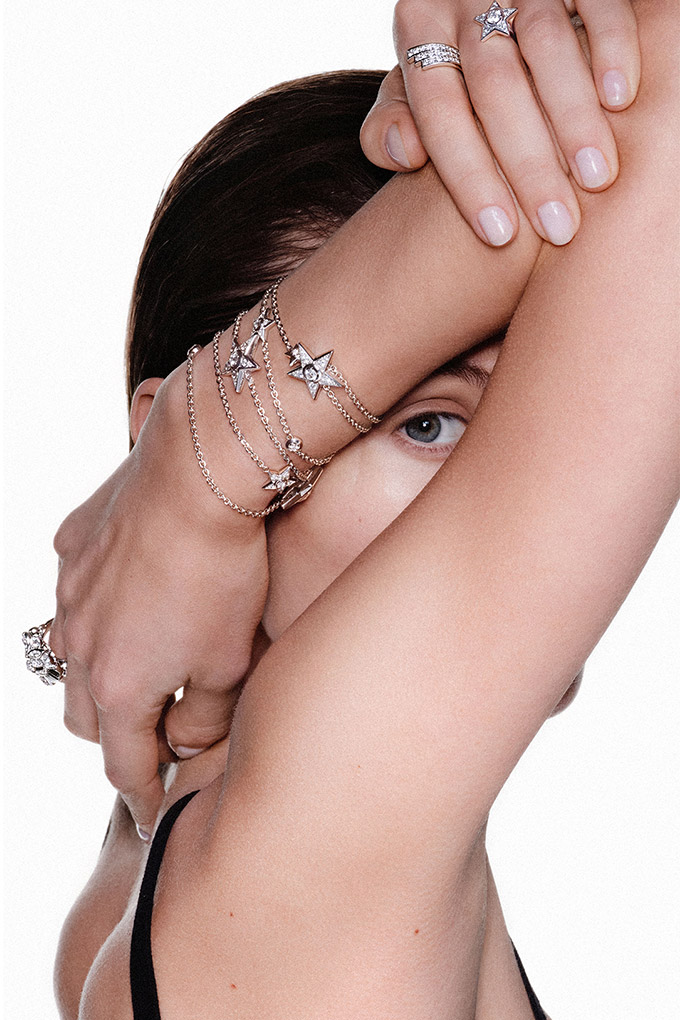
Abstraction can be found in the fine jewellery, wherein the wings of each bird have been made into a motif. Verdeille has preserved the finest details from the classical Bird on a Rock: feathered wing tips in engraved gold and elegant organic curves. What’s exceptional is the subtle, jewellery craftsmanship involved even in such seemingly simple designs. A single piece can involve up to three different diamond-setting techniques to create plays of light and subtle differences in texture; and a line of rings and bracelets with layered feather motifs feature an ingenious style of hidden channel setting with no prongs that makes the diamonds appear fuller and more brilliant.
The September 2025 ‘Big Fall Issue’ of Vogue Singapore is available to pre-order online and on newsstands from 4 September.