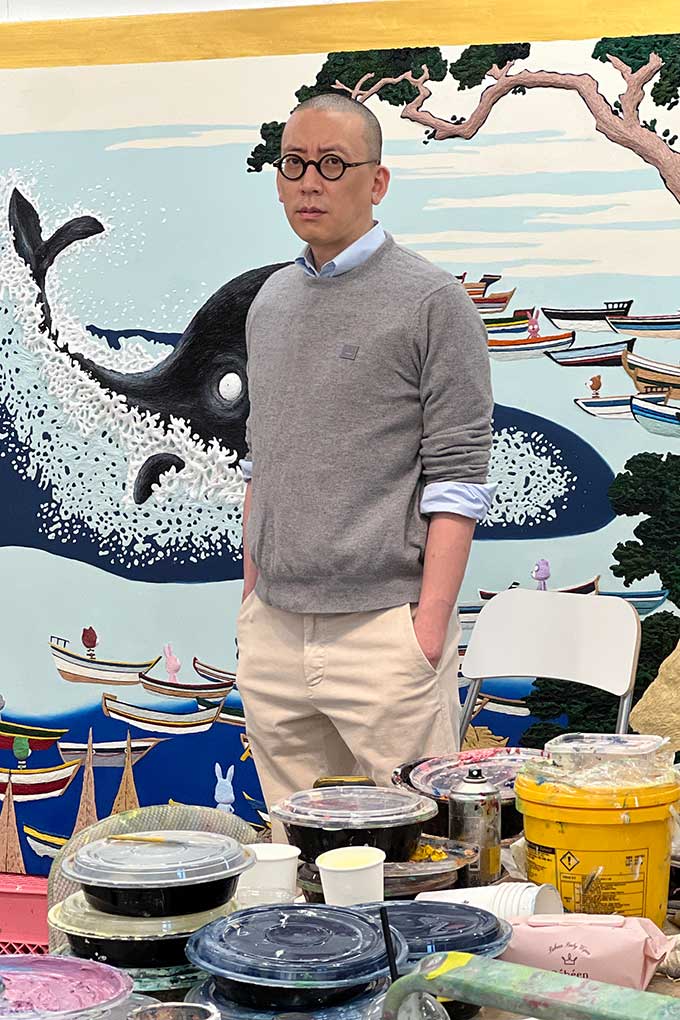
There lies a certain magic in stepping into a world that is made entirely from its own fabric. At Tang Contemporary Art, Woo Kukwon’s first solo exhibition in Singapore, Universe’s Universe, allows visitors to do just that. Distinct and whimsical, his art provides a glimpse into a cosmos shaped by mythology, literature and the quiet wonder of everyday life.
The title of this exhibition carries dual meaning. For one, it calls to mind the endless imagination and wonder that the concept of the universe evokes. But more profoundly, Universe’s Universe is a world inspired by Woo’s young daughter Woojoo—whose name translates to ‘universe’ in Korean—and the way she views and experiences life.

Woo’s signature style is unmistakable: vibrant colours, thick textures and a playfulness that reveals his vast imagination. His works bring together the magic of fairytales with visual storytelling that feels alive, open-ended and emotionally resonant. Over the course of his career, collaborations with brands like Dior, Valentino and BMW have transformed his paintings into wearable art and immersive experiences, drawing a global collector base that includes the likes of BTS’s V, Blackpink’s Jisoo and actress Son Ye-jin.
Working closely with Yonni Park and Sue Oh, the directors of Tang Contemporary Art Seoul and Singapore respectively, Woo shaped the exhibition to highlight both his technical mastery and the intimate storytelling at the heart of his practice. Through 24 works, visitors encounter a parallel reality that boasts child-like wonder as well as a deep understanding of the human experience—a vision of the world seen through the eyes of artist, father and daughter all at once.

Take us back to the start of your career as an artist. What were your earliest inspirations for making art?
Art has been woven into my life from the very beginning. My father, a lifelong literati painter, filled our home with the quiet hum of artistic discipline. In his studio, the scent of ink, the rhythm of brushstrokes, and the ever-present images became the texture of my childhood. But it wasn’t all romantic. From close up, I saw how gruelling an artist’s life could be. Creativity often came wrapped in solitude. To live as an artist was to grapple endlessly with oneself.
There was even a time I swore I’d never follow that path. But the impulse to draw never left me. After years of emotional searching, I found myself returning to art—not with resistance, but with clarity. Looking back, I don’t think I ever had another option. Art wasn’t a career choice. It was already inscribed in the way I lived and understood the world.
You have a very whimsical, vibrant and distinct art style. What drew you to this and how has it evolved over the years?
I’ve always felt ill at ease with rigid structures. The conventional, the orderly—these felt more foreign than freeing. So my work began much like spontaneous mark-making, almost like doodling. To this day, I try to maintain that sense of openness. I don’t set rules when it comes to colour, texture, image or text. I experiment freely, sometimes painting with sticks or coloured pencils instead of brushes to achieve more visceral, expressive surfaces. The thick textures that now define my work weren’t part of some master plan. They began as small gestures to amplify parts of the canvas, and gradually, they took on a life of their own. I see my process not as completing a form, but as exploring the possibilities that lie beyond it. There is no fixed destination—only the continuous act of searching.
“I hope to recover something forgotten—a clarity only visible when seen without the interference of adulthood”
Can you tell us more about the motifs that appear in your art?
My motifs often emerge from the space where personal experience intersects with impressions left by literature, philosophy, music, and religion. As a child, I was immersed in books. I was captivated by the moral ambiguities, the symbolic layers, and the profound questions about good and evil, love and sacrifice. Rather than quoting these sources, I deconstruct and reimagine them. They become part of a new fable—one told through my own visual language. Each painting builds a narrative of its own, not from what was, but from what could be.

Tell us about the thought process behind this exhibition. What inspired the pieces, and what was the process of creating them like?
The exhibition title, Universe’s Universe, holds many meanings—but for me, it is most intimately tied to my daughter, Woojoo. Her name also means ‘universe.’ Her birth was a big emotional shift and made me reconsider everything I thought I knew. That transformative energy lives in these works. Since her birth, the image of a child has appeared again and again in my paintings—not just as a portrait of Woojoo, but as a vessel for a purity I’ve long yearned to rediscover. Through Universe’s Universe, I hope to recover something forgotten—a clarity only visible when seen without the interference of adulthood.
This is your first solo exhibition in Singapore. How do you feel about bringing your art to a Singapore audience?
I’m deeply grateful for the warm welcome I’ve received here, especially as a first-time visitor and exhibiting artist. This city left such a positive impression on me—clean, calm, kind. I already know I want to return, next time with my family. I look forward to continuing this connection and plan to take part in the next art fair in Singapore. This is not a farewell—it’s a beginning.

Having worked with fashion brands like Dior and Valentino, what do you think is the relationship between fashion and art?
When I first collaborated with fashion, I was both excited and apprehensive. How would the emotional texture of my paintings translate into something wearable? The process of adapting painterly elements into tactile materials was challenging, but also deeply inspiring. What struck me most was the brand’s commitment to evolving their identity without losing its essence. I was moved by their energy—how fashion, like art, can expand meaning while preserving core integrity. To me, fashion is a wearable sculpture. It’s not just a commodity; it’s an aesthetic language that brings art into daily life. Like a painting, it speaks of its time.
What do you hope people take away from your art?
There’s no fixed message in my work, and I never hide secret meanings. I want viewers to construct their own stories, shaped by their own eyes and lives. The imagery may seem familiar, but its significance isn’t universal. Some might feel joy; others might find irony or melancholy in a small detail. I want to leave that ambiguity intact. Some elements may clarify a theme, while others invite metaphor. Ultimately, I hope people see the work as it is, and feel it as they wish—unfiltered, unprescribed. If it leaves a personal impression, however faint or fleeting, then it has done its part.
Universe’s Universe runs from 26 July to 30 August 2025 at Tang Contemporary Art Singapore.