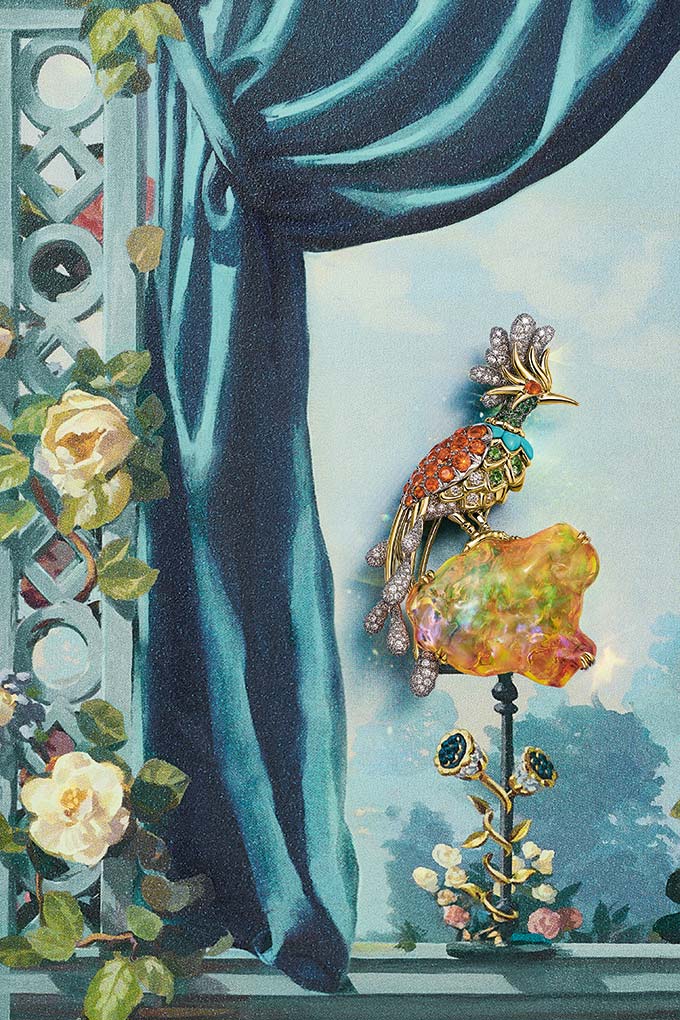
Tiffany & Co. unveiled the spring chapter of its Blue Book 2026 collection in New York, transforming the penthouse of its landmark flagship on Fifth Avenue into a verdant paradise. The setting was an interpretation of Oak Spring, the famed Virginia farm estate of one of the maison’s most influential clients and muses Rachel Lambert Mellon. Better known as Bunny Mellon, she remains a rare figure in American culture who effortlessly joined taste, discretion and influence.

A passionate horticulturist, Mellon did more than simply wear Jean Schlumberger’s creations—she completed the narrative behind them. Her deep appreciation for nature mirrored the legendary designer’s fascination with flora and fauna, a dialogue that resonates throughout the Blue Book 2026 collection, titled Hidden Garden. The result is a range of high jewellery that reimagines some of Tiffany & Co.’s most celebrated motifs, from the iconic Bird on a Rock to emblematic butterflies, and from cascading ivy to delicate jasmine blooms, each infused with a sense of vitality and movement.

Tiffany & Co.’s chief artistic officer Nathalie Verdeille designed this collection, which frolics delicately between surrealism and wonder. Yet beyond the extraordinary gemstones and savoir-faire virtuosity lies a larger question: how does one continue the legacy of both Tiffany & Co. and Schlumberger while ensuring it remains relevant to a new generation? Verdeille shared her insights over email on creativity, legacy and the evolving place of high jewellery in a rapidly changing world.
Looking back on your time in New York, what have you learnt from immersing yourself in the culture of Tiffany & Co.?
It has reinforced the idea that Tiffany & Co. is as much about people and their memories as it is about jewellery. Every day, I move between two worlds. One is the archive, which holds more than 150 years of extraordinary motifs, icons and unrealised ideas waiting to be rediscovered. The other is the personal stories attached to our creations. An engagement ring, an anniversary bracelet, a jewel passed from one generation to the next—every piece becomes part of someone’s life. I love contributing to those living stories. Each collection is a dialogue between past, present and future. There’s something incredibly meaningful about giving a young woman the opportunity to wear a contemporary interpretation of a piece her grandmother once loved. It allows the emotional thread to continue while breathing new life into Tiffany’s legacy.

Do you see yourself more as a designer or as a custodian of a legacy?
I see myself as a storyteller. Some designers feel the need to distance themselves from the past in order to leave their mark. I’m drawn to the opposite approach. My role is to connect Tiffany’s history with the intimate and contemporary stories of the people who wear our jewellery. The archive offers endless inspiration, but history is never static. It becomes meaningful when it is re-interpreted for a new era. I find great joy in creating that conversation between heritage and modern life.
Jean Schlumberger’s work was rooted in nature and a sense of engineered whimsy. How do you approach his legacy today?
Jean Schlumberger once said that he wanted everything to appear organic, irregular and alive. That creative spirit continues to guide me. Like him, I begin with individual elements: a stem, a leaf, a petal. Each detail is treated as a living entity. As they come together, the piece begins to take on a life of its own, becoming dimensional, vibrant and almost more real than nature itself. What fascinates me is how volume and movement can transform jewellery into something beyond ornament. The pieces become a form of living architecture, animated by light, energy and motion. For me, preserving Schlumberger’s spirit is not about replication. It’s about embracing his sense of curiosity, daring and wonder.
“I see heritage as a springboard rather than a limitation.”
In a measured global economy, how has your definition of value in high jewellery evolved?
Today, value is as much about emotion as it is about craftsmanship. That idea guided our latest Blue Book collection, which marks a departure from the world we explored previously. After celebrating nature in all its abundance, I wanted to move towards something more sensual and glamorous, where the jewellery feels almost fused with the body. The collection also reveals a lesser-known aspect of Jean Schlumberger’s creative world that has rarely been explored within Tiffany’s recent history. It reflects a distinctly French sensibility, while retaining the bold, free-spirited energy that defines New York. That meeting of elegance and creative freedom continues to shape Tiffany’s future.


The high jewellery of Tiffany’s Blue Book has always existed between fantasy and commerce. How do you balance creativity with the realities of a luxury business?
The balance comes from understanding that heritage is alive. Collectors are drawn to Tiffany because they recognise certain themes and icons, but they also expect to encounter them in new and unexpected ways. Whether it’s an extraordinary gemstone, an unexpected cut or a bold new interpretation of a familiar motif, our responsibility is to continue delighting people without losing sight of who we are. Collections such as Bird on a Rock and the Paradise Birds chapter demonstrate how a signature idea can be revisited again and again while still feeling fresh. I see heritage as a springboard rather than a limitation. It guides us, but it also gives us the confidence to experiment, explore and create something new.


How do you decide what feels relevant today rather than simply familiar?
My approach is surprisingly simple. I design jewellery that I would want to wear. I’m drawn to generous volumes, vibrant colours and sensual forms. I want each piece to feel alive, full of movement and light. At the same time, it must feel effortless on the body. I wear every creation throughout the development process, from the resin model to the finished jewel. Comfort is just as important as beauty. I often imagine the moment when a collector first puts on a piece and sees it come to life against the skin. That emotional connection is what I’m always striving to create—the moment when a piece of jewellery ceases to be an object and becomes part of someone’s story.
The July/August 2026 ‘Audacity’ edition of Vogue Singapore is available online and on newsstands.