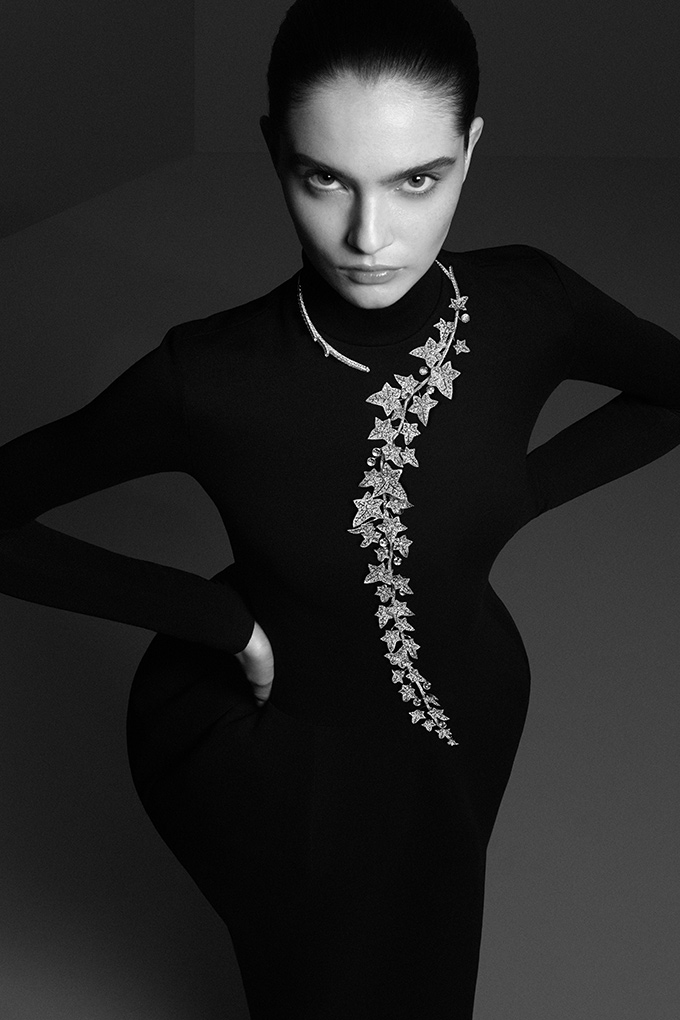
Those who don’t learn from the past, as they say, are destined to repeat it. But what if one looked to the past, fell in love with it, took from it its best, and repeated it with an eye for modernity? That is what’s happened at Boucheron, with its latest Histoire de Style collection of high jewellery. Titled Nom: Boucheron Prénom: Frédéric, creative director Claire Choisne has turned to the house’s archives and distilled three kinds of fours: four design principles, four historical masterpieces, and four remarkable new jewels.
These jewels and ideas exemplify the brilliance of founder Frédéric Boucheron, who was the first of the great Parisian jewellery houses to move into Place Vendôme, and who in his time was something of a maverick who defied convention. With this quartet of high jewellery, said Choisne in press notes, “I pay homage to Frédéric Boucheron by sketching his portrait through four major pieces”.

The first centres on the historical address of Boucheron, on 26 Place Vendôme in Paris. Before this square became the heart of high jewellery and luxury in Paris, it was rue de la Paix down the street that housed the most prestigious haute couture and haute joaillerie maisons. Boucheron bet on the square’s potential grandeur—plus, the corner building at number 26 receives fabulous daylight that makes gems sparkle. This address is so important to Boucheron’s identity that the Colonne Vendôme and the square’s octagonal shape form the house’s logo.

Choisne referenced a necklace from 1839, which featured a central pink diamond and an emerald-shaped central motif. To re-interpret the design, she pulled the lines of its silhouettes taut, lengthening and modernising the collar with lines of round- and baguette-cut diamonds, and a graphic strip of black lacquer. Its central motif deepens the illusion of an emerald shape and cut, with a setting style the brand dubs ‘mise en abyme’, or ‘set in an abyss’. Concentric rows of lacquer, baguette-, round-, and emerald-cut diamonds create the illusion of the stepped facets of an octagonal emerald gemstone cut, set in its centre with a 10.01-carat DFL Type IIa diamond of that very same kind.

Next, Choisne looked at what is perhaps Boucheron’s most radical design: the Question Mark from 1879, the world’s first claspless necklace. Choisne picked a Question Mark style from 1884 with a cascade of diamonds for inspiration.

Instead of the historical design’s line of round brilliants, she proposes now instead a sequence of fancy cuts that express the variety of diamonds. In sequence from top to bottom: a 0.81-carat DIF marquise, a 1.71-carat DFL Asscher, a 1.76-carat DFL oval, a 2.09-carat D VVS2 hexagonal, a 2.02-carat DIF Type IIa pear, a 3.07-carat DIF Type IIa emerald, a 2.96-carat DIF round, and at its tip a 5.01-carat DIF Type IIa kite-cut framed by a halo of baguettes.

Boucheron’s way of thinking about how jewels are worn on the body can be attributed to his background as the son of a draper. Surrounded by lavish silks and lace, the jeweller’s creations took on a complementary role to clothing, not merely adornments divorced from fashion. A circa 1880 shoulder jewel with flower motifs and pearls inspired Choisne, as it has for several years now, to further explore the nomadic potential of jewellery to roam and wear all over the body.

She designed a jewel made of two symmetrical halves, with a pair of ornate pavé brooches each threaded with seven chains of bezel-set diamonds that total over 2,500 diamonds and over seven metres in length. It can be transformed and worn six ways: combined to form a necklace with shoulder adornments; as a pair of shoulder brooches with the diamond chains draped on the arms; a double sautoir with drops in the front and back; two separate necklaces; a choker; and as a pair of bracelets on the wrist.

Finally, Choisne referenced Boucheron’s distinct perspective on nature. It’s an open secret that the world’s top jewellery maisons have particular styles and preferences in flowers. One of Boucheron’s high jewellery neighbours on Vendôme adores soft, almost powdery pastels; another neighbour on the rue de la Paix prefers red and a deep, intense palette. Beautiful florals most of them, but at Boucheron the preference is for untamed, unruly flora that express liberated and vivacious life. The earliest sketch of a Question Mark necklace from 1879 was rendered with a design of ivy leaves—far from a noble plant and more commonly seen as undesirable.

One of Choisne’s dreams was to reproduce the design of this first necklace and bring to reality its dramatic length. Perhaps truest to the past of the four in this collection, this necklace is based on that sketch from 1879. The creative liberties of the modern age have more to do with engineering and architecture, adapting the imposing scale of these draped vines and their tremblant-set motifs so they wear on the body with an effortless equilibrium. Large as it is, Boucheron included a multi-wear function so that the ivy jewel can be separated and turned into a shorter Question Mark necklace, a collier necklace, a brooch and a hair jewel.
Vogue Singapore’s April 2026 ‘Retrofuture’ edition is available on newsstands and online.