At half past six in the morning, birds begin to arrive, the land turns an even deeper green. Breakfast might include eggs gathered from chickens sheltered beneath bamboo, greens
picked from a nearby bed and papaya from a tree that nobody planted. After dark, crickets take over, and the occasional civet cat or porcupine appears. It is a marked contrast to their former life in Singapore, roughly a thousand miles away, where the conveniences of condominium living shaped their idea of comfort. In Bali, the family has begun to reconsider what
constitutes a good life.
“In Singapore, home was about comfort and convenience, having all the facilities of a nice condominium,” says Stefan, founder of natural sleep brand Heveya. “We probably associated luxury more with branded goods, nice restaurants and the comforts of city life. Now, luxury is having space, privacy, being surrounded by nature and being able to grow some of our own food.”

Heveya Farm Sibang, the couple’s home for the past few years, lies in Bali’s Abiansemal district, between the tourist hubs of Canggu and Ubud. Sibang is an emerging hub for sustainable architecture, permaculture and eco-living; the Magnuses’ property is a shining embodiment of this philosophy. At its heart is a restored Javanese joglo, with a separate kitchen and dining area set among vegetable beds, fruit trees, flowering plants and herbs. Pockets of wildness remain everywhere and the grounds are shaped by the natural contours of the land. Rather than a single enclosed residence, the home is a collection of buildings connected by the garden.
The family initially intended to spend a year in Bali, but stayed for five, living in Canggu during that time. As the move started to feel more permanent, they began searching for a home near the Green School—a story in itself—which their son attended. The property they found in Sibang had forested areas, a river, two natural water sources and a temple in the middle. “It also had very good feng shui,” Stefan recalls. “It just felt right.”
Listening to the land

The land was already thriving, so the couple decided to build around its contours. They resisted conventional advice to flatten the site and cut drainage channels. Instead, water flows downhill through an irrigation system.
The house came through a more unexpected route: Facebook Marketplace. In Java, Stefan explains, traditional Javanese houses known as joglo are routinely sold, dismantled,
transported and reassembled elsewhere. “We liked the idea of preserving a traditional Javanese house rather than building something new. It’s more sustainable and also much faster.”
Roughly 15m square, the joglo serves chiefly as the family’s bedroom and living space. Its high timber roof shelters an interior with few rigid divisions, as linen curtains are instead drawn around the sleeping area. An open-air bathroom has a carved onyx tub and ironwood details. Beyond the room, a broad timber veranda provides somewhere to sit and watch the farm and forest. The family planned much of the work themselves, sometimes with imperfect results. As their first project, the joglo remains the most personally meaningful part of the property.
There was no comprehensive site plan and the other structures followed as the family worked out what they needed. “We never designed everything as one big project,” Stefan muses, “but somehow it all fits together very well.”
New life for old things

That fondness for objects with a past is evident in the furnishings and other details. “We don’t follow a particular decorating style,” Stefan says. “We like using what we already have, and when we buy something, we prefer it to have a story.”
Old office cabinets once used to store name cards now hold cutlery; in the dry room, former pharmacy cabinets now store seeds. There are old opium beds, too, and chairs made of
plastic recovered from Bali’s rivers by the environmental group Sungai Watch. A long dining table by ChopValue is made from over 100,000 discarded chopsticks, pressed into a surface that, at first glance, resembles timber.
This emphasis on longevity is reflected in Heveya, which prioritises natural materials and durability. In their Bali home, those ideas have taken on a personal form, influencing both the furniture they bring home and their everyday habits. “We’ve also become more conscious of waste,” Stefan says. “We try to reuse, repair and recycle things, making them last longer instead of constantly replacing them.” Their approach to decorating is part of that thinking: furniture need not be new, nor even serve its original purpose, to earn a place in their home.
From garden to table

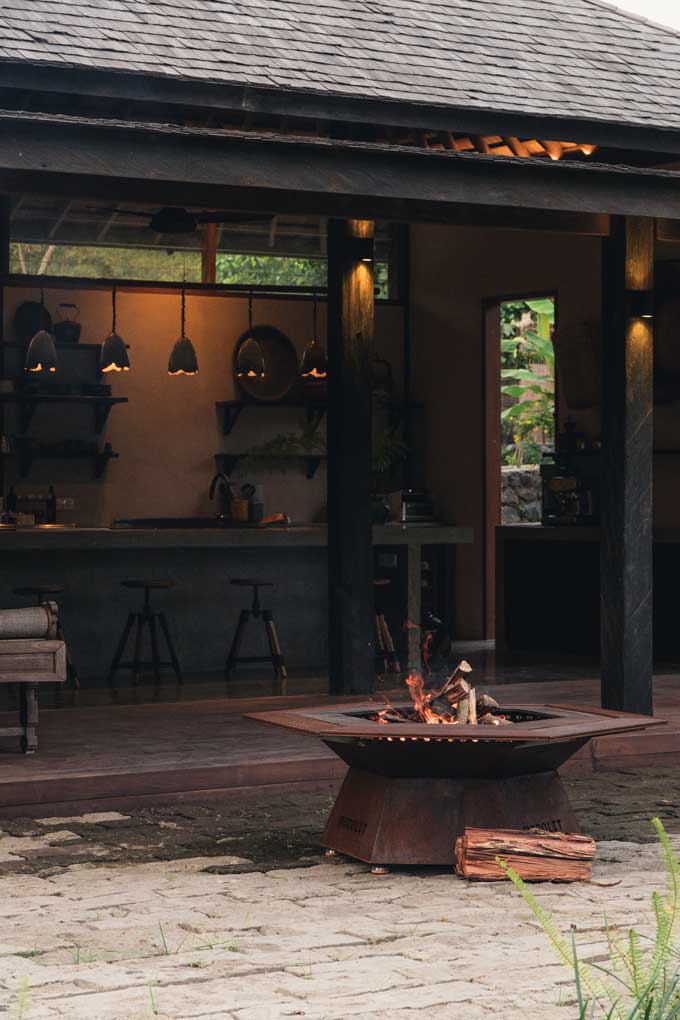
The kitchen, the most recently completed structure, serves as both a gathering place and an extension of the garden. Nearby is a purpose-built fermentation and dry room, where jars are labelled and dated and the surplus harvest can be preserved. Friends generally begin a visit with a tour of the grounds before sitting down to fruit, vegetables or teas grown and dried on the property. Even the fruit soda—made with fresh rosella or passion fruit syrup—is homemade.
Visitors are sometimes surprised by the farm’s size. “It is part of our home, not something separate from it,” Stefan says. The need to cross the farm to reach the kitchen and dining area reinforces this idea.
The family is also surprised by how well everything grows without chemical pesticides and with minimal disturbance to the farm’s natural balance. Raised beds contain vegetables, herbs and medicinal plants among flowering species and fruit trees. The beds minimise disturbance to the soil, while different crops are grown alongside one another to encourage a balanced ecosystem. The result is a landscape that is as much a garden to wander through as a source of food for the family.


Less obvious to the casual visitor are the natural systems that hum in the background to allow this place to thrive. Stingless bee colonies provide honey, of which only a small portion is taken for human consumption. Organic scraps feed black soldier fly larvae, which in turn feed the chickens. An old bathtub beneath a tree has become a vessel for earthworms that produce vermicompost for the soil. Organic waste is turned into biochar, which also goes back to feed the soil. “We’ve become much more conscious of what we eat and where our food comes from. We eat less processed food now,” Stefan says.
The measure of enough
Most mornings, Stefan rises with the sun, exercises and spends time with his son before work. Elly tends the crops; Stefan works in the joglo and walks through the farm when he needs a break. The land produces more food than the family can consume, and the harvest is shared first with the people who work there and their families, then with others in the community.
Farm life has reshaped their priorities. “Our lives were much more about business, brands and consumption. Now, wherever we travel, Elly collects seeds instead of branded handbags!” he says. The experience has prompted them to reconsider what it means to have enough, bringing a deeper sense of contentment. “We’ve discovered that needing less gives you a new sense of freedom,” he says. “To us, that’s a different kind of luxury.”