There is a particular kind of certainty that belongs only to the young.
Not certainty that life will unfold according to plan—most of us are fortunate enough to lose that illusion early—but the belief that certainty itself can be earned.
My twenties were animated by that certainty. Looking back, people often describe my career as a succession of reinventions. The Pianist. The Dancer. The Student. The Photographer. The Writer. The Consultant. The Editor. The Filmmaker. I have never recognised myself in that narrative. It assumes a neatness in life that I find repulsive.
We rarely meet people in their entirety. We meet them in a particular chapter and promptly mistake it for the whole book. The version of someone we first understand becomes the version we hope they remain. We like origin stories, redemption arcs, overnight successes that secretly took twenty years. We like narratives that resolve because resolution reassures us that the world is orderly. We say we admire reinvention, but more often we admire it retrospectively, once all the uncertainty has been edited out.
Perhaps that is why we like identities that stand still long enough to be named.
Mine never really did. Every few years, my curiosity wandered into a different medium. My early agents bemoaned my lack of focus. The Pianist learned that a pause can carry more weight than the note that follows. The Photographer learned that a frame is in fact an act of exclusion. The Writer learned that the audience becomes immersed only once the dialogue stops explaining itself. I tended to my disciplines like pets, borrowing from their lessons on emotional architecture and movement and endurance and restraint. They became available to one another. From the inside, they obeyed the same logic. I was always chasing that moment preparation dissolved into intuition—or better still, knowledge became fluency.
For a long time, I mistook fluency for certainty. I could bottle the feeling. It was a ninth-grade science exam. I had studied with such obsessive discipline that every answer arrived before I consciously reached for it. This must be what they call flow state, I marvelled at the time. Practice, I concluded, erased doubt.

Law school unsettled that belief first. Business school complicated it further. Knowledge alone was no longer enough. Instead, several contradictory positions could all be defended with conviction, and something morally indefensible could become etched into history as precedent if repeated often enough. This sat uneasily alongside the logic I had inherited as a child of immigrants that excellence was never an aspiration so much as insurance. If you were young, if you were a girl, if you were Chinese (or god forbid not Chinese enough), you had to be twice as good simply to arrive at the same start line. I convinced myself that if I could become indisputably excellent—if I became fluent in every room I entered—prejudice would eventually concede.
It was an elegant theory. It was not how the world worked. It took me longer than I care to admit to realise that I was still measuring my life against timelines designed by people whose definitions of success bore almost no resemblance to my own. The irony was that, by then, I had become remarkably fluent.
Before my thirtieth birthday, I flew from New York to Los Angeles and drove to Palm Springs with my oldest friend and my newest friend. (I would go on to fall in love with the latter—my now-partner and father of my children). The rest of my truest witnesses flew in from all corners of the world and from every chapter of my life. The one who had first met The Pianist. The one who had danced with The Dancer. The one who had hired The Photographer. The Writer. The Filmmaker. Many of them had never met one another, yet all knew the same person. Some time between dinner and cake, my newest friend asked the congregation to tell everyone How They Had Met Margaret. As we went around the table, The Editor was scarcely mentioned. Each remembered my curiosities, not my competencies. They had remained my truest witnesses—some for two decades—precisely because they had never perceived me as a sum of my milestones.
By the time we said our goodbyes, it was the Monday after the first Monday in May. I was well into my third year of living in Beijing, and by certain measures that mattered to certain insiders and outsiders alike, had become alarmingly fluent. Our team had found a rhythm that, years earlier, I wouldn’t have believed possible. We had pushed through what felt like a sonic barrier in culture, building a community that wasn’t simply reflecting the creative landscape, but participating in shaping it. Decisions that had once required enormous effort had become both instinctive and somehow procedural.
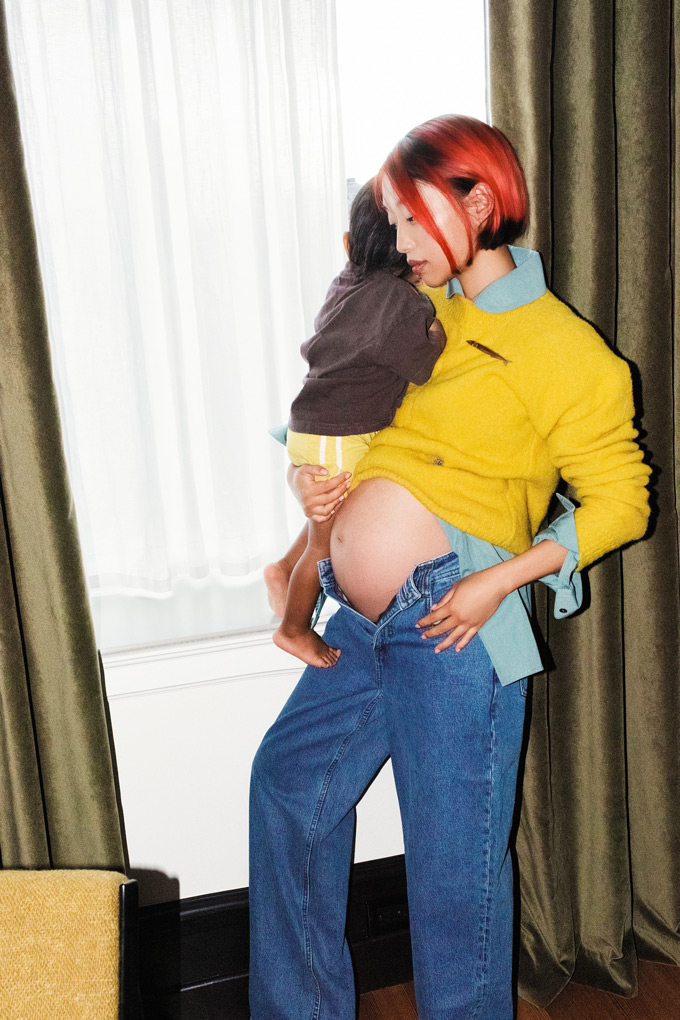
The seed planted in Palm Springs lay dormant until one jet-lagged 3AM the following Lunar New Year—sitting cross-legged on the bathroom floor, looking at two unmistakable lines on a pregnancy test.
This remains the clearest moment of my life. I had to leave Beijing.
How could I ask my unborn child to pursue their own curiosity, if I no longer trusted mine? I had mistaken competence for clarity; momentum for direction; legibility and predictability for success. Our children do not simply inherit our values. They inherit the questions we choose to keep asking. Mine had quietly become somebody else’s.
It would take the majority of my pregnancy to disentangle myself from Beijing and move back across the planet—my latest pet, The Editor, in tow. No sooner had I given birth to our son (closely followed by the placenta and my film production company) did questions emerge about when I planned to return.

Return is a revealing verb. Return to work. Return to your body. Return to public. Return to yourself. Return to normal. But where, exactly, are we imagined to have gone? Do we wait in the wings to resume as though pregnancy and childbirth and motherhood are mere interruptions to regular programming? For the first time in my career, there was no return to my chapters and pet disciplines in the way I’d known them. Hell, I tried. Work was still the language I spoke most fluently. On Zoom, the visible part of me looked composed. Out of frame, my body was swollen beyond recognition. Both were true, but a need to explain persisted — why the screenplay was taking longer, why my son cried during meetings, why I’d become quiet in public, why film, why now. I grew fascinated by the amount of narration women are expected to provide for their own lives. Not because the questions themselves matter, but because they presumed that every absence or deviation from expectation should be announced and accounted for.
I have become less interested in stories that explain women than in those that accompany them. To explain someone is to resolve them. To accompany someone is to remain beside them while they hesitate, contradict themselves, disappear for a while or change direction. The women I make films about do not exist as symbols of strength or sacrifice. They are allowed opacity. Their lives are not diminished by the fact that they cannot yet explain where they are going.
My son has shown me how early we confuse measurement with meaning. Before we have learned who a child is, we begin measuring who they are becoming: the hours they sleep, the weight they gain, the words they know.
Yet he has never once measured me. He knows only whether I am present enough to match his curiosity as he experiences the world for the first time.
Perhaps this is the certainty that belongs only to the young.