Fate is a quietly powerful thing. A familiar concept across Asian cultures, it is the belief in a predestined matter that brings people, places or things together. It calls on a divine power or cosmic order to flesh out the path of one’s life, beyond human control.
For Singaporean filmmaker Anthony Chen, fate seems to have shaped his 14-year collaboration with actors Yeo Yann Yann and Koh Jia Ler. The trio first crossed paths during casting for Chen’s debut feature, Ilo Ilo, a story about a Filipino domestic worker and the boy in her care. Koh, then 11, starred as the boy, while Yeo played his frazzled mother.

Bound by an invisible thread of fate, they reunited six years later for Chen’s sophomore feature, Wet Season, with Yeo and Koh playing a teacher and student who develop a special bond. Seven years on, the trio came together again for We Are All Strangers, the final chapter of Chen’s Growing Up trilogy. After premiering at the Berlinale, Hong Kong International Film Festival and Italy’s Far East Film Festival earlier this year, the film finally returned home in August.

“It was almost like fate brought us together again for the second film because I was constantly looking for a new fresh face, and somehow after a long search we landed back on Jia Ler, and then Yann Yann was brought in again in the process. You’re constantly looking for something when they’re actually right there before you, and I knew right away we were going to make a third film. That’s the reason I coined it the Growing Up trilogy,” Chen explains.

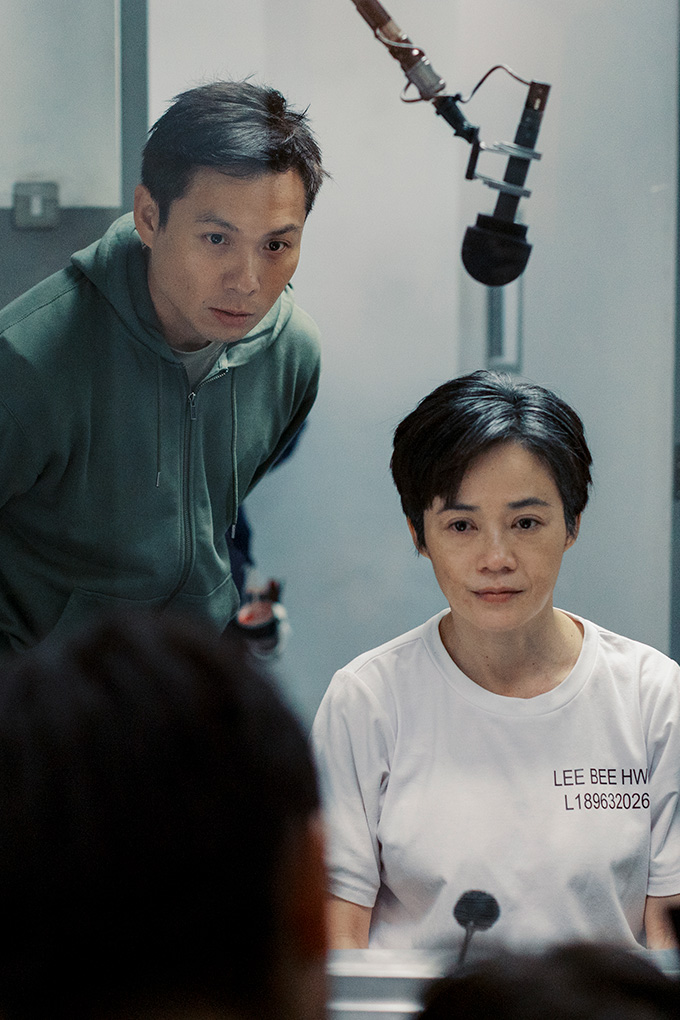
We Are All Strangers follows an ordinary family on the brink of upheaval. It centres on 21-year-old Junyang and his hawker father, Boon Kiat, whose lives are upended when the younger man and his girlfriend Lydia confront adulthood after an unexpected decision. As they navigate their new circumstances, Bee Hwa’s arrival and fierce love reshape the household dynamic. Through the parallel journeys of two couples—one young, one older—the film explores what it means to build a chosen family. Yeo and Koh reunite as Bee Hwa and Junyang, respectively.

The trilogy charts childhood to adulthood—and, coincidentally, Koh’s coming of age. In Ilo Ilo, he played a primary school boy; in Wet Season, a secondary school student; and in We Are All Strangers, a young man navigating adulthood as his world unravels. “The character is always very close to my age, but that’s how I can understand the character better,” he adds. “I feel like in a way both of us have watched Jia Ler grow up,” Chen and Yeo reflect.
Despite vastly different plots across the three films, a recurring theme runs through each: found family. Chen finds himself constantly going back to this trope, attributing it to the prominent role family plays in Asian cultures. “We always see ourselves as a collective. And in spite of Singapore being so cosmopolitan, we’re constantly aware that it’s not just about ourselves,” he says.

That sense of found family can be found off screen, too. Behind the scenes, the trio have formed a familial bond after collaborating for 14 years—a kismet connection that Chen says is unusual to find. “It’s quite special because it’s very rare in life where cinema and our personal lives intersect,” Chen comments. Yeo’s pregnancy was mirrored in her Ilo Ilo character, with the film’s final scene capturing the actual delivery of her child. Chen was the first witness.

Leading the three films has challenged Yeo creatively, physically and mentally. “I’m very grateful for this experience and I appreciate Anthony’s trust in my craft, that I’m able to handle the different characters across the trilogy,” she shares. She recalls the last 14 years fondly. “There’s pain, joy, frustration; there are crazy moments, and moments when we feel like a family.”
Chen echoes this wholeheartedly. “There are so many shared experiences that have evolved beyond the working relationship on set. What is really precious with these two is that I feel like I could go anywhere with them. There’s that very deep trust that whatever it is, we can get there. Which is why, yes, the film is about a constructed family, but that’s the family you see on screen. Off screen, we are the constructed family.”
That trust is what allows Chen to pour himself so completely into these films. Though none of the stories are autobiographical, the trilogy is deeply rooted in his inner life. “There’s so much of my own feelings and learnings about humanity, human dynamics and emotion that are placed deeply onto the screen.”

Zoom out and Chen’s trilogy reflects not just adolescence or the filmmaker’s life, but Singapore’s evolution. Ilo Ilo is set against the 1997 Asian financial crisis, while Wet Season alludes to the early 2010s through footage of Malaysia’s Bersih rallies. By We Are All Strangers, the setting is modern-day Singapore, with the family watching the SG60 National Day Parade at home. Together, the films chart a nation, preserving moments of Singapore that have changed—or disappeared altogether. “Interestingly, it feels like these films might end up becoming a time capsule, like an archive of Singapore,” Chen observes.
That’s why local cinema is important. It captures a shared history. But the value of Singaporean film lies in the people who support it. “This is a film that’s worth your time,” Yeo remarks.

In We Are All Strangers, Bee Hwa is a Malaysian who moves to Singapore for work, juggling odd jobs and caring for her younger brother before becoming a kopitiam ‘beer lady’. To Yeo, she embodies a familiar Singaporean ideal: working hard, building a home and finding belonging, even at great personal cost. “We need to reflect ourselves in films too. Everyone in the film is trying their hardest to survive and it’s very much what our society is like.”
For Chen, it is an honest portrait of his country, society and people. “If we don’t represent ourselves on screen and don’t think that our stories, characters and lives are worth documenting or worth translating on screen, then I feel like we are devaluing and looking down upon ourselves.”

Bringing these stories to the local big screen felt like a homecoming. “It was exciting to bring the film back. These three films are deeply Singaporean and I’m hoping that the Singapore audience can receive it in a big way. When we screen overseas, a lot of the foreign audiences read very deeply into the film, but I feel that only Singaporeans will connect with its nuances in a much stronger and deeper way,” Chen shares excitedly.
Fate brought Chen, Yeo and Koh together; choice kept them bonded. Fourteen years on, they hope Singaporeans embrace a story that’s truly their own.
The September 2026 ‘Beyond The New’ edition of Vogue Singapore is available online and on newsstands.