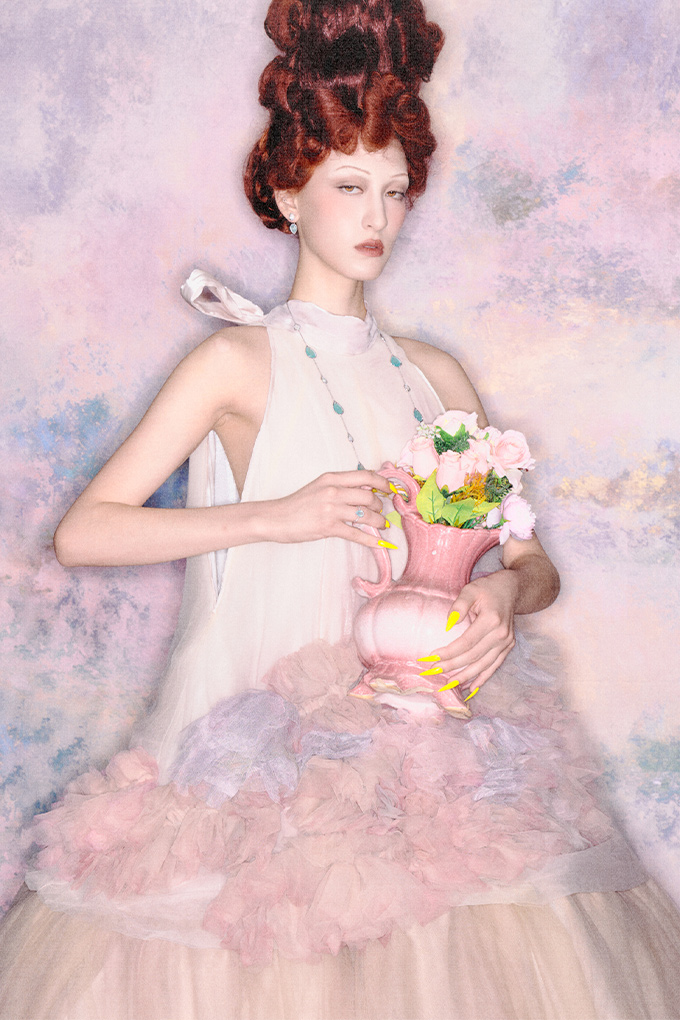
In fashion, graduation season carries its own strange theatre—a stretch of time when a single cohort of designers, working in total isolation from one another, somehow produces a spread of ideas wide enough to fill a whole cabinet of curiosities. For this shoot, cast in the soft hush of porcelain stillness and rouged, doll-like wonder, Vogue Singapore builds a world around eight collections from Lasalle College of the Arts, Raffles College of Higher Education and Nanyang Academy of Fine Arts, each a marker of where the city’s next wave of design talent is headed.
From skin rendered as sculpture to menswear unpicked at the seams, and from ancestral memory to speculative futures, these collections carry the individual histories of their makers while hinting at where their practices might grow from here. Taken together, they play like entries in the same collection—each one a singular point of view brought to life through hard-won process and personal story, transformed here into a still, painterly figure worth pausing over. Below, step through the eight distinct graduate collections on show and the stories behind their designs.

Ye Zixuan, Geraldine
Ye Zixuan, Geraldine traces her fascination with fashion to a vintage sewing machine she stumbled across in primary school, less the machine itself than the curiosity it sparked about how garments, and the stories inside them get made. Museum visits sharpened that instinct further, feeding a design process built on close observation of form and texture. Her graduate collection, Healing Hues, turns that same close attention on the body, taking human skin and its physiology of bruising, wrinkling and dehydration as its visual source material. “[These marks are] symbols of strength and endurance,” she says of the concept.
Executing it required a slow, exacting process: hand-dyeing tulle with a sponge to build irregular patches of colour mimicking real skin tone variation, then hand-pleating and gathering thousands of individually cut tulle ovals into sculptural, three-dimensional surfaces—physically demanding work given how much volume the technique required relative to her smaller frame. Nothing about the marks is smoothed over or hidden; they stay visible by design, meant to be read rather than concealed. It’s work in service of a design philosophy Ye is unusually articulate about: that what defines her work is “atmosphere and conceptual depth”, carrying a mood and an intention beneath its surface, specific enough to be recognisably hers.

Mumtaz Syahadah
Mumtaz Syahadah’s fascination with garment construction started by watching her mother hand-repair torn school uniforms. That instinct for mending and for what lies beneath a surface comes through pointedly in Fissure, her graduate collection interrogating toxic masculinity through menswear. “Fashion should not be limited by ideas or strict rules about gender,” she says of the collection’s premise, which the name gestures to directly, the cracks in rigid ideas of manhood, and the room those cracks make for feeling, softness and an evolving sense of self.
The final silhouette came after several discarded directions, including sheer voile silhouettes revealing more skin than menswear typically allows and an attempt to graft feminine motifs directly onto masculine tailoring, before Mumtaz landed on the sharper idea of working within corporate tailoring by using silhouette breaks and waist emphasis to convey unease and fragility from inside a structure coded as powerful and controlled. Executing that meant real engineering: wool suiting reinforced with firm interfacing, and a shoulder rebuilt from hard felt and boning after softer paddings collapsed under their own weight. “Clothes can help change how people think of and support being unique,” she says—a fittingly unglamorous, hard-won thesis for a collection about the cost of rigid expectations.

Isavella Kouvelis
Isavella Kouvelis believes that fashion’s greatest power lies in its ability to transform. Her graduate collection, Φως και Πάθος (Greek for Light and Passion) draws from the glamour of performance, shaped by visits to Arts Centre Melbourne’s Diva exhibition and the Grammy Museum in Los Angeles, where stage costumes and red-carpet gowns revealed themselves as far more than beautiful garments. They became extensions of the people who wore them, capable of capturing emotion, confidence and identity in a single look. “I wanted to create garments that don’t just dress the wearer but make them feel like they’re stepping into the spotlight of their own world,” she says.
That spirit carries through a collection that is unapologetically devoted to occasion dressing. Rich duchess satin, velvet, sequins, feathers, rhinestones and Swarovski crystals are brought together through corsetry, precision draping and structured internal construction. While the finished garments revel in glamour, they are underpinned by extensive hand embellishment to keep each heavily corseted piece comfortable without losing its sculptural form. Kouvelis’s collection is an ode to fashion’s emotional pull—those rare moments when getting dressed becomes an act of confidence, celebration and self-expression. As she puts it, “fashion isn’t just about what we wear”; it’s about the stories a garment allows us to tell.

Ahmad Hanif
Ahmad Hanif hadn’t always imagined a future in fashion. Ballet was his first love, and for a time, he dreamt of becoming a dancer. That path was not available to him growing up, but the language of movement stayed with him, eventually finding new expression through design. Discovering Alexander McQueen was a pivotal point: proof that clothing could hold narrative and emotion, not just drape a body. “That changed the way I saw fashion and inspired me to study it,” he says. His graduate collection, Silent Pirouette, explores identity through the lens of ballet and the gendered expectations he encountered wanting to pursue it as a boy.
Ahmad’s works are led by textile experimentation and it shows: felting and hand-beading build surfaces that reference the bruises ballet dancers accumulate through years of training as evidence of their endurance rendered soft. Organza and tulle keep the silhouettes moving, echoing the fluidity of the discipline that inspired them. Rather than staging masculinity and femininity as opposites, in the vein of Simone Rocha’s menswear interventions, Ahmad wants them coexisting in a single body. “I wanted to show how they can exist together in one person,” he explains of his collection, which draws less from theory than from a life spent watching a dream he didn’t get to live.

Chen Si Hang
Chen Si Hang designs jewellery as wearable art. “Beyond its visual beauty, I believe every piece has the power to convey emotions,” she says. Her graduate collection, Sensoria, sees each piece as an intervention against modern burnout, drawing on principles of Zen and the visual language of prayer beads to build objects meant for pause rather than performance. Rose quartz, chosen for its associations with emotional balance, anchors pieces alongside sandalwood beads infused with essential oils, releasing a calming scent throughout the day as the piece is worn.
Technically, the collection leans on precision as much as symbolism. Moving parts, engineered with the help of 3D printing for precision, invite the wearer to fidget and touch, turning what could be passive ornamentation into something that’s closer to a daily ritual. “[Each piece] invites the wearer to pause and engage with the jewellery,” she notes of the design intent. Chen’s minimalist, sense-led approach, which is rooted equally in traditional cultural reference and contemporary material technology, argues for jewellery as a quiet form of self-care rather than a decorative statement.

Quek Yu Tong
Quek Yu Tong grew up around makers—a seamstress grandmother and a grandfather gifted at sketching and sculpture, and that inherited instinct for craft collides in her graduate collection with a speculative premise. Rebirth is set in the year 3100, a future in which Chinese cultural identity has nearly vanished, preserved only in fragments. The collection asks what’s left to rebuild from and how. Quek found her answer partly in the Chinese mythological figure Ne Zha, whose story of self-renewal and choosing one’s destiny she treats as guidance rather than folklore. “Culture isn’t something fixed in the past,” she says, believing that it can evolve and be carried forward.
That premise plays out through two techniques layered together: traditional Chinese knot-making reimagined in fabric rather than cord so each knot becomes a structural garment detail rather than an ornament, and patchwork, where every fabric fragment stands in for a scattered piece of cultural memory—mythology, belief, ritual—pieced back into something whole. The result is deliberately maximalist: heavy layering, bold colour, exaggerated silhouettes and modular pieces built to be restyled, reflecting Quek’s pull towards sci-fi, EDM and lucid dreaming as much as her Buddhist and cultural roots. “Your destiny is shaped by your choices rather than by others’ expectations,” she says of the guiding idea holding the collection together.

Andrea Sanchez
Andrea Sanchez came to fashion by way of fine art and a passing thought two years before her degree began, what if I studied fashion instead? Her graduate collection, Origenes, returns to that fine-art instinct, built on nine months of research into Mexican surrealism and the extreme gender-based violence women face in her home country. The aim was never to make the subject palatable. “[I wanted to] reclaim the narrative surrounding the perception of the body,” she says of the collection’s core intent, using the surrealist technique of Automatism—quick, abstract drawings of the female body—as the starting shapes for her draping.
Sanchez constructed the entire collection herself, a six-week process she took on to avoid outsourcing any part of her vision, down to a wet-moulded leather technique she’d never attempted before: soaking and shaping the leather over a form as it dries, chosen because it could hold shape like a second skin. A black-and-white palette, arrived at after early colour experiments felt disjointed, let the silhouettes and leatherwork carry the weight instead. Gold accessories nod to Mexican craft traditions and pull the narrative back to its source. She says it was always about “trusting the process and not focusing on the final outcome”.

Lim Min Teng, Kashawna
Lim Min Teng, Kashawna traces her path to fashion back to a childhood atelier visit, where she watched a designer sketch her mother and grandmother’s outfits for a family wedding and then, over a few unhurried weeks, turn paper into garment. That fascination with transformation resurfaces in Jellyfish Allure, her graduate collection built around an unlikely inspiration: the jellyfish. “I began with the idea of imagining what a jellyfish would wear if it were human,” she says, not to camouflage the creature’s strangeness into something more palatable, but to let a character embrace it fully, translating jellyfish movement and fluidity into a wardrobe of self-possession.
The making process had its own turbulence. An early attempt at dip-dyeing fabric for an ocean-blue ombré didn’t take evenly, leaving visible blotching once the fabric dried, a technical failure Lim folded into the design instead of hiding, adding swirls of blue and green that now read as seaweed drifting through water. “Mistakes can become opportunities to strengthen a design concept,” she says candidly. A liquid-organza-look fabric gives the garments their underwater sheen while still holding structure over a petticoat she engineered herself after off-the-shelf options fell short. Beneath its whimsical exterior lies a grounded takeaway about self-acceptance: presenting yourself authentically resonates far more than diluting who you are just to conform.
Photography Zantz Han
Styling Lance Aeron
Hair Ken Hong using Goldwell
Make-up Kimberly Chee using Dior Beauty
Manicure Jia Hui Oh
Set designer David Shih
Photographer’s assistants Michelle Yap and Tan Peng Sheng
Props Say Chunkie Studio
Hair assistant Jeffrey Hew
Stylist’s assistants Megan Lim, Natalie Chan and Aria Glozier
Model Sarah Bridges/Ave Management
Special thanks to Dainté Living
Get your copy of the September ‘Beyond the New’ issue of Vogue Singapore online.