Near the end of Anthony Chen’s We Are All Strangers, the main character, Junyang, played by Koh Jia Ler, hops into a taxi he flags down and tells the driver to “just drive”. My anxiety kicks in. It’s a pragmatic response that has been slowly drawn out over the course of this film—after all, how is a new dad sitting in mountains of loan shark debt; his dad recently deceased from cancer; his stepmother just sent to jail on behalf of his ignorance; supposed to fork out the cash for a running cab metre?
Yet somehow, it works out. A few years later, we go back into the family home; he is picking his son up from childcare, and Lydia (Regene Lim), who left school to marry him in a shotgun wedding, is back in the classroom and reclaiming agency over her own life again. He’s even arranged to have a piano delivered to their home; an invaluable sign that he has been slowly making amends and wants her to get back a version of the life she gave up for him, since she had failed her piano recital due to morning sickness all those years ago.

The film never really tells us how Junyang and Lydia get out of the immense financial black hole that Junyang racks up over the months that follow the passing of his father, Boon Kiat, beautifully portrayed by Andi Lim. It washes the problem away like it never happened; as if it’s trying to remind us that it’s a film and it will allow you the magic of the medium: escapism.
But throughout most of the 157-minute watch, it does precisely the opposite. Things get a lot worse, before it even begins to get better. It starts off small; Junyang possesses unseemly character traits that we might see in anyone. When placed next to his diligent and indefatigably kind widowed father who runs a humble hokkien mee stall at the neighbourhood coffee shop—never inflating the prices for his customers despite rising costs—Junyang pales in comparison. He is unmotivated, reckless and couldn’t care less about earning his way in the world. In time however, a clear cost arises: he gets Lydia pregnant. His mother-in-law demands he take responsibility in the only way that would be recognised by society. He needs to marry her daughter, and it needs to be grand enough. Worthy enough.

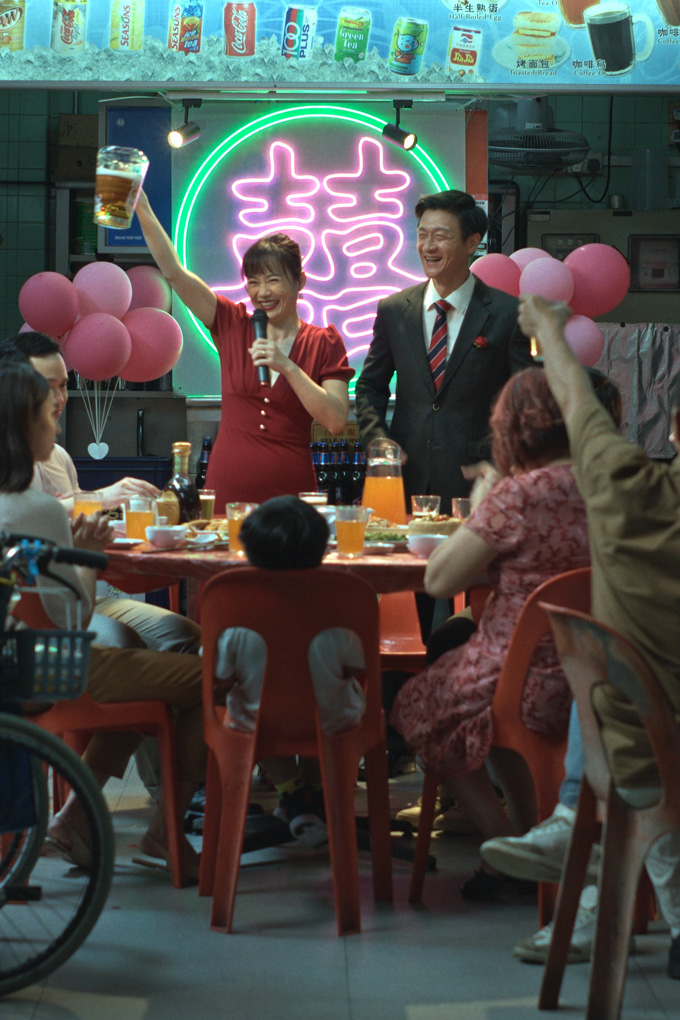
The cost, however, evades him still. It falls instead, on his remorseful father who believes he has failed in bringing up his son, and must atone for it by shielding Junyang from the actual financial burden of not simply hosting a grand wedding, but also bringing a child into the world. Just when Boon Kiat was trying to enjoy some semblance of happiness again, as he pursues Bee Hwa (Yeo Yann Yann), the beer ‘girl’ whom he has harboured a crush on for a while now, considering their proximity at work. He gives the grand wedding to his son, and settles for a celebration held at the coffee shop they work at for his own union to Bee Hwa—a wedding that Junyang dares to deign to be at.

That is not to say that Junyang does not try. The cumbersome task of having to feed five mouths instead of two suddenly takes a toll, and Junyang must toil too. Yet whilst he starts off as a Grab delivery man, he craves the fast life; the one that says you can earn top cash for minimal effort. His life as Steve the property agent, however, is short-lived when he is scammed by one of his clients and wastes himself away as he finally begins to feel the unbearable weight of what his father has felt all these years.
And he crumbles beneath its weight. Tragedy strikes and his father is no more. He picks himself back up with the loan sharks on his tail; this time with Bee Hwa to lean on. But then, it strikes—again.

This time, it is unrelenting; iron-clad; a knife straight to the gut. As a result of Junyang’s seemingly harmless ignorance, he and Bee Hwa become third-party sellers of a drug that has not passed the national health standards and approval system. The result is a jail sentence, which Bee Hwa bears on his behalf instead. Out of a curious fondness—towards the wayward son of the man who loved her without ever asking to be loved in return.
Just before it happens, you follow the eye of the innocent baby who crawls to the front gate just as two pairs of feet come into view. It cuts to the policeman’s face that gives away a fraction of a feeling as he processes what he is about to do to a family that is already fragmented. He too, acutely aware of the exacting demands of the law: there are no second chances this time around. A whisper somewhere; hasn’t he been given enough?
But the sliver of hope arrives in the film’s orchestrated ending: three years later, and the family is healing itself. We can only begin to guess at the context clues that Chen has left us with. Considering Lydia’s background, perhaps she finally called in a favour with her somewhat estranged mother. Whilst the ruthless, pragmatic side of my brain goes there, there is a lesson in not knowing.

Because it gives hope to someone out there. Someone whom the country may have already deemed lost, long before they even began. It is no mistake that Chen has willfully brought together this riff-raff of characters under the same roof to form his ‘broken’ nuclear family: the single father; the aimless young adult; the chasteless teenage student; the spinster still living with her married siblings. Somehow, they are forced to live together; a perfectly normal and pragmatic occurrence for anyone trying to find housing in our land-scarce estate—live with your parents first, and save money on childcare whilst you’re at it. There’s even a poetic element to the Chinese name of the film that reads 我们不是陌生人, translating to We Are Not Strangers.
Yet the real beauty of We Are All Strangers lies in its ending, when it finally closes the loop on how Junyang and Lydia might find their way through. Just as the film begins, Junyang opens up his father’s old hokkien mee stall, takes out the fresh ingredients, ladles it all together in the wok, and prepares the humble dish—plate by plate. It is after all, a labour of love.

We Are All Strangers will be in cinemas from 20 August.