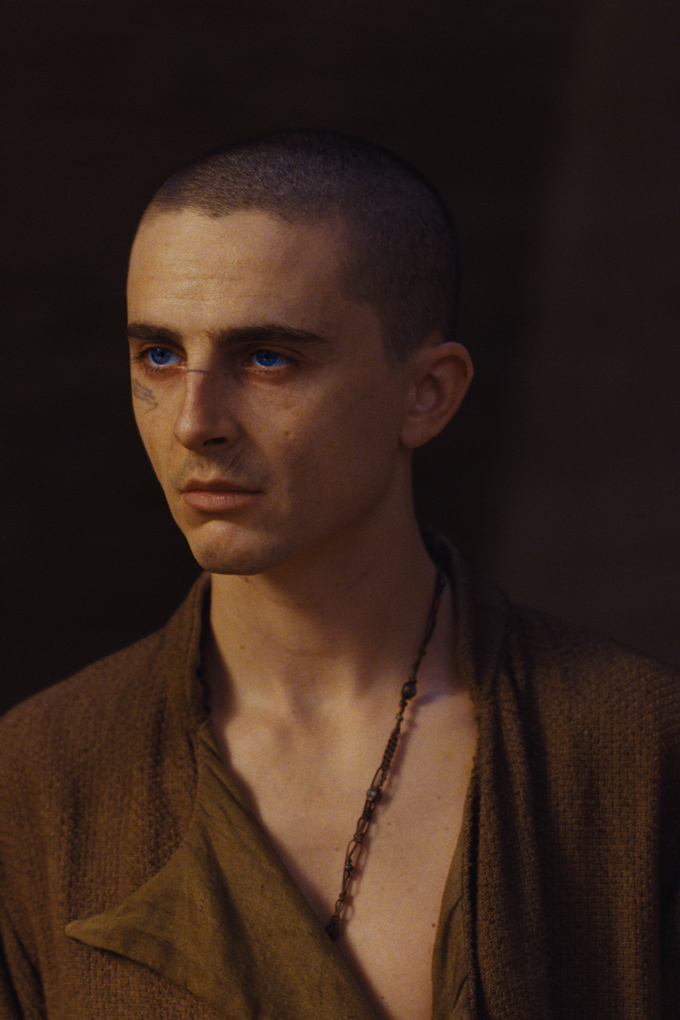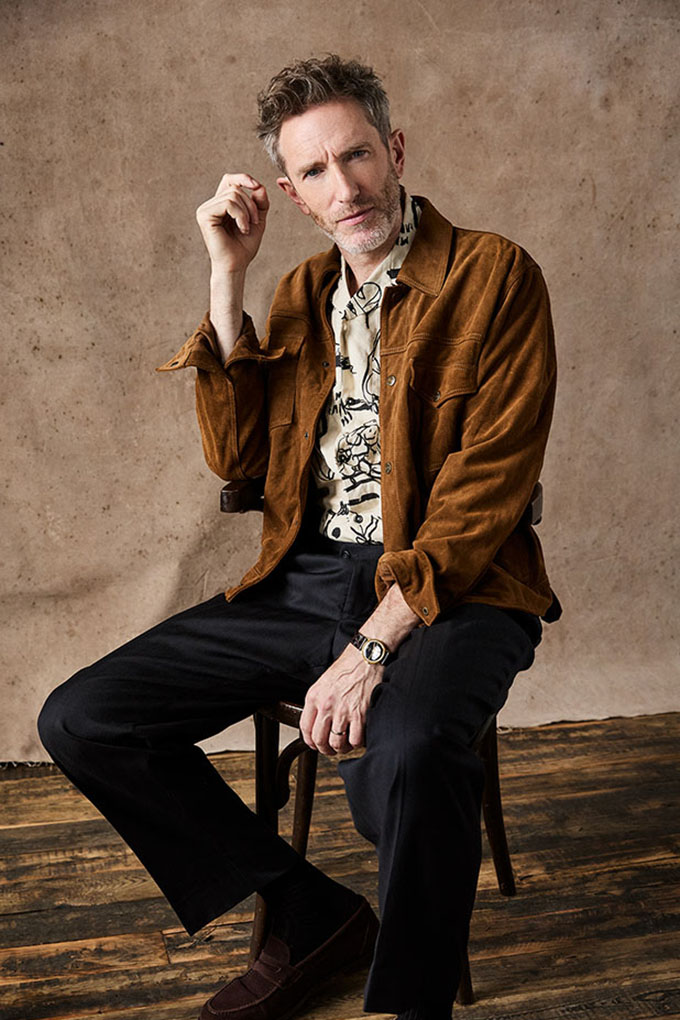
At the time of writing, I’m seated at a table in a house on the southern island of Aotearoa, New Zealand. A country where, for many fans of J. R. R. Tolkien, ‘it’ all started. Peter Jackson’s storied film adaptations of The Lord of the Rings trilogy were shot here; as was much of the new Amazon Prime television series, The Lord of the Rings: The Rings of Power. Nowhere else in the whole wide world is there more fitting a backdrop to write about one Daniel Weyman, who plays none other than the wise wizard Gandalf in The Rings of Power.
Spend just a minute in the company of Weyman, and you might be surprised to discover the 48-year-old English actor had never really read a book in his spare time until he was 21. Since university, Weyman has always possessed a particularly tender, clever way with his words—with a mischievous twinkle in his eye and an innocent, almost child-like wonder in his voice. Perhaps it’s not so surprising, then, that he was called to don the mantle of one of the most famous characters in fantasy literature.

Few stories written throughout the history of mankind boast as much emotional staying power as J. R. R. Tolkien’s The Lord of the Rings. Ever since the author first published The Hobbit in 1937, he has been widely regarded as ‘the father of modern fantasy’. He basically invented the concept of ‘world-building’. To this day, his highly intricate, immersive approach to breathing life into nations, races and languages in far-flung settings has served as the exemplar for which all other fantasy writers aspire to.
So when The Rings of Power television show was first announced in 2017, the stakes were high—especially because Tolkien’s avid fanbase still had Jackson’s adaptations living rent-free in their minds. The Amazon Prime series, however, takes several thousand steps backwards in the timeline: long before a small hobbit and his trusty gardener would undertake the journey of a lifetime to destroy an evil ring in the heart of a fiery mountain.
So long ago, that Season 1 of The Rings of Power sees the wizard Gandalf make his first-ever appearance, as ‘The Stranger’—a figurative newborn, a lost soul searching for his purpose in the grand arc of Middle-earth’s history. In fact, Weyman only gets his staff and is named Gandalf in the very last episode of Season 2.
This means that the third season of The Rings of Power comes hotly anticipated. While the dark lord Sauron has begun to tighten his grip on the realms of elves, men and dwarves, the good guys have, at long last, found their star player. Finally, the bedraggled Stranger comes into his own; finally, Gandalf stands, trusty staff in-hand, ready to resist the growing darkness lurking in the shadows of Middle-earth. Weyman is, understandably, very excited.

When I spoke with the actor over Zoom, his energy was infectious from the get-go—warm and charming, with just the right amount of dry, self-effacing wit. It was difficult to tell where Weyman ended and Gandalf began. Maybe this presentation is merely a by-product of having spent countless hours living as one of the Istari, the order of wizards who serve as representatives of the angelic Valar—protectors of Middle-earth and its people. Or maybe Weyman just has that ‘X factor’, that ineffable kernel of grace and poise that resides deep within the very best actors and actresses. It’s probably a mix of both.
Either way, that sort of inarticulable authenticity is precisely what makes him the perfect choice to take on the role first carved out by the venerable Sir Ian McKellan in 2001’s The Lord of the Rings: The Fellowship of the Ring. For those not in the know, Gandalf is not your typical wizard. As ‘a servant of the Secret Fire’ and ‘wielder of the flame of Anor’, he is more than capable of performing powerful feats of might and magic. However, Gandalf is often simply content to adopt the role of the itinerant mentor—Weyman aptly refers to the wizard as “a spiritual guide” who, from time to time, takes to the stage in order to encourage and empower those around him. Truly, the very opposite of ‘main character syndrome’.
“Gandalf knows he isn’t going to be able to control all of the tides all of the time,” the actor explains. “He can’t hold back all the water, but he realises that’s not his job. His job is to give succor to those who are around him, so that they may live their lives. Gandalf realises that he is doing the best he can, and that we’re not necessarily great at doing that as human beings. But if you can realise that, it gives you some liberation, and perhaps comes this twinkle of the eye—comes this idea of mischief. Things might be bad, but what can we do? All we can do is walk forward and try our best.”

Not for nothing do hobbits and wizards go together like bread and butter—Weyman’s take on the quietly powerful role Gandalf plays in The Rings of Power holds a mirror to why Frodo Baggins and Samwise Gamgee in The Lord of the Rings make for such compelling characters. Courage comes in many forms, and, sometimes, the least remarkable creatures are capable of the greatest acts of courage. With a response like that, I probably shouldn’t have been surprised to hear his take on the fantasy genre—the best I’ve heard in recent memory.
“What we take as an audience is this idea of a real, fully fleshed-out world that we can go and visit,” Weyman observes. “When we’re there, we’re removed from our real-life world. We enter with a slightly different perspective, and when we’re in these worlds, we can experience things that seem analogous to things that happen in the real world—but they’re very, very different. I think that’s really comforting for us as human beings. It allows us to explore sides of ourselves that maybe the real world doesn’t easily cater to.”
It’s a welcome surprise when the next words out of the actor’s mouth is a loving ode to an underrated niche of the fandom community: cosplayers and fanfic enthusiasts. Clearly, Weyman knows game, the worn leather boots of the Grey Pilgrim a seemingly perfect fit for the actor. When you read stories, you’re better off living them—not just scanning lines and flipping pages. Agency is important.

I couldn’t help but smile at his enthusiasm. “One of the things I love about being involved in the show is that it’s allowed me to get to know people who cosplay, people who write fan fiction,” he remarks energetically. “People who take fantastical sources of story and then make it their own—who say: ‘Do you know this represents me? This makes me feel good. This resonates. This is something I want to identify with.’ The joy around fandom is really important. As adults, we should engage with these things more; we should allow ourselves because it’s really fun.”
For someone who has never been part of a fantasy production before—who didn’t even know he was auditioning for the role of Gandalf until filming started—Weyman is happy to roll with the punches, because he is intimately aware of the inherent privilege that comes with the territory of being an actor.
“I am effectively being paid to cosplay Gandalf,” he says jokingly. “You know, often people say to us, ‘Oh, the make-up chair must be tough. The make-up artists are aware that they’re keeping you for two, two and a half hours in there.’ And I’m like: no, this is joyous for me. You’re transforming me. I see you living your Gandalf story through me. I am the conduit for your version of that story.”
If only more people bore the kind of selflessness Weyman appears to wear so effortlessly on his sleeve. This is an actor who knows how to give credit where it’s due. Production is a team effort. Gandalf would be proud. “I’m lucky that I can go and act in The Rings of Power, because loads of the sets are practical,” he exclaims. “They’re real. We’re not using all green screens. Wonderful artisans have built these extraordinary details, and that, again, is another joy.”

It shows, too: from the first minutes of the first episode of Season 1, to Gandalf’s first appearance in Season 3, the people working on The Rings of Power have not forgotten the hallmark of Tolkien’s writing: his exhaustive, meticulous world-building. You see it in the stitched threads lining the robes worn by each member of the cast—including Gandalf’s iconic, floppy hat—as well as across the vast expanse of every awe-inspiring battlefield set piece.
This level of detail is more than just an exercise in breathing life into well-laid plans. It is, as Weyman sees it, a way to realise Tolkien’s legacy in the present day. “In season three, there is the idea of this evil growing, the darkness growing, this sort of seed of awfulness spreading across Middle-earth,” he describes. “The people of Middle-earth have to answer the question: are you going to try and do something together, or are you going to try and fight this individually? It’s a really pertinent question, isn’t it? As always, with any good sort of literature, these things stay alive because they continue to resonate.”
This resonance is the thing in fantasy—the secret sauce that makes a character compelling and a story worth investing time and energy into. Of course, the ingredients that go into this sauce all look, feel and taste different to everyone. But, according to Weyman, you’d be hard-pressed to find a better role model than Gandalf.

“I love the fact that his journey has mirrored—or really, led—my own,” he recalls. “I love the fact that I’ve been having these realisations about who I am as a human being through Gandalf. I think: what would Gandalf do? How could I be a little bit more like Gandalf? I’ve found myself redefining some of the words that I’ve grown up with, like courage and strength. Previously, I thought that courage was about numbing everything else out so I could get through something.
“There might be a place for that, but now my courage is more about being able to sit with difficult stuff, to be present when things are tough. I wasn’t great at doing that in my earlier life. I think I was very, very scared, and not wanting to admit I was scared. Now, I’m much more comfortable, and it is so like Gandalf’s journey. So I thank this show so much, and Tolkien for writing it all, because it’s really helping me in my life. The idea of thinking: I feel scared at the minute. But that’s okay. I can still live this beat. Whatever is going on that’s difficult, I can be with this. I realise that that is my courage.”