Venture into the dungeon. Slay the evil dragon. Save the whole damn kingdom.
Dungeons & Dragons (D&D) is all the buzz now—and for good reason. It became public knowledge when the hit television show Stranger Things premiered a decade ago. However, the now-iconic tabletop role-playing game (TTRPG), created by Gary Gygax and Dave Arneson, has provided a safe haven for nerds around the world for more than 50 years.
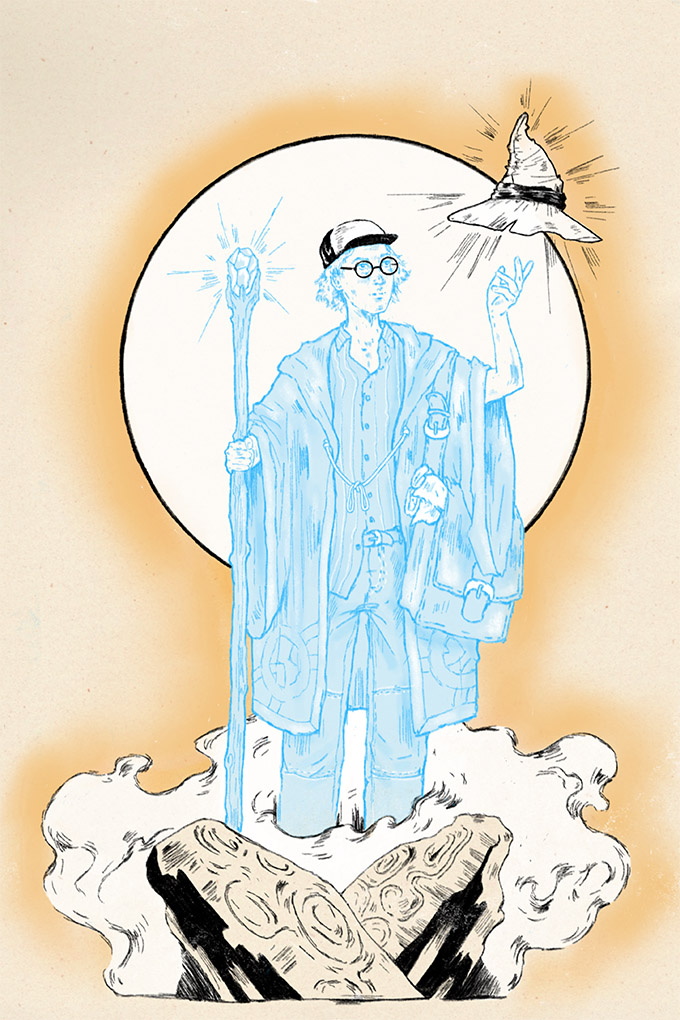
The concept of D&D is simple, even if the rules are somewhat infamous for being complicated. Each session is led by a dungeon master (DM), who acts as the intrepid guide and rules judge for players pretending to be various and sundry characters. A classic party could look something like this: a valorous human knight, stoic elven archer, rabble-rousing dwarven warrior and old, grumpy wizard (The Lord of the Rings is truly timeless).

Together, the party undertakes a quest to do something, usually spread across several sessions as part of a broader campaign. Perhaps they need to stop a rampaging horde of evil goblins, pounding on the gates of the last bastion of civilisation; or maybe they need to recover a fabled artefact, long lost to the passage of time, at the behest of a mysterious patron.
Importantly, winning is not the priority. What matters is how you get there and who you become on that journey. Oh, and dice. Dice are important, too.
The primary relic of choice, the 20-sided die, determines the success of your actions. Roll a rare 20 for a critical success and leap over that gaping hole in the floor with stunning panache. Conversely, roll a dreaded one for a critical failure and you might just trip on the edge of that hole, falling spectacularly to your doom.

Death is not to be feared, though, because in D&D, every moment is a high. Whether the party stands in triumphant victory or mourns in shared loss, it’s impossible to not feel the tug of emotion when you’re directly responsible for crafting the story. The imagined-world premise is merely the stage upon which real-world memories are made.
To many, the experience is memorable because it is pure, distilled fantasy. For example, all I wanted to do when I started playing D&D in 2007 was to be a sneaky, knife-juggling, tragically edgy rogue. I’m not alone on the team, either.
My colleague, Vogue Singapore watches and jewellery editor Gordon Ng, is a talented DM now, but got his start cobbling together abbreviated character sheets on scrap pieces of notebook paper with just two friends. “That really helped falling in love with it,” he recalls. “It made me think more about the role-playing character choices rather than game mechanics.”
Everyone has to start somewhere and all are welcome. But much more than a mere exercise in creative self-expression, D&D is, first and foremost, a call to action for authentic living. As Ng puts it: “It is a game of unlimited, open-ended choice, where the objective is to make up stories together—no winners or losers. A lot of pretenses tend to fall away in that environment.”

There are plenty of people who don’t get it, though. Many boomers of yore have, at best, dubbed the experience as meaningless fluff and escapist fantasy. At worst, particularly during the ‘Satanic Panic’ of the ’80s, they hailed it as an opportunity for the devil to gain dominion over your eternal soul. Of course, on both counts they are wrong. Anaemic views like these do a grave disservice to the practice of good-hearted community and the act of earnest memory-making.
TTRPGs like D&D are special because they are an occasion to gather with other human beings, embodying fictional characters in a vast, detailed world that is removed from the limitations of the physical plane. The possibilities are, well, endless. That’s what makes fantasy fantasy. Put simply, to play D&D is to engage in collaborative storytelling at its finest, to embrace your inner nerd and the unique lived experiences of your fellow players.
What makes this seemingly strange game so appealing to its swiftly growing fanbase is the fact that the players are the ones creating whole worlds full of unforgettable moments, from epic, larger-than-life feats of might and magic to small, everyday acts of bravery and heroism. Whether you are a fledgling barback or a bigwig lawyer, everyone is welcome at the table. The only performance that is necessary is the one that is true to yourself.
In a world that is more divided than ever, D&D is the great social equaliser. This is never more apparent than in the game’s phenomenal rise to popularity on the internet.
Critical Role is an ‘actual play’ D&D web series livestreamed on sites like Twitch and YouTube. The show consists of a veritable who’s who of veteran voice-over artists in the entertainment industry, from the cast to the DM, Matthew Mercer. Together, they expertly juggle sweeping prestige drama and gut-busting improv comedy to tens of thousands of viewers every week.

These view counts are, quite frankly, outrageous, especially since each episode averages a four-hour runtime and there are well over 100 episodes in every campaign. However, four campaigns later, the series shows no signs of slowing down. For example, the premiere of the current campaign last October hosted a record-breaking 180,000 viewers across all platforms. The actual play show has even spawned two hit animated television series on Amazon Prime, covering key story arcs from the first two campaigns.
These numbers signal an incredible truth, one realised by more and more people with each passing day. On its face, the recipe for Critical Role‘s success is objectively baffling, yet the show remains a steadfast source of comfort for people of all cultures and classes around the world. This is because the message D&D champions, through shows like Critical Role and in basements around the world, is one of community, of finding family in strange places and wonderful ways.

I’m proud to call myself a Critter (as fans of the show call themselves) now, but well before the internet became the place it is today, I made some of my fondest memories playing D&D with close friends throughout the years. This game gave me the chance to feel like I belonged somewhere. It still does.
In many ways, the game is the perfect antidote to male performativity. Why bother putting on a front? Insincerity has no place at the table. Everyone is there for the same reason. To tell stories, to make new memories and to have fun together. (If you slay a dragon or two along the way, all the better.)

The game asks but one thing of you: to give a little of yourself up to the gods of fate and whimsy. Critical Role founding cast member Liam O’Brien knows this intimately. “The world around us is growing more cluttered by the minute with computers, screens, AI, digital entertainment, you name it,” he reflects.
“D&D feels like it’s maybe one of the last places we get to explore and tell stories powered entirely by our own imagination. There is no better virtual reality available than the one that spills out of our brains at the game table. I’ve role-played bashful androids, lumbering ogres, even refined priestesses. And the wonderful thing about stepping into the shoes of someone drastically different is that it often leads to greater understanding and empathy. You learn to celebrate the differences, but also recognise the human traits we all share in common.”

If this sounds scary, it’s because it often is. But the best things in life can be scary. As Ng remarks: “It takes a bit of courage, I think, to be a grown-up—everyone has jobs and families, and a ton of other attendant responsibilities—and decide that what you’re going to do for fun is sit at a table with a bunch of people and play pretend like children do.”
Truly, sometimes, in order to have a good time, you must climb cringe mountain. How else would you embody the role of a charismatic, lute-strumming halfling bard; a venerable, spell-slinging elven wizard; or a raging, greataxe-wielding half-Orc barbarian?
Sam Riegel, another founding cast member of Critical Role, is perhaps the best example of what the power of uninhibited creativity can unlock at the table. As the de facto class clown of the group, he is never without a joke up his sleeve—more than most, he appreciates the importance of wearing your heart (and humour) on your sleeve. “Authenticity in TTRPGs doesn’t mean you have to play as your authentic self—quite the contrary. Instead, it means bringing emotional honesty to your character,” he observes.
“Experiencing a world through someone else’s eyes is incredibly important in this day and age. It’s an exercise that stresses empathy, understanding, and caring—traits that directly counteract the forces of toxicity and bullying. Put simply, if you walk a mile in someone else’s shoes, even fantasy elven boots, you become a kinder person in real life. And that’s not magic.”

This can be a particularly difficult ask for many men, notes Dennet Krishnan, founder of TableMinis, a local organisation that offers players the chance to dip their toes in far-flung worlds across games like Pathfinder, Cyberpunk, Warhammer 40,000, Daggerheart (Critical Role’s TTRPG) and, of course, D&D. “Men are taught to perform a version of strength. To dominate the conversation, to compete. To appear confident, decisive and unshakeable at all times. But a tabletop game quietly dismantles that performance. This game does not reward ego. Charging ahead alone often ends badly. What the table rewards instead is listening to others, trusting your companions, sharing ideas and solving problems together.
In many ways, the healthiest tables run on values that are the exact opposite of toxic masculinity. Cooperation instead of dominance; empathy instead of bravado; vulnerability instead of performance. In D&D is the opportunity to realise that strength can also look like kindness, humour and care for the people around you.”
So where does this leave you, dear reader? What does all this mean for the enterprising nerd in Singapore? Is there a table out there for you? Take heart, because if you’re interested in embarking on what could very well be the adventure of a lifetime, you’re not alone.

Sometimes, the only way to learn is by doing, by diving in feet first regardless of how high up the drop is. As Riegel is careful to point out: “Sure, there’s tons of rules. But those rules are just a framework for creativity and imagination. They’re kind of made to be broken. Besides, there are new games out there these days that are easier to pick up. Like Daggerheart, our game! But seriously, it’s super easy to learn and fun to play. In any TTRPG, the first game is the hardest. If you can get past that, you’ll be golden.” (For those not in the know, the plug here by Riegel is very much on-brand—look at any of their livestream interludes and he’ll be the one responsible for creating whole skits for the sole purpose of promoting sponsors.)
On this front, the cast of Critical Role are in agreement. “The best way to get a handle on any game’s rules is to start playing it,” O’Brien suggests. “It is of course helpful to spend time diving into a rule book but I find it’s best to learn by doing. If you are lucky enough to be near a local game shop, spend some time there, see if they have anything going on and just jump in a game. I promise, making mistakes is half the fun. And unlike when I got started in the ’80s, there are now a whole host of actual play shows you can find to see these games in action. That is a fun way of getting a feel for a specific TTRPG.”
In the same vein, Krishnan cautions an open heart and mind, stating: “The biggest misconception about TTRPGs is that you need to know everything. You do not. Like most good things in life, you learn by doing. In truth, the hardest part has never been the rules. It is simply finding a table and group of people willing to begin together. That’s why I created TableMinis. A lot of the work we do here is designed to help new players take their first steps into TTRPGs. You just need to show up and be curious. The local scene is special. It’s like a village. We are small, even by Singapore’s standards, but that only makes it all the warmer, more welcoming and deeply community-driven.”

Of course, you could come at it from the other end of things, too. Ng’s advice here might come across as intimidating, but in a culture where standing out is frowned upon, he bears a good point. “Learn to be a Dungeon Master. It’s the scariest thing for newcomers and players to hear, but if you really want to play, give DMing a shot. Go watch videos on YouTube, go watch some actual play, go read the basic rules (they’re free!) to pick it up. It’s kind of that idea of ‘if you build it they’ll come’. If you offer to run a game, the players will come. And more people than you might expect will be interested to give it a shot.”
So what are you waiting for? Entire worlds are out there for you to imagine and bring to life. All it takes is a bit of reading and a willingness to open yourself up to new experiences. May the dice rolls be ever in your favour.
Pre-order your copy of the Vogue Man ‘Pursuit’ issue online or pick it up on newsstands from 15 April 2026.