At the start of this month, Bad Bunny, born Benito Antonio Martínez Ocasio, made history by winning Album of the Year for Debí Tirar Más Fotos at the 68th Annual Grammy Awards. It marked the first time a Spanish-language album had taken the ceremony’s top honour, a momentous achievement given the current political climate, something the artist himself was keenly aware of. Wearing a Schiaparelli suit, Bad Bunny stood with a defiant posture and puffed‑out chest, prompting many fans to speculate that he was wearing a bulletproof vest for protection amidst ongoing ICE raids across America targeting migrant communities. Truth or not, he used his acceptance speech to issue a direct protest against ICE: “We’re not savages, we’re not animals, we’re not aliens—we’re humans.”
It was a message he sought to echo just a week later, via his headlining set for this year’s Super Bowl LX halftime show.The artist began his set emerging from Puerto Rico’s sugar cane fields, surrounded by rural farmers in pavas, uncles mid-game over dominos, a piragua stand serving shaved ice and girls getting their nails done, before stepping onto the stage—all familiar scenes of the Puerto Rican way of life. The message soon became clear: joy itself can be an act of resistance.

At a press conference, Bad Bunny told Apple Music’s Zane Lowe and EbroBad that “the world will dance”, and he delivered immediately, opening with the kinetic rush of ‘Tití Me Preguntó’ before gliding into ‘Yo Perreo Sola’. He soon reappeared atop the casita from his Puerto Rican residency, a scene of domestic celebration, joined by Cardi B at a pari de marquesina, or house party. The mood was then jolted as he crashed through the roof and a fleeting burst of Daddy Yankee’s ‘Gasolina’ played, a clear nod to the Puerto Rican artists who laid the groundwork for reggaetón’s global rise. As the strings of ‘Monaco’ swelled, the set shifted once more. Lady Gaga emerged in a staged wedding scene to sing her verse of ‘Die with a Smile’, her collaboration with Bruno Mars, backed by a live salsa band. Who better than Mother Monster, to put on a show about celebrating love?
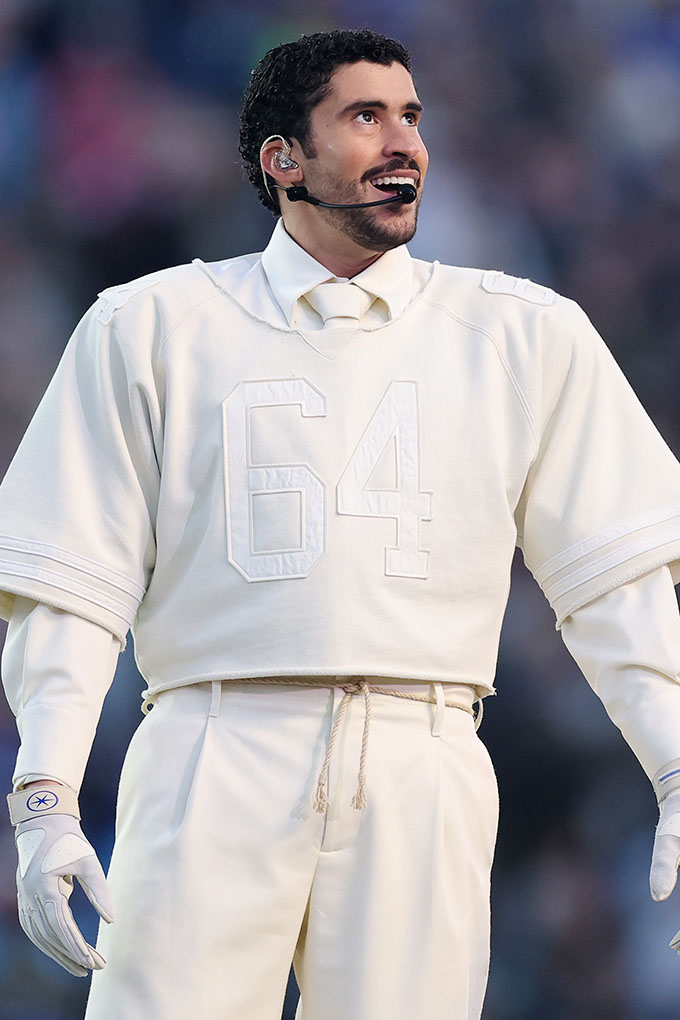
The moment also allowed Benito a costume change, returning in a crisp white suit, channeling a classic salsero for ‘Baile Inolvidable’ and ‘Nuevayol’, as the stage morphed into a block party that neatly closed the loop. And just as he promised, the world did not stop dancing.

Other than Lady Gaga, the 14-minute set featured guest performances from fellow Puerto Rican and pop legend Ricky Martin and included fleeting appearances from stars such as Pedro Pascal, Karol G and Jessica Alba, who could be seen dancing on the porch of his iconic casita, a joyful tableau that celebrated togetherness and the way music can unite people in a shared moment of harmony.
Throughout the performance, Benito sang entirely in Spanish, asking millions of viewers to meet him where he was. It was a deliberate choice, and one that drew criticism from President Trump, who wrote on his social media platform, “Nobody understands a word this guy is saying.” Rather than dilute the moment, the refusal to translate only reinforced the point. Bad Bunny did not soften his language or tailor his performance for comfort; he trusted that meaning could travel through rhythm. For some viewers, confusion became part of the experience, a reversal of the expectations so often placed on non-English-speaking artists. In that sense, the performance functioned as both spectacle and statement, insisting that Spanish, and the culture it carries, belongs at the centre of the global stage without explanation or apology.

He closed the show by naming every country in the Americas, reminding everyone that America is a continent, each name a call across the stadium as the flags waved in a living sea of colour and movement—a ripple of identity and pride stretching across the stands. ‘DtMF’ pulsed through the air like a heartbeat that carried the crowd along with it, every note weaving together celebration. By the finale, what began as a bold assertion of cultural identity had transformed into a universal call for empathy, a reminder that music transcends language and politics alike. Behind him, the screen bore his final, unflinching message: “The only thing more powerful than hate is love.”