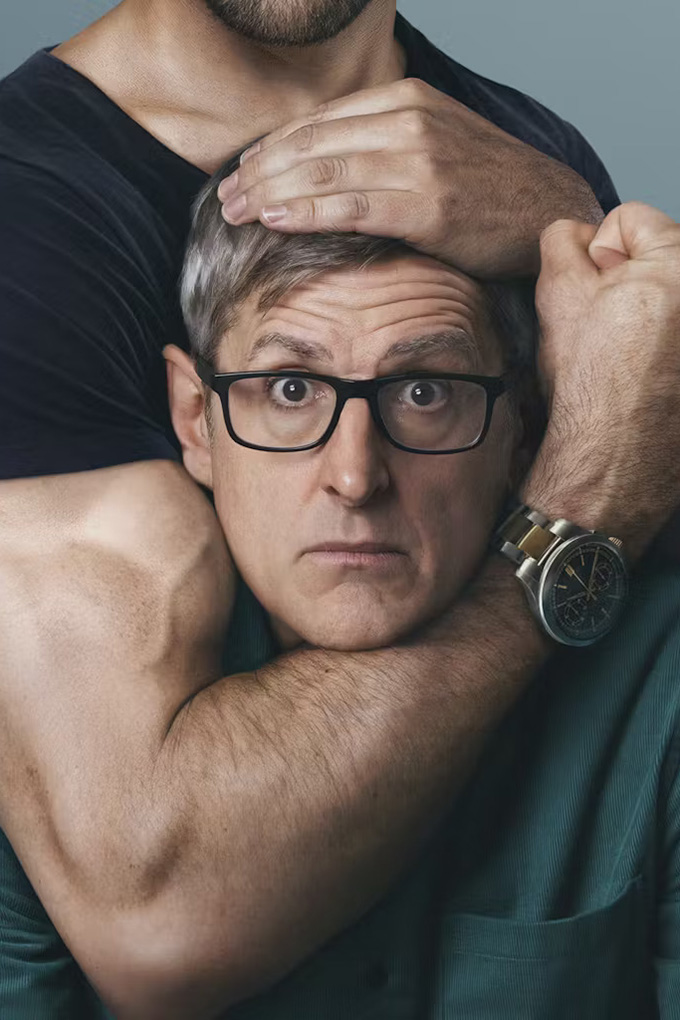
“There is a war on man being strong,” quipped Justin Waller in Louis Theroux’s latest Netflix documentary, Inside the Manosphere. Of everything said in the hour-and-a-half documentary—following men who’ve built huge audiences (and incomes) on viral stunts, extreme rhetoric and aspirational lifestyle content—that might be one of the least offensive lines. Anyone who has spent even a little time online would know this isn’t something rare. Over the years, there has been a growing pocket of male influencers whose whole shtick is to “coach boys on how to be boys,” as Harrison Sullivan (better known as HSTikkyTokky) puts it. These influencers identify as part of the so-called red pill community—a term adapted from The Matrix—which frames itself as breaking out of a system that is supposedly biased against men: the 9 to 5 grind and a society designed to keep men broke and losing. It’s not confined to one corner of the internet either; this content travels easily across TikTok, Twitch, Kick and Telegram, where short clips feed into each other and steadily grow audiences in the millions.

The documentary opens with Theroux meeting Sullivan, a young man fixated on working out and bettering himself. Notably, he admits his mother wouldn’t approve of most of what he says, and that he would never let his daughter join OnlyFans, despite profiting from it himself through a Telegram channel where he promotes creators and takes a cut. In another instance, Waller claims to be in a one-sided polyamorous relationship, encouraging men to sleep around and have as many children as possible, before sheepishly admitting he doesn’t live that lifestyle and is, in fact, married with two kids. Meanwhile, Myron Gaines privately tells Theroux he plans to have multiple wives. But when Theroux raises the idea of “one-way monogamy” in front of Gaines’s girlfriend, his tone shifts immediately: “Who knows? Maybe I’ll only wanna be with one girl after all.” The credits later reveal she left him. Hypocrisy is a common thread throughout the documentary, and it quickly becomes hard to ignore. If they don’t believe in what they’re preaching, why are they saying these things?

The answer, it seems, is the algorithm that rewards them. Going viral is internet currency, and in a saturated online space, the easiest way to achieve that is by saying something outrageous. Platforms push what keeps people watching, and what keeps people watching is often what provokes them. There’s a striking moment where one subject essentially admits on camera that he has chosen an immoral path in pursuit of clicks. The main figures—Sullivan, Gaines, Sneako, Waller and Ed Matthews—reflect the same pattern: increasingly extreme content made for attention and monetised accordingly. Much of it comes at the expense of women and constant encouragement for followers to do the same, to not be “cucks.” “Destroy her life.” “I dictate when I wanna put my dick in you…Women love guys like this.” The aggression is endless, and so is the hypocrisy. Sullivan says his mum hates homophobia and misogyny and that he’d get a slap if she heard him. He promotes OnlyFans creators but would disown a daughter for doing it, and a son for being gay. At a certain point, the contradiction stops looking accidental and starts to feel like part of an act.
Theroux also digs into the kinds of viewers drawn to this content. One young man says he watches it to feel motivated, like he can do anything. There is something real underneath all of this: many young men are lonely, confused and searching for meaning. The same young man later reveals he comes from financial hardship and struggled with depression after his brother’s suicide. In that state, when a “gigachad” influencer promises a life of Ibiza villas and endless beautiful women—if you just buy into his Telegram course—it’s not hard to see how he starts to look more like a saviour than a scammer.
The pipeline is gradual: what begins as fitness advice or self-improvement content slowly bleeds into dating strategy, then into something more rigid and resentful. But what the manosphere offers these young men, in place of actual tools, is a villain: women. In this space, women become something to conquer, something to get past. If you’re struggling, it’s because of them—because they won’t let you be a “real man,” because the system is stacked against you. When the loudest message wins, hate travels much further than anything nuanced ever could. It gives frustrated young men somewhere to direct that anger, and it keeps them coming back.

So how does a woman exist in this space? There are a handful of scenes with the influencers’ partners, and they are telling. One woman sits through a conversation about her boyfriend’s views on fidelity looking visibly uncomfortable, to the point where you almost want to reach through the screen. Another laughs awkwardly as she is referred to as “the dishwasher,” while posing in a bikini. On Gaines’s streams, women gleefully submit themselves to debasement, often as a way to promote their OnlyFans pages or social media accounts. But these moments are brief. The women remain on the periphery, even though they are central to everything being said. What’s missing are those dealing with the fallout: the schoolgirls who become quieter navigating boys exposed to this content, the young women who can hardly find men in their circles untouched by it, the mothers watching their sons gradually become hate machines. The effects show up in classrooms, in relationships, in the way young men talk about women when they think no one is listening. That wider impact is barely explored.
Inside the Manosphere reveals how a profit-driven network of influencers weaponises misogyny to shape young audiences. Boys are taught that their worth is conditional, earned through dominance, while women are positioned as either reward or obstacle. In doing so, it exposes the manosphere as something larger than a subculture: a system, amplified by platforms and algorithms, that normalises anger and rewards those who push things further. In the face of such overt resentment, the consequences on our society might feel bleak. It’s impossible to think that anything can really change.
Sure, we can hold platforms and the alpha male influencers who promote these lifestyles accountable for the systems they’ve built. But what society really needs to shift the barrel lies in the consumer. The real work needs to be done by audiences everywhere, internet literacy needs to be learned and critical thinking needs to be nurtured in these young, impressionable boys who are taking their words as gospel. The question then is this: who does the responsibility fall on?
Watch Louis Theroux: Inside the Manosphere on Netflix.