Gilead welcomes us back. The dystopian patriarchal dictatorship of Margaret Atwood’s famed The Handmaid’s Tale returns once more in The Testaments, the new Hulu sequel set 15 years after the season finale of its predecessor.
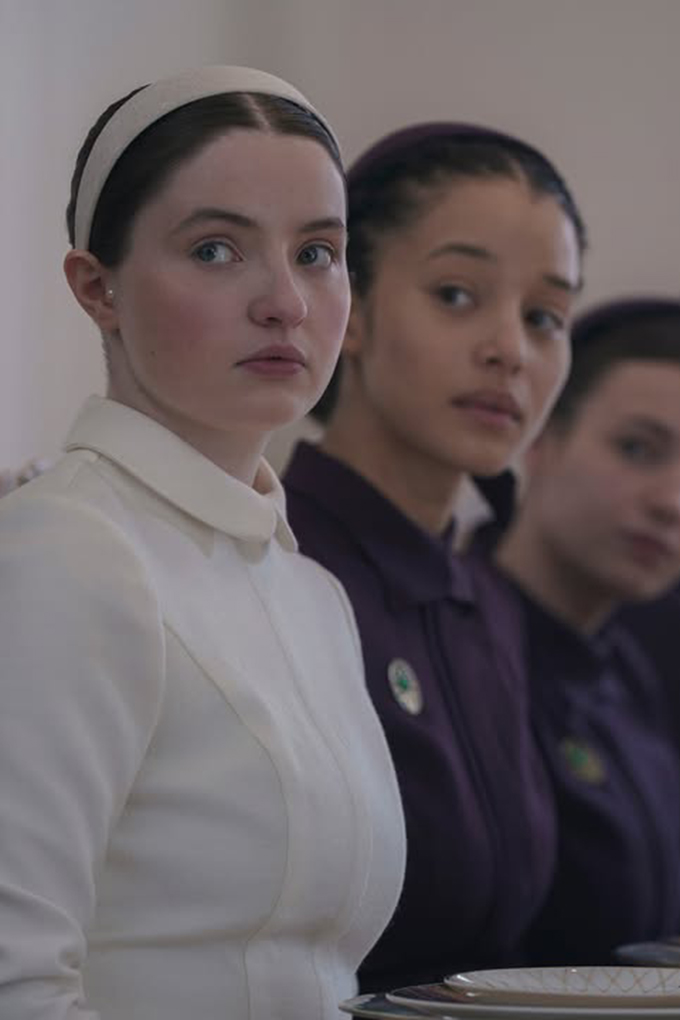
Followers of The Handmaid’s Tale will instantly recognise the manicured backdrop of the show, where women are subjugated to the authority of men, with the sole purpose of child bearing. The Testaments continues in the same vein, as main characters Agnes and Daisy rise as the new generation of Gileadian women, enrolled in Aunt Lydia’s elite preparatory school where young girls are trained to be the perfect Wife—the highest rank a woman can be in Gilead.
One Battle After Another’s Chase Infiniti plays Agnes, the ‘daughter’ of a commander whose whole reality is built within the walls of Gilead. Meanwhile rising star Lucy Halliday takes the lead of Daisy, a girl who enters Gilead from the ‘outside world’ with a secret motive. As different as both girls seem, they soon realise they’re more alike than they think as an awakening rises and rebellion strikes. Hand in hand, their sheer raging will and determination might just take down the theocracy.
There’s none more powerful than a teenage girl. Ahead of The Testaments release, Vogue Singapore speaks to Infiniti and Halliday on expanding Margaret Atwood’s universe, the power of community and the power it has to enact change.

You’re entering The Handmaid Tale’s universe. What do you think the overall impact and message of the original is (including the book), and where does The Testaments come in in all of this?
Halliday: I think the impact the original books and show had was quite prolific. We saw that the Handmaid’s costume became emblematic for protests, and it became such an important piece in the movement for women’s rights, for everyone’s rights in general. I’d like to think that The Testaments is hopefully just a continuation of that movement and a continuation of proliferating the idea that you can enact change and that you can, whether it be on a minute scale or on a grand level, band together and form communities and use your voice and I hope that The Testaments continues that sentiment.

What was it like playing roles that expand on the existing universe of The Handmaids’ Tale? How much of it affected your preparation of the role?
Infiniti: We really got a hold onto all of our resources that we possibly could. We read the books, watched the show. We talked to Elizabeth Moss, who’s an executive producer. We talked to Ann Dowd, who’s also in the show; Bruce Miller, who is our showrunner. We definitely did all of our research beforehand because we wanted to make sure that we were entering this with as much knowledge as possible, as it is such an important and beloved world that has so much love surrounding it. So we really felt the responsibility, stepping forward into it, to make sure that we were not messing up anything, and we wanted to make sure that we were expanding it in a way that felt satisfying to the viewers as well.
Getting to play a character like Agnes, it felt like such a gift because she’s so different to me. And I think that there’s so many beautiful things about her that I really love and there are many things about her that I may not agree with, but I will never judge her for that.
Halliday: I think in terms of the expansion, hopefully what The Testaments brings is not just the introduction of new characters, but also the introduction of a new audience. I hope that there’s individuals who maybe didn’t watch The Handmaid’s Tale, and I hope that they’ll come to this because, yes, I want everyone who watched The Handmaid’s Tale to watch this also, but if you haven’t, that’s okay. And you don’t need any pre-requisite knowledge to be able to access this show and you can come in fresh and begin this journey with us. And that’s what I hope as well, that more people come to view Margaret Atwood’s work and this world and become affected by it.

What is the significance of Daisy and Agnes’s kinship throughout the show? What do they learn from one another as their friendship progresses?
Infiniti: From the start, they know at their core, that they are very similar. But they don’t like that. They don’t want to be. They want to be better than the other person. They truly believe that. And I think that’s the first thing they learn, but then as time progresses they figure out that they’re not that far apart and that’s something that they should embrace. And they do end up embracing it, which I think is beautiful.
Halliday: I completely agree with Chase. I think the relationship of Agnes and Daisy is the epitome of “you can’t make a generalisation about people that you’ve never met.” And I think they definitely both have done that in the sense of Daisy has this preconceived notion of what a girl in Gilead is and Agnes, vice versa, has an idea of what a girl from outside Gilead is, and as far as they’re concerned, they hold those to be very strong beliefs and actually, as the season progresses, both feelings dissipate and they come to the understanding that actually we can’t be making such strong sweeping statements about individuals unless we’ve met them. I think it’s quite wonderful to see that friendship develop and to see how these two individuals from very different places actually have common ground and they find that common ground and they find a love for each other because of it.

How does The Testaments reflect the current socio-political times we live in? What message would you like to give to younger women watching the show?
Infiniti: I think there are so many things in the story that people can relate to, whether it be the essence of friendship or sisterhood, going through puberty, having a crush, and experiencing those first beautiful moments in life of growing into your own.
But to those who are watching it, I would say that we see you, and we hope that you feel seen with some of the things that happen in our story. And I think that also something I would love for people to take away is that something the girls do very well, which is the essence of a community. And I think that’s something that I would love for people to take away and to build their community and pour into their own communities, wherever they are, and use that to enact small bits of change in any way that they can. Because the world is a scary place and it does seem very similar to what’s happening in the world right now, but you also have to remember that Margaret Atwood wrote The Handmaid’s Tale in the 80s and she pulled everything from that from history. So everything that’s occurring in these books, unfortunately, it does seem very topical today, but they’re also things that are not new. Which is unfortunate considering it’s 2026. But I think that something about the show that you can take forward is the essence of hope that I think that the girls have as well.
Halliday: I concur, I think what the issue represents is that we are not singular entities. We do not sustain life as an individual and we have a necessity for community and for support from one another. We can’t be tearing down our neighbours and if we ever have the opportunity to support another person or to stand up for another person, on a minute level or on a grand scale, then that’s what we should do. We should be standing up for one another. We should be protecting each other because community is about being a part of our society and we needed to sustain life and it’s so important that we should be using our voices to protect each other.
Stream The Testaments on Disney+ here.