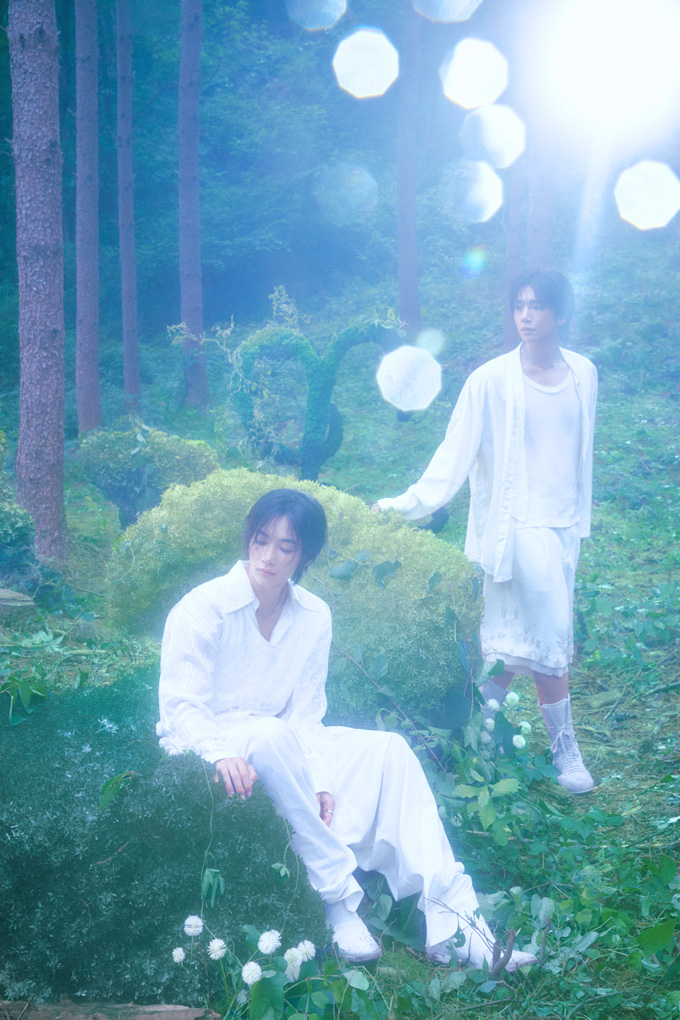
Everyone needs a gang. The girls in Tan Siyou’s debut film, Amoeba, know this fact intimately—and its significance is something we could all learn from. In fact, audiences around the world have already been privy to the movie’s technical and emotional heft, as it made waves with its world premiere at the 2025 Toronto International Film Festival.
Amoeba is Tan’s first feature film, but you would hardly know from watching it. Down to its framing, composition and colour grading, Amoeba plays like a triumphant debut—characteristic of a director who has been around the block and found her voice; one that speaks with quiet, self-assured confidence.
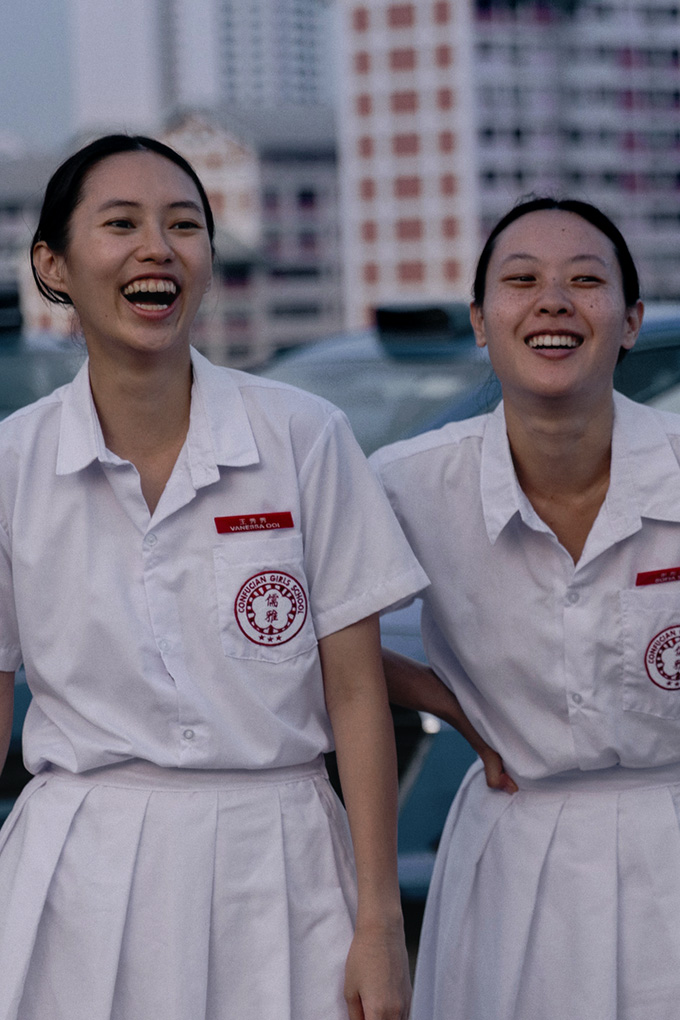
On the emotional front, the movie reaches for the stars, and in so doing finds its place at home in the short, but storied canon of Singapore’s film industry. Set in modern day Singapore against the backdrop of the strict, demanding Confucian Girls Secondary School (CGSS), the story follows the lives of four girls who meet in the midst of all the beautiful mess of adolescence.

At face value, it is a coming-of-age film. The main character, Choo, sticks out like a sore thumb in the system, but never backs down from speaking her truth. The three friends she makes—athlete Vanessa; privileged Sofia; and class clown Gina—are kindred spirits, brought together by a shared desire to stay true to themselves in a society that is wholly unforgiving in its mandate for conformity. Their relationship—a significant part of which is filmed with an old camcorder, found-footage-style—is a testament to the vulnerable strength that forms the basis for the very best kind of adolescent rebellion.
Amoeba is also a ghost story. While Choo and Vanessa find shared comfort in being haunted by spirits in their bedrooms, the real horror is made painfully, beautifully explicit in the unrelenting grip of all-too-real cultural institutions. In the face of school and family pressure to embrace ambivalence and social normativity, the solace that ultimately draws the girls together is found in the advice of their mentor, Uncle Phoon, who offers them the rough and ready tenets of what it means to be in a gang. No wanton violence here—just joyful loyalty, righteousness, brotherhood and truth.
Tan’s debut feature is plenty hefty, but she sticks the landing, striking a delicate balance between elements of horror and the trappings of the heart. The girls do not go gentle into that good night, and audiences everywhere should be glad for it.
In the wake of its hometown success—the film was first shown to local audiences at a sold-out screening as part of last year’s Singapore International Film Festival—Vogue Singapore reached out to Tan and three of the cast members, Ranice Tay (Choo), Nicole Lee (Vanessa) and Lim Shi-An (Sofia). The resulting conversation was a reminder of the truth behind Amoeba—that joy is, truly, an act of resistance.

Congratulations on your success Siyou, both overseas and at home! As your debut film, why Amoeba? Why now?
Tan Siyou: When I think about this question, I always go back to why I started thinking about making this film in the first place. It’s really about my friendships. The questions I had revolved around all of us being raised in Singapore’s repressive environment, which developed this bond that we all have—and we still have to this day. That was the starting point of the film.
In a lot of coming-of-age movies, it’s just about sex. But in Singapore, we’re not having sex here. We’re just trying not to be scolded, trying to pass our exams. Even though I’m an adult now, the questions of my teenage years are still in me. I wanted to make a film that I could investigate and learn—and unlearn—things that were indoctrinated in me since young.
Found footage isn’t something we see that often, but it plays an integral role in Amoeba’s storytelling and character development. In what ways was the format important for you?
TS: Mixed media adds something to the narrative by helping interrupt it. Found footage is usually seen in horror films, and in some ways this is a bit of a horror film. Of course, as a film, it’s about many things. It’s a teen film with no sex. It’s a gang film with no drugs. It’s a horror film with no horror. But it can be quite horrifying to grow up in this kind of environment—to accept that you have to lose your sense of self and embrace a certain identity to grow up. That process of coming-of-age is horrifying.
The camcorder is an old, discarded thing—but it’s the old stuff that’s important to me. Old buildings, old spaces, the places that people just want to renovate and build a mall on top of. The camcorder is that old thing that the girls reclaim. It’s used as a tool for rebellion, an added layer of resistance. Recording themselves—telling their own story—becomes an act of agency, especially in an environment that always looks to control the narrative.
And for characterisation purposes, it’s important to think about who is behind the camera. It’s Sofia’s camera that Vanessa uses because they’re good friends, and then Sofia gives it to Choo. It’s a special kind of transmission. The ones who end up using it the most are Choo and Vanessa, which says a lot about their relationship.

Speaking of, the supernatural makes for a uniquely compelling manifestation of both girls’ angst and anxiety. Why go with ghosts? What do they have to say about the pressures of living in Singapore as a school kid?
TS: There was a ghost in my room when I was growing up. It was completely intertwined with my teenage years, and I felt it should be part of the movie. While it took a long time to write it, the ghost’s effect on me many years later was to help me question reality—the unseen emotions, feelings and dynamics between people. In turn, I became more attuned to those things. The film was a way to explore that.
Stylistically, I tried to calibrate the ghost to be both vague and specific enough that the audience could bring a little bit of themselves to the story. The things that we try to suppress, like our desires and dreams, come back to haunt us. That’s what Choo and Vanessa experience together—an invisible frisson that’s still real and tangible. Growing up, people tell you need to do this or that you shouldn’t do that. But if your heart is telling you something different, should you listen to it, or put it away?
What was your inspiration behind the colour grading with the film?
TS: When I initially talked about the film with my director of photography, we were going for something colder—more blues and greens. But my amazing colour grader, this old French guy like Santa Claus, made it a bit more red. Because despite how cold, sterile or inhuman I thought Singapore was, he believed the film was ultimately joyful. And I found a lot of joy in the editing process, in working with the crew and the cast. It helped me choose to remember my time in Singapore as a time of youth, freedom, recklessness—pure joy.
Ranice, you did such a phenomenal job of channelling Choo’s indignation and ‘edge’. What was it like taking on that role?
Ranice Tay: I really had so much joy pouring myself into the role. There are a lot of feelings of wanting to rebel growing up in Singapore. So when Siyou brought the script to me, I felt a very natural connection to the character. Choo almost felt like a buried version of myself.
When I was her age, I wasn’t as vocal as her, but I harboured the same desires. The way she thought and spoke and behaved were all bubbling inside me but I never had the courage to act them out until I became much older. Now I’m more aware of the state of society and how it necessitates a kind of conformity. Playing as Choo was like putting everything that I know as my grown-up self into an adolescent body. It played out like a love song to myself, almost like a second chance at being a teenager growing up in Singapore.

In the beginning, Choo prays to the Goddess of Mercy. But the symbol that she and her friends eventually rally around is the God of Righteousness. What do you think is the relationship between those two deities, and why does it matter for the gang?
RT: Like many in Singapore, I grew up Buddhist and Taoist. Praying to Guanyin Pusa was something I was very familiar with. But the concept of being a sinner actively asking for forgiveness seems diametrically opposed to the idea of righteousness. Mercy is asking for something to be given, but righteousness feels like wrestling power to change your environment and your destiny.
In that way, the gang discovers their anger can be a holy one. The film asks us to channel righteous anger in a constructive way, one that asks the right questions to bring us to a higher state of consciousness as a society. When you’re taught that being angry is a sin, there’s a part of you that wants to ask for forgiveness. There’s a beautiful symbiotic relationship there between the two deities.
Nicole, it seems like a small thing, but Vanessa expressing her desire to leave the swim team to try football is an indicator of personal ambition, something that is clearly not top of mind for the powers that be at the school. Why is that important?
Nicole Lee: In school here, we have all these boxes that we are put in based on what we’re good at, and they define you. If you’re 10 years old and you go to the gifted education programme, people just think that you’re a smart kid—that’s who you’re going to be. That’s who Vanessa is. She’s been good at swimming all her life, so therefore she is a swimmer. Would she dare to renounce swimming just because she doesn’t enjoy it anymore? It’s a simple thing to say it out loud, but it’s such an act of rebellion, choosing something different simply because she enjoys it on a personal level.
In fact, I see too much of myself in Vanessa. I grew up in a Catholic, Chinese girls’ school, so you can imagine how much conformity was part of my life. I lived in an ecosystem where there was so much pressure to be well-behaved and well-liked. Like Ranice said, I would not have had the courage to speak out as a teenager, but how I wish I did. This film is my catharsis, to go back all those years ago.

Shi-An, Sofia might come from privilege (at least compared to the rest of the gang), but she’s still a kid—and the desire to belong is a universal one. What advice would you give to students now looking to find their sense of belonging in Singapore?
Lim Shi-An: Honestly, the first thing that comes to mind is that I don’t think I have any advice to give! Even if I could speak to my younger self now, I think all the things she went through then helped shape the person who she is today. You wouldn’t be able to find your fully formed self if you weren’t repressed, if you didn’t go through times when you felt like your identity was being lost. It’s from those painful times that you go from an amoeba to a fully-fledged human being.
As a teenager, you don’t care about what other people think. They fall on deaf ears because at that stage of life, that is the only world you know. That’s the beauty of our movie. It captures a time in these girls’ lives where this is their whole world. Exams feel like the end of the world, because they are. Their friends are all they have, because they really are all they have. That’s the bubble they live in, and that’s why the emotions feel so real.
When is a camcorder not a camcorder? So much of the girls’ sense of belonging is embodied in the act of recording their fellowship. What do you think the device signifies?
LS: It’s interesting because the camcorder is almost like another character in the film. It’s a strange, third-party observer, a strange other narrative. At the end of the film, Sofia passes the camcorder to Choo, which is powerful to me because it’s a way of passing the narrative on to Choo—letting her run free and wild, to see the world through her eyes and her eyes only. I really liked that moment.

For the class: CGSS’s values—purity, moral uprightness, diligence and filial piety—stand in direct conflict with the values of what it means to be in a gang, at least according to Uncle Phoon. Is there a place in Singapore for both?
TS: My intention going into Amoeba was to explore a kind of ‘Chinese-ness’. A lot of our values, especially in school, tend to be extremely gendered. Girls’ schools value purity, boys’ schools are all about bravery and courage and action. The words themselves are not gendered, though. It’s society that uses them as a means of control. It all goes back to Confucianism, which is a big part of the ethos of our country. These values are subliminally perpetuated, where women are born to obey their fathers, their husbands, their sons. In the film, this mechanism of control is in conflict with girls aspiring to loyalty, brotherhood, righteousness and truth. I wanted to replace the schools’ values with the values of being in a gang, because those things are actually very essential for any human—not just for men, and not just for gangs.
NL: That’s so true. Now I realise how gendered my school was, espousing all these values that were in servitude to others. Therefore, when I look at the two sets of values in the film, I don’t feel that they’re different—they’re just both sides of the same coin. It’s in how you phrase it. Filial piety is about caring for family, but brotherhood is also about that. One’s just worded as what you can do for others; the other describes what you are a part of.
TS: Totally, exactly. Everything drinks from the same well of Confucianism. The school is a gang in a way. The teachers are a gang. These contradictions are important because both sets of values are fundamentally about the same thing.
RT: This is why I love the arts. At the end of the day, these are just words. The question is: what do these values mean to the individual? That’s why we need the arts so desperately, because they are a social third space for asking these questions, to wrestle back the narrative to ourselves and to find a kind of inner coherence between what we desire and what society desires.

If there was one takeaway for someone watching Amoeba who has never visited Singapore, what would you hope that to be?
TS: Many people have not been to Singapore, and they have a certain perception of what Singapore is—modern, wealthy, clean. I hope that people can see that we are more than that. When the film’s shown in Europe, people think that the experience is very different, but it’s not as different as you think. All governments want to control institutions. This film is a way to add to the breadth of human experience. I hope that people watching it can see different shapes to the fabric of growing up.
RT: I wanted to point to what Nicole was saying about being identified very quickly about what we’re good at. But what about being good at listening to your own heart? I feel like that’s not acceptable here. It is a necessary talent, though. I hope viewers can see that Singaporeans are still very much alive, still finding a way to stay true to ourselves in the marginal spaces that we have access to. Acts of rebellion and revolution come through in the smallest of ways, like finding joy or telling the truth despite all the pressures to be a model, perfect citizen.
NL: I wanted to also spotlight the friendship. If anybody watches this, I want them to see how the strength of friendship can thrive amidst such structural constraints. You find your people and hold on to them fast. The film is a critique of a system, but it’s still actually so euphoric and so fun. That’s the best part of Amoeba—we’re alive and finding our own joys despite everything.
TS: And that joy is an act of resistance.
NL: It’s powerful.
LS: I echo what everybody else has said. Siyou is incredible and I’m so happy that the film is being recognised and going places. Maybe people haven’t heard about Singapore before and don’t know much about it, but I would like them to know that the arts that come from Singapore are of a global quality, well-deserving of a world-class stage.
TS: That’s totally true. I firmly believe that we have so much talent here. We can make things and we can export them to the world, we just need to believe in ourselves. There’s often a very strong sense of inferiority—there’s a narrative of not being good enough. But we are good enough. Now we need to believe in ourselves and feel proud of the things that organically came out of being a young country. All our contradictions, all our confusions, all the things that make us unique.
Watch Amoeba in cinemas now.