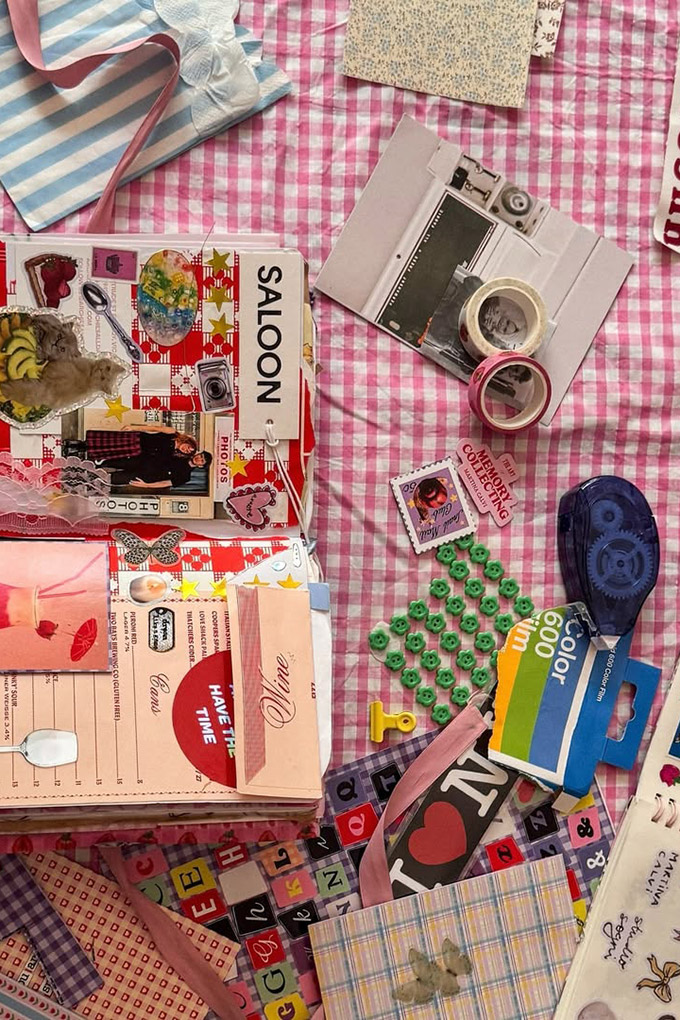
I’ve always considered myself to be a sentimental person. I find myself picking up mementos of all sorts wherever I go, collecting tangible memories of what happened that day. As time passes, the collection grows. Now, I’m left with a box full of souvenirs. That’s where junk journaling comes in—a scrapbook-style journal crafted from the amalgamation of pamphlets, ticket stubs and other keepsakes I collected along the way.
I had stumbled upon a double-edged sword. The space where my box of collectables once sat was cleared and the act of placing pieces to paper became a tool for self-reflection. It was a newfound hobby that organically made its way into my routine. I returned to it regularly to update the archives of my life on paper, and the colours and images on them present themselves as a new theme to explore across the blank pages of my journal. That was the best part—the freedom.
View this post on Instagram
For craft artist and online creator Martina Calvi, that principle serves as the backbone of all her work. “I like how free and creative the format of junk journalling is. There really aren’t any rules,” she shares. Junk journalling became a way to play, express and create for herself without pressure or perfection. It also offers a unique perspective on journalling.
Local illustrator and fellow junk journal practitioner Jeanette Yap finds it to be a refreshing new form of creative expression. “The process is open and determined by me, yet I am also limited by the materials and pages,” she comments. This paradox leads to a desire to create some form of aesthetic cohesion, training her eyes and taste. To Yap, junk journalling is an extension of her profession and practice, where the focus is on the process rather than the outcome.


Aside from personal enrichment, junk journalling also points to a larger phenomenon we’re seeing in contemporary culture. The rise of digital efficiency and hyper-productivity has caused things to shift in the other direction—the return of analogue. While junk journalling is not a novel concept, the desire for interaction with the physical and increased resistance against AI plays a role in the revival of a ‘crafty renaissance’, as Calvi labels it.
The result is a more intentional way of life that replaces doomscrolling with physical craft, fostering clarity, focus and intuition. This is certainly reflected in our local state. “Things are so automated and fast-paced in Singapore, and so much can be accomplished digitally, that slowing down and making things with your hands can feel counterintuitive,” Yap observes. “Yet so much of life happens during experiences that could be easily preserved if given the space and time. If someone chooses to do this, it must be intentional. Hold these people close to you; they are your community.”
View this post on Instagram
Community was precisely what Cinantya Kumala was in search of. The Indonesian diarist was eager to return to journalling after being diagnosed with a chronic mental illness, but was unsure of where to begin. None of the existing workshops available resonated with her and so she established Project Teacups, an initiative running prompt-based journalling sessions, gathering a like-minded creative community.
Cinantya noticed how it brought guests from far and wide, each with a unique take on their personal stories. “I once peeked at a spread where someone tracked how many times they exclaimed “aduh!” (Bahasa Indonesia for “ouch!”),” she said amusedly. For Australia-based Calvi, creating her bestseller A Year of Junk Journaling took her on a global book tour across the world where she visited London, Paris and New York.


Personal anecdotes and contact numbers were swapped at these meet-ups over the intentional craft of cutting and sticking, creating a community like no other. “No matter what city I was in, or what language people spoke, the essence of the people always felt the same,” Calvi shares on the common thread that bound them all.
Therein lies the charm of junk journalling. Where a hyper-personalised craft can bring new meaning to community and starting anew on a blank page is a liberating yet empowering feeling to behold. For those eager to embark on this journey, Calvi, Yap and Cinantya outline a beginner’s guide with crucial first steps and their junk journalling must-haves below.

1 / 3
Martina Calvi
Top tip: Start with what you have and don’t worry about creating a ‘perfect page’—there’s no such thing!
What you need: A Tiny Store ribbon journal, a glue tape roller and anything I have on hand. My bag is always filled with scraps and ephemera I’ve collected.

2 / 3
Jeanette Yap
Top tip: Start collecting ephemera in your environment so you have a good stash to work with in no time. It will also encourage you to observe your surroundings and consumption, your preferences and habits. When the layouts start to get overwhelming, having a theme or limiting yourself to one to three colours for a spread helps.
What you need: An A5 Midori notebook, glue and scissors. I challenge myself to keep the tools I use for junk journalling to the bare minimum so that I can place more emphasis on the ephemera.

3 / 3
Cinantya Kumala
Top tip: Junk journalling is where you can free yourself from any restriction or expectations. If it’s your first try, I’d suggest managing your expectations by collecting inspirations and replicating your favourite ones. It’s similar to copying others when drawing for the first time.
What you need: A well-organised toolbox or storage case to house all your supplies is key, as good storage makes the entire experience more comfortable. And of course, the basics—scissors, glue and a high-quality pen—are essentials that should be with you at all times.
This story appears in Vogue Singapore’s March ‘Ignite’ issue, available online.