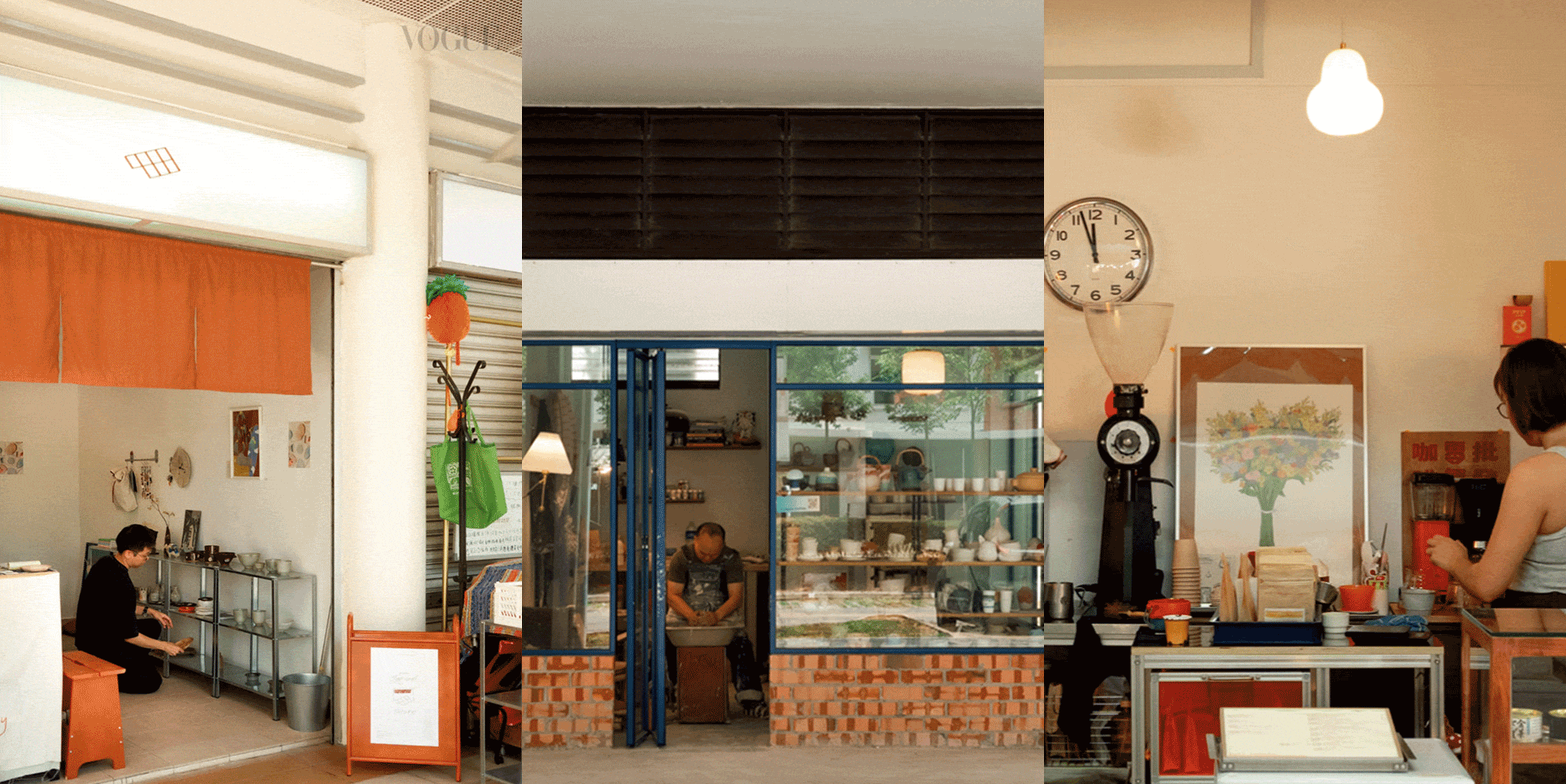
The heartbeat of a public level. This is where residents can find shops selling daily essentials or communal spaces for people to connect. Places like hawker centres and wet markets are also where a community’s kampung spirit flourishes: the deep sense of neighbourly care, solidarity and exchanges of kindness. To Singaporeans, this is what home looks like. But a shift has been taking place beneath these HDB blocks. A growing number of local enterprises are setting up shop in neighbourhoods, creating a new wave of community hubs with their own pockets of connection. Here, we spotlight three homegrown makers who have carved out third spaces in the places they know best.
Studio SF

Set at the bottom of an HDB block in Bedok South, Studio SF is an extension of Kevin Chua’s pottery world. “There’s something very grounding about taking a lump of clay and slowly turning it into something functional or something completely unexpected. Studio SF grew from that,” the founder says. He began making ceramic pieces at home, his collection gradually growing as he accumulated more equipment. Soon, a dedicated space was needed and the studio was born, offering pottery sessions.
Chua takes delight in the way the studio intertwines with the lives of surrounding residents. “You could be walking home, buying dinner or taking your child downstairs and suddenly realise there’s a pottery studio in your neighbourhood,” he muses. It piques the neighbours’ interest as they walk past and take a peek through the window, until they finally walk in and make a piece for themselves. Interactions tend to be informal, organic and built on a whim.

That is what sets the heartland studio apart. As a fellow member of the community, Chua is a familiar face to those who walk in. The personal relationship gives them a reason to engage with their own neighbourhood, quietly adding another layer to the Bedok South community. These connections grow beyond the studio’s four walls, with Chua conducting sessions at the Active Ageing Centres nearby, intergenerational workshops at the local community centre and workshops with special needs students at their vocational academy.
Operating within the neighbourhood has allowed Chua to witness firsthand how pottery adds to people’s lives. He has seen seniors be completely absorbed by the clay in their hands, different generations gathering and connecting over each other’s creations, and even a marriage proposal. The couple in question came to Studio SF for a pottery session, ending with the man getting down on one knee. “That [moment] definitely stays with me. You start out thinking you’re opening a place for people to make pottery and somehow end up conspiring on a proposal,” Chua recalls.
If anything, that is what opening a neighbourhood studio has taught him: the quiet ways a community can show up. “It doesn’t always have to start with a big initiative. Sometimes it’s just giving people a table, some clay and a reason to sit down together.”
Luli Roasts

At the heart of this micro-roastery sits a passion for the people around it. Founded by Lily Chow, Luli Roasts began as a way to share her experiences of, and experimentations with, coffee roasting with others. Now, the shop enables her to shine a light on the intricacies and craft of speciality coffee. In her eyes, coffee is an integral part of everyday life, and spotlighting its nuances and technicalities in Toa Payoh West Market & Food Centre is an extension of that philosophy—crafting where the everyday happens.
The minutiae of daily life are also a constant inspiration for Chow’s coffee blends. Deli Dream stemmed from her love for breakfast and complements both local and continental morning plates. It is a medium-roast blend of Ethiopian and Colombian beans, creating a mellow, pleasant taste when enjoyed hot. Once your food is finished and the coffee has cooled, fruity notes of dried longan and lychee shine through, ending the meal on a delicate sweet note. Hawker Hustle, on the other hand, was created for the community she found when she opened Luli Roasts. Inspired by local kopi, she created a three-origin blend of arabica, robusta and liberica beans to mimic its robustness, leaving a deep, nutty flavour that lingers. The ode to local kopi is also an approachable entry point for those new to speciality coffee, a common encounter in a mature estate’s wet market.
For Chow, heartland shops are the heartbeat of a living neighbourhood: a bustling, lively place where residents commune and check in on one another. Each life bears witness to another. “In this market, I have seen new residents move in, fellow hawkers becoming parents or grandparents, and regulars opening up, approaching my stall out of curiosity and intrigue,” she recounts.

After all, a micro-roastery is an unexpected sight. “It takes time and effort to introduce a new concept and line of products to them,” Chow explains. Despite its unfamiliarity and novelty, the patrons of Luli Roasts are of a good mix. She runs into young families, expatriates and elderly folk who have lived in the surrounding HDB blocks for years. “They come with an open and curious mind,” Chow says. An ‘uncle’ became a regular in the early days of Luli Roasts, exhausting the menu of coffee blends. Chow speaks fondly of him. “He is a down-to-earth man who simply enjoys brewing and drinking coffee at home. He’s open to trying anything new and also brings along coffee beans his children bring back from trips abroad. I get to try new roasters’ coffee from elsewhere.”
While setting up shop in a wet market may be an unconventional choice, Chow wouldn’t swap it for the world. It is no coincidence that she established Luli Roasts in the wet market. “There was this laidback ease when I dropped by to eat at the hawker centre upstairs,” Chow recalls, that heartfelt sensation being all she needed as a sign to bid for a stall there. It has been a great blessing for Chow, who runs Luli Roasts alone. She recalls kind actions from her fellow market vendors: the fishmonger from stall 93 who keeps her in mind for freshly cooked fish, and neighbours who ring her up when an unattended parcel is spotted. The market’s kampung spirit is what keeps her going when things get tough.
Sideway

Time slows down at Sideway. The morning breeze gently filters in, people taking their time to browse the shelves lined with an eclectic collection of curated craft goods. Founders Yasha Lai and Keneth Tan welcome all who enter, eager to swap stories on the objects in the store and the makers behind it.
As purveyors of handcrafted mementos and potters themselves, the idea to open a curated craft shop originally surfaced as a faraway retirement plan. But a visit to their friend Chow of Luli Roasts brought the idea into motion, setting Sideway in stone.
Sideway makes craft accessible to all. Encounters with well-made objects, thoughtful design and handcrafted items are typically associated with galleries and exhibition spaces, but are now available within the vicinity of one’s home. For Lai, it is vital that these little material pleasures are experienced, held and felt in person, and available for everyone to enjoy.

The select craft store has now made its way into the lives of Tiong Bahru residents. “We want craft to be a part of everyday life and we hope being in a residential neighbourhood plays a part in that,” Lai explains. Sideway faces Kim Cheng Street, a quiet alley that cuts through the estate. This makes for a number of passers-by, from variousneighbourhood folks, aunties and uncles to peers and like-minded individuals. At times, newcomers are unfamiliar with the nature of Sideway. “As a market stall, some folks do get surprised by our prices sometimes. We try very hard to keep things affordable, but it is also really important tous that our makers are paid fairly for their works,” Lai elaborates.
It is only fitting for local makers to showcase their work in a setting that feels close to their roots. For potter and maker Tan, being situated in a market has opened up space for ideas that may never have emerged had Sideway been elsewhere. The candour and accessibility of neighbourhoods also give budding entrepreneurs room to create, explore and experiment with less financial pressure. “We’ve always framed Sideway in our heads as an experiment, and if we were to fail, we’d be more than glad to have experienced that together,” Tan reflects.
A venture like this has only revitalised the locality. The ground level no longer runs on pure necessity, but has become a breeding ground for creativity and curiosity. “I hope that having bookshops, libraries and perhaps a stall like ours would encourage not just locals, but also tourists to venture out and explore new places beyond their usual itineraries,” Tan quips.
The October 2026 ‘Artisanal’ edition of Vogue Singapore is available online and on newsstands.