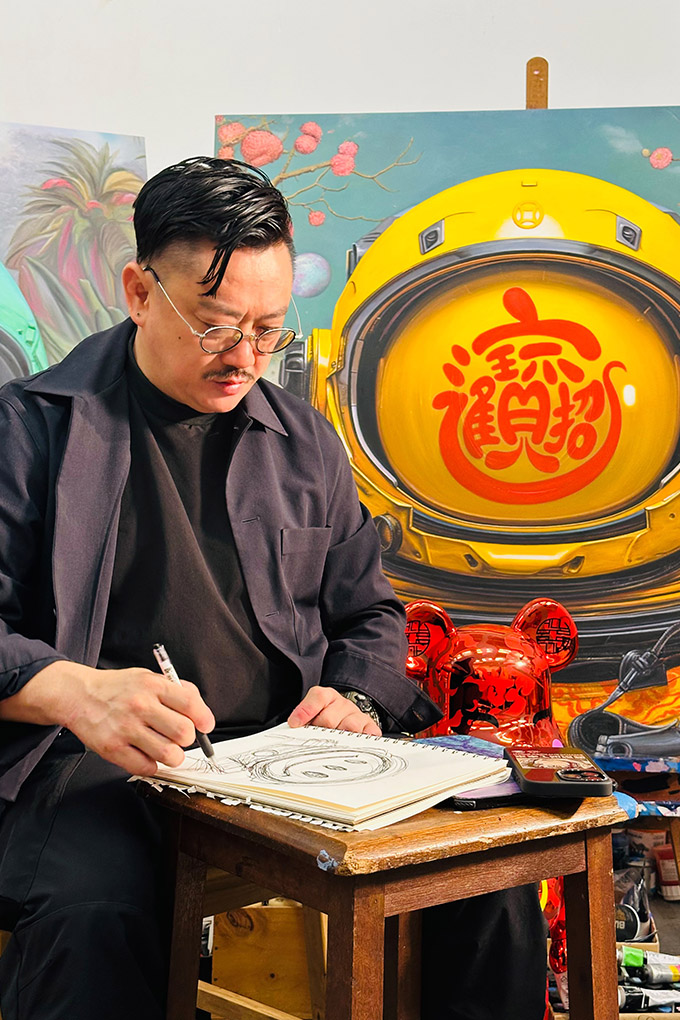
“It was surreal, like I was in a dream,” Singaporean pop artist Jahan Loh says about his collaboration with Plus44, the lifestyle brand founded by Formula One (F1) driver Lewis Hamilton. Conceived as a space for creativity, diversity and individuality, it releases limited-edition capsule collections inspired by Hamilton’s personal style, having previously partnered with renowned artists such as Takashi Murakami.

Loh is the latest artist to join the roster, timed with the Singapore Grand Prix held last month. Marking Plus44’s debut in Southeast Asia, the capsule captured the region’s spirit by reimagining racing culture and streetwear through Loh’s signature Spaceman motif alongside a bespoke art collection. Camouflage-print paintings morph into car exhaust patterns, evoking the cosmic matter through which Loh’s Spaceman wanders. In the artist’s eyes, F1 and the Spaceman are two sides of the same coin. “If anyone could pilot a spaceship, it’d be an F1 driver. After all, F1 is about a man in a high-tech machine going at super speed. I found synergy between the racecar’s exhaust fumes and the spaceships,” he elaborates. The camouflage plays on a contradiction: originally designed to blend in, it is worn in fashion to stand out.

Fashion is familiar territory for Loh. His prominence in the pop art scene paved the way for a slew of star-studded streetwear collaborations with the likes of Casio, sneaker boutique Limited Edt, and Pharrell Williams and Nigo’s Billionaire Boys Club. From graffiti art and acrylic paintings to photography and full-metal sculptures, Loh’s visual language has moved fluidly over the years. “I was curious about whatever was happening around me. When I was younger, music, graffiti, design, fashion and art were already interconnected. Digital culture accelerated that collision. Technology changes very quickly, but artists have always used the tools of their time.”

Now, the digital age has brought a new democracy for artists. Social media has removed traditional barriers, drawing audiences in instantly with a single swipe or click. Loh has witnessed his own roots in street art evolve from a rebellious pavement subculture into something that has become institutionalised across museums, galleries and luxury fashion. The question he now poses challenges its autonomy: “Acceptance can also domesticate a subculture. The question is whether it can retain the independence and irreverence that made it important in the first place.”
A similar concern surrounds art’s increasing entanglement with artificial intelligence (AI). In an infinite sea of AI-generated media, how does an artist’s voice rise above the noise? Loh chooses a counterintuitive path, leaning into AI as an instrument to bring his Spaceman and universe to life through animation. “Every generation fears the new machine. AI fascinates me because everyone seems equally excited and terrified by it, which is usually where something culturally interesting begins. I see it as another tool for expanding worlds I’ve already been building through painting, sculpture and animation.”

It is easy to get lost in the universe Loh has created. A mere glance opens up a portal into a vast alternate realm, where spacemen roam free in psychedelic landscapes of pinks and blues. Beyond the canvas, Loh’s world extends into tangible items you can carry with you—phone cases, T-shirts, figurines and the like. He has never denied the commercialism that sits alongside his works; Andy Warhol had already blurred the lines between art and consumerism in the ’60s. In the same vein, Loh understands that the supermarket, the celebrity, the gallery and the factory are all part of the same cultural machine. The fine line lies in maintaining control. “Commerce can give an artist independence, but it shouldn’t dictate the art. The danger is not making money from your work, but allowing money to decide what the work becomes.”
With the Spaceman, the possibilities know no bounds. It has unlocked a gateway far larger than the artist himself—a space for hope to thrive in all forms. For Loh, it is both a nostalgic nod to his past and an optimistic look into the future, carrying a piece of where he comes from into the places he has yet to reach.
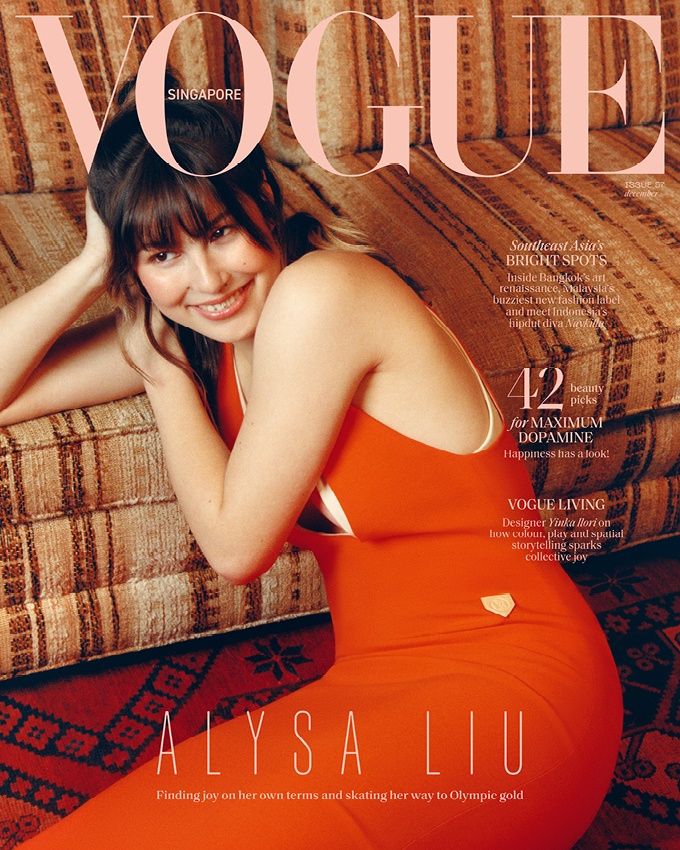
The November 2026 ‘Soft Power’ edition of Vogue Singapore is available online and on newsstands.