It is incredibly bold, if you are a contemporary art museum, to uproot yourself from a specially commissioned avant-garde building in the 14th arrondissement of Paris to move north, up into the heart of the 1st and next to what is arguably the most famous museum in the world: the Musée du Louvre. That, however, is exactly what the Fondation Cartier pour l’art contemporain did in October last year in a monumental change of address to the Place du Palais-Royal.
The Fondation Cartier pour l’art contemporain is the first of its kind. In 1984, Cartier International president Alain Dominique Perrin founded France’s first corporate foundation dedicated to contemporary art. Its founding story goes like this: Perrin, a lover and collector of contemporary art, thought of a foundation to provide artists with financial and legal assistance. His friend, the French sculptor César, gave him a new perspective: what artists really needed, he said, was the resources and nimbleness to create and exhibit work. Public museums run by the government, César complained, took too long.

After a first decade in Jouy-en-Josas, a southwestern suburb about an hour’s ride from the centre of Paris, the Fondation Cartier moved into its first newsmaking digs: a glass-and-steel building on Boulevard Raspail designed by the Pritzker Prize-winning architect Jean Nouvel. Avant-garde and novel at the time, the almost entirely see-through building was a design sensation, an imaginative idea for an art museum you could glance into as you passed by it. It served well enough for the next three decades as similar luxury-brand-backed art institutions sprung up, each with a starchitect attached to design: Frank Gehry’s Fondation Louis Vuitton and Tadao Ando’s Pinault Collection at the Bourse de Commerce in Paris, and the Fondazione Prada by Rem Koolhaas’s OMA in Milan.
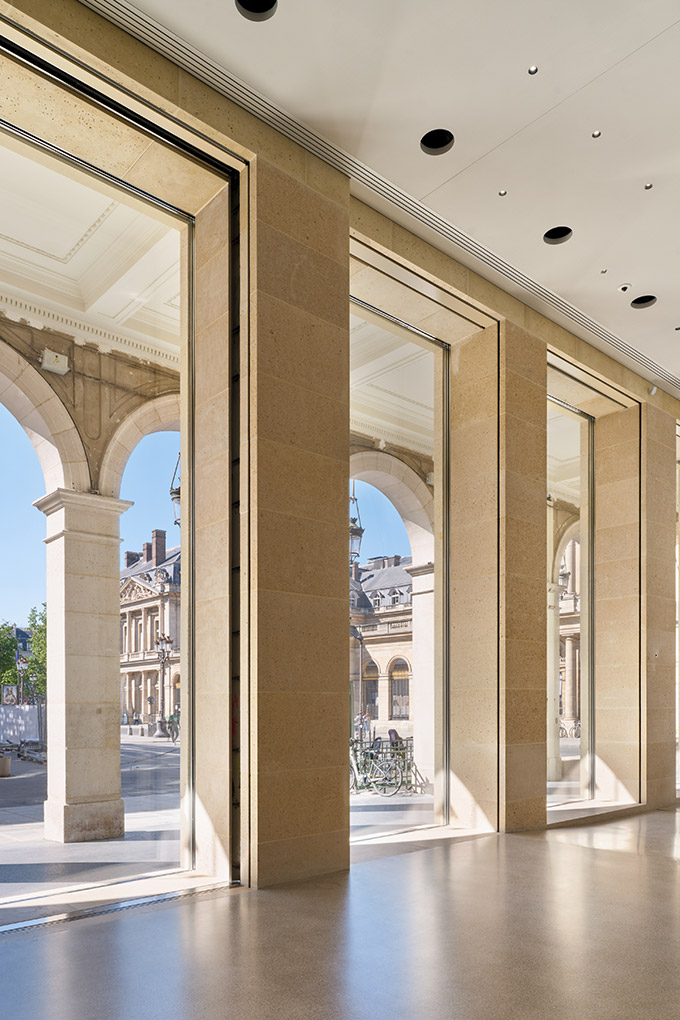
Now, a little after celebrating its 40th anniversary, the Fondation Cartier pour l’art contemporain has found a new home that’s about as close as it possibly gets to the centre of Paris. It’s located now on a square in the Place du Palais-Royal, next to the Louvre, and in a listed Haussmannian building with a storied history. The building first opened in 1855 as the Grand Hôtel du Louvre, becoming France’s pioneering luxury hotel. In 1887, it was transformed into the Grands Magasins du Louvre, one of the world’s earliest department stores. In 1978, it became the Louvre des Antiquaires, a home to antique shops and dealers. Because the historic building is a listed monument, the Fondation Cartier could only work on remodelling its interior—an undertaking it once again turned to Nouvel for.

What’s remarkable about the new Fondation Cartier pour l’art contemporain are the sightlines. Nouvel’s primary and most pivotal architectural intervention was the introduction of five immense mobile platforms. Made out of steel and painted a muted, industrial grey, they are a stark contrast against the Palais-Royal building’s soft golden-beige Saint-Maximin limestone columns. These five platforms run the 150m length of the Fondation Cartier, and can be set at different heights in the space’s 11m-tall interior. It is a shockingly simple idea (though its industrial, engineering and fabrication processes were certainly complicated), and one that opens up nearly limitless possibilities for exhibition making.


Those possibilities were explored to a promising degree with the institution’s inaugural show: the Exposition Générale, curated by the Fondation Cartier’s director of collections Grazia Quaroni, and strategic projects and international programs director Béatrice Grenier, that puts forward nearly 600 works by over 100 artists from the Fondation’s collection formed over 40 years. Curating a show like this—what’s essentially a contemporary art museum’s greatest hits—has to be difficult. Intellectual curiosity and an openness to different subjects and mediums are some of the Fondation Cartier’s strengths; and because it tends to acquire works from exhibitions and artists it has commissioned, its collection is, as a result, diverse.
In the Exposition Générale, Quaroni and Grenier homed in on four themes that roughly and best encompass the institution’s areas of interest: Machines d’Architecture, which considers adaptations of architecture; Être Nature, which assesses our relationship with the natural world, urban environments and challenges notions of anthropocentrism; Making Things, which explores the act of creation in art, craft and design; and Un Monde Réel, which deals with interpretations and ways of experiencing our world through technology, fiction and science. It’s an expansive exhibition that clearly reflects the intellectual breadth of this museum.

But back to those sightlines. Two factors by Nouvel create a wonderful viewing experience. The first is the mobile platforms, which, set at different heights, carve out unique spaces to accommodate different works. The second is the way the architect has designed the space so that, from both sides of the Fondation, you get a clear view as far out as the street. It’s possible to stand inside with your back to the Rue Saint-Honoré and look across the museum and out through to the Rue de Rivoli on the other side, pedestrians walking and all. There is a porosity with the city of Paris, giving you the sense that these works have not been hemmed into and isolated inside a white box.
The more pertinent effect of these sightlines—courtesy of the mobile platforms and lateral viewing opportunities—is the visual and experiential interactions one makes with the art on display. In a classical museum setting, you’re left to make conceptual associations to your left and right. If you were hardworking, you might circle back around to connect different pieces the curators have put on show. At the Fondation Cartier pour l’art contemporain, the sightline extends upwards and down, and even outside beyond the museum’s glass windows.

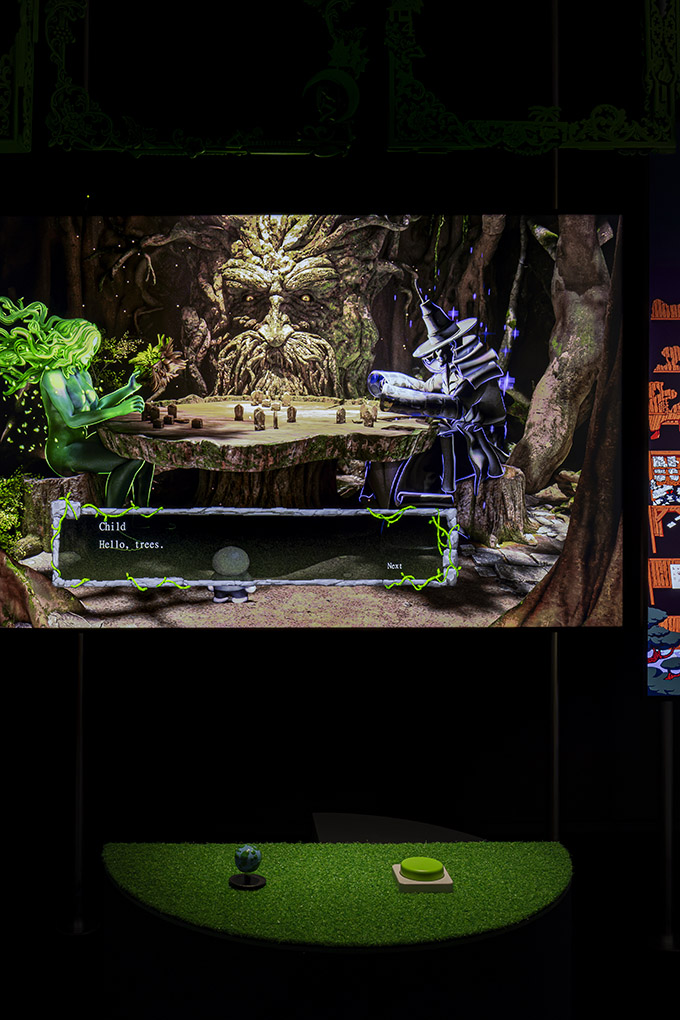
I was especially taken by a vantage in the Être Nature area on the ground floor. From there, ‘Terra Maravilhosa’ by Bruno Novelli came into view—a fantastical acrylic painting of nature rendered in an almost digital, psychedelic palette. Just off the ledge, I could see down in the basement ‘Natureza Espiritual da Realidade’ by Luiz Zerbini, an assemblage of found objects housed in glass tables with a herbarium and a live tree at its centre. Further behind Zerbini’s work, I could hear animal noises coming from Bernie Krause’s ecological soundscape, gathered over 50 years, of forests and animals—some of which have gone extinct and vanished from our planet. Between the Zerbini and Krause, Nouvel left a portion of a stone arch—the oldest architectural remnant of the building. And back at eye level, I could see outside onto a modern-day street of Paris with pedestrians either zipping by or pausing, curious, to peer inside and snap photos on their phones.

This is just one spot, and the museum’s other floors and areas offer just as varied and stimulating views to pause, perceive and think from. Nouvel’s work for the Fondation Cartier is not outwardly grandstanding, but it does something far more vital for the physical experience. It encourages new ways of viewing, of making your own associations and responses to works in relation to each other. It is, in a word, invigorating.

In Conversation with Grazia Quaroni
Collection director of the Fondation Cartier pour l’art contemporain
How are you feeling about the Fondation Cartier’s new home?
There is more space for exhibitions, but this isn’t the only thing. We wanted to expand in terms of services we offer to our public. The new Fondation Cartier will have, in the very near future, more facilities for didactics and pedagogy dedicated to students, young people, children and families. We’re also going to have, in 2026, a very nice restaurant, which we didn’t have in Boulevard Raspail.
The location is also impressive. The Fondation is in the heart of Paris.
We are just in front of the Louvre, where the pulse of the city is the most intense. Everything will change, our public too, so I think we will need to attend to even more excellence. But we’re ready for that.
The debut show of this new address is an Exposition Générale—a survey of the Fondation Cartier’s collection. Why did you choose to mount a general exhibition?
This inaugural show is a great occasion to show the public our collection. It has been shown a lot abroad and internationally, but since we didn’t have a large-scale space in Boulevard Raspail it was only shown on a few occasions and not on a very wide scale. We felt the professional art world and wider public had a kind of request to know the Fondation Cartier’s collection better, and this is a great opportunity.
You mentioned didactics and pedagogy. Combined with the location, are you expecting a shift to a more general public and educational initiatives for them?
It’s not a shift. It’s increasing activities that we already had but didn’t have a dedicated space for before. The idea of welcoming a very wide public has always been the philosophy of the Fondation Cartier. It was never just for the smaller art world, although the contents of the exhibitions are quite sophisticated and can satisfy scientists and experts on the subject. We always pay attention to having a pedagogical model of exhibition.

Boulevard Raspail was a complete architectural novelty by Jean Nouvel. This new home at the Place du Palais-Royal is in a historical building. What difference does this make?
It’s totally different, and it’s good, let’s say, that we can accept every situation. This is the third Fondation Cartier: the first one was outside Paris, in a big sculpture park. Then in Boulevard Raspail we were blessed by the invention of Jean Nouvel with a brand-new building that Cartier commissioned. Here, we face a totally different situation because this building has existed since 1855. It’s really what everybody identifies with the heart and architecture of Paris, you know, the Haussmannian period that built up the entire aspect of the city.
Something that Nouvel has retained is this transparency of the building with its surroundings.
We are just in front of the Louvre—just across the street. We can see the Louvre and their exhibition spaces from ours. Jean Nouvel was somehow able to keep this transparency and transversal glance exactly like in Boulevard Raspail. People who are walking in the street can see inside the museum, and there is a kind of porosity between the world outside and what’s going on inside. This is something we like as an institution: to not just exist apart but to be part of this contemporary world.
One more thing by Nouvel: the system of movable platforms. It opens up a lot of possibilities for exhibitions. How did you use it in this inaugural exhibition?
We displayed the platforms in a very varied way so they can adapt to many different works, and to show for the first time the potential of this building and this dynamic device. It was very moving to understand how it works, and how many different [opportunities] will develop in the years to come. It’s just the beginning, you know?
Was this a request from the Fondation Cartier team?
No, no. It’s an idea by Jean Nouvel. His idea in general is that we don’t know what artists will do in 10, 20 or 50 years. So we have to bring them the most flexible space for contemporary art and to be allowed to invest in the space. It has to mean something to the artists.

How is this going to affect the Fondation Cartier’s Collection?
This has consequences for the Collection because most of the works come from our experience of exhibitions with the artist. Each work has a story, but it’s also that each work was born in a particular situation. It is, of course, adaptable to many different situations, but the idea that we work out the project and the works with the artists themselves in an exhibition-making situation makes the collection somehow stronger and more precise. It’s different from, I don’t know, buying at auctions. We give directions to the acquisitions every year and of course we had some ideas in mind because we knew we were going to this new place.
Can you tell us about any of these ideas?
One of the most recent acquisitions is an installation by the Brazilian artist Solange Pessoa. She’s been working with the Fondation Cartier in group shows. She didn’t have a solo show, but we were extremely interested in her work—not only for the monumental state, and of course now that we have the space to allow it and show it—because her work touches on some of the preferred and longtime subjects in the Fondation like nature, the interpenetration between human, nonhuman, animal and vegetal conditions. She reflects very well this spirit and engagement, so we already had this new space in mind when we made this recent acquisition.
You’ve been with the Fondation Cartier since 1991.
Yeah, let’s forget about it. [laughs]
What’s changed between now and then?
I think curating has evolved anyway, myself or not. The most important thing is to pay attention to the whole world, to women artists, to an inclusion of all media and disciplines. Something very important that happened in these decades is that a work of art is not considered only an object, it could be research that lasts for years and that then gets to an installation, an aesthetic result. This is extremely important, and you can find an aesthetic way to raise consciousness and to say important things.

The Fondation Cartier was the first of its kind when it opened in 1984. Now, there are many like it: Kering at the Bourse de Commerce, the Fondation Louis Vuitton, the Fondazione Prada. What sets the Fondation Cartier apart?
Let’s say that we’re less alone than when we started. I don’t know exactly what an ‘identity’ means, but after 40 years we’ve built up something that allows us to say that there is a kind of DNA of the Fondation Cartier. It’s based on observation of the real world, on a close relationship with the artist, a never-ending conversation that takes different shapes. And the idea of including, since a long time ago, not only disciplines that aren’t usually in museums but also artists from geographies that are very little represented in western museums.
Paris is an important city for museums and the Fondation has the Cartier name in it. Do you see your work as having something to do with being French in some way?
I really hope we have a global vision because we need that. The world needs that and artists need to work globally. There might be a French touch in some details, but the interest is not focused on one point.
With a bigger home for the Fondation Cartier, do you feel the space empowers you to do things you previously weren’t able to do?
You know, I think it’s not a matter of scale. Somehow it’s not.
The January/February 2026 ‘Art’ issue of Vogue Singapore is available online and on newsstands.